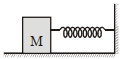
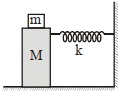
In the given figure, a mass $M$ is attached to a horizontal spring which is fixed on one side to a rigid support. The spring constant of the spring is $k$. The mass oscillates on a frictionless surface with time period $T$ and amplitude $A$. When the mass is in equilibrium position, as shown in the figure, another mass $m$ is gently fixed upon it. The new amplitude of oscillation will be
A$A \sqrt{\frac{M-m}{M}}$
B$A \sqrt{\frac{M}{M+m}}$
C$A \sqrt{\frac{M+m}{M}}$
D$A \sqrt{\frac{M}{M-m}}$
JEE MAIN 2021, Medium
Download our app for free and get started
B$A \sqrt{\frac{M}{M+m}}$
b Momentum of system remains conserved.
$p_{i}=p_{i}$
$MA \omega=( m + M ) A ^{\prime} \omega^{\prime}$
$M A \sqrt{\frac{k}{M}}=(m+M) A^{\prime} \sqrt{\frac{k}{m+M}}$
$A ^{\prime}= A \sqrt{\frac{ M }{ M + m }}$
Download our app
and get started for free
Experience the future of education. Simply download our apps or reach out to us for more information. Let's shape the future of learning together!No signup needed.*
A pendulume clock loses $12\;s$ a day if the temperature is $40^oC$ and gains $4\;s$ a day if the temperature is $20^oC$. The temperature at which the clock will show correct time, and the coeffecient of linear expansion $(\alpha)$ of the metal of the pendulum shaft are respectively
Let $T_1$ and $T_2$ be the time periods of two springs $A$ and $B$ when a mass $m$ is suspended from them separately. Now both the springs are connected in parallel and same mass $m$ is suspended with them. Now let $T$ be the time period in this position. Then
Two particles are executing simple harmonic motion of the same amplitude $A$ and frequency $\omega $ along the $x-$ axis. Their mean position is separated by distance $X_0 (X_0> A)$. If the maximum separation between them is $(X_0 +A)$, the phase difference between their motion is
The kinetic energy of a particle executing $S.H.M.$ is $16\, J$ when it is in its mean position. If the amplitude of oscillations is $25\, cm$ and the mass of the particle is $5.12\, kg$, the time period of its oscillation is
The period of oscillation of a mass $M$ suspended from a spring of negligible mass is $T$. If along with it another mass $M$ is also suspended , the period of oscillation will now be
A particle executes simple harmonic motion (amplitude $= A$) between $x = - A$ and $x = + A$. The time taken for it to go from $0$ to $A/2$ is ${T_1}$ and to go from $A/2$ to $A$ is ${T_2}$. Then
The period of small oscillation of a simple pendulum is $T$. The ratio of density of liquid to the density of material of the bob is $\rho \left( {\rho < 1} \right)$.When immersed in the liquid, the time period of small oscillation will now be