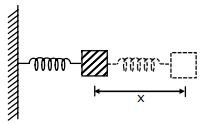
Let $T_1$ and $T_2$ be the time periods of two springs $A$ and $B$ when a mass $m$ is suspended from them separately. Now both the springs are connected in parallel and same mass $m$ is suspended with them. Now let $T$ be the time period in this position. Then
Medium
Download our app for free and get started
$\mathrm{T}_{1}=2 \pi \sqrt{\frac{\mathrm{m}}{\mathrm{k}_{1}}} \quad$ or $\mathrm{k}_{1}=\frac{4 \pi^{2} \mathrm{m}}{\mathrm{T}_{1}^{2}}$
${\mathrm{T}_{2}=2 \pi \sqrt{\frac{\mathrm{m}}{\mathrm{k}_{2}}}} {\text { or } \quad \mathrm{k}_{2}=\frac{4 \pi^{2} \mathrm{m}}{\mathrm{T}_{2}^{2}}}$
${\mathrm{Now} \quad \mathrm{T}=2 \pi \sqrt{\frac{\mathrm{m}}{\mathrm{k}_{2}}}} {\text { or } \quad \mathrm{k}=\frac{4 \pi^{2} \mathrm{m}}{\mathrm{T}_{2}^{2}}}$
In parallel $\mathrm{k}=\mathrm{k}_{1}+\mathrm{k}_{2}$
Substituting the values of $\mathrm{k}, \mathrm{k}_{1}$ and $\mathrm{k}_{2}$ we get:
$\frac{1}{\mathrm{T}^{2}}=\frac{1}{\mathrm{T}_{1}^{2}}+\frac{1}{\mathrm{T}_{2}^{2}}$

Download our appand get started for free
Experience the future of education. Simply download our apps or reach out to us for more information. Let's shape the future of learning together!No signup needed.*
Similar Questions
- 1A simple harmonic oscillator has an amplitude $A$ and time period $6 \pi$ second. Assuming the oscillation starts from its mean position, the time required by it to travel from $x=A$ to $x=\frac{\sqrt{3}}{2} A$ will be $\frac{\pi}{x}$ s, where $x=$__________.View Solution
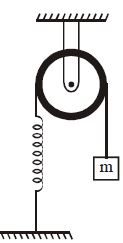
- 2A mass $m = 8\,kg$ is attahced to a spring as shown in figure and held in position so that the spring remains unstretched. The spring constant is $200\,N/m$. The mass $m$ is then released and begins to undergo small oscillations. The maximum velocity of the mass will be ..... $m/s$ $(g = 10\,m/s^2)$View Solution
- 3Two particles are performing simple harmonic motion in a straight line about the same equilibrium point. The amplitude and time period for both particles are same and equal to $A$ and $T,$ respectively. At time $t=0$ one particle has displacement $A$ while the other one has displacement $\frac {-A}{2}$ and they are moving towards each other. If they cross each other at time $t,$ then $t$ isView Solution
- 4A particle executes $SHM$ of period $1.2\, sec$ and amplitude $8\, cm.$ Find the time it takes to travel $3\,cm$ from the positive extremity of its oscillation. ..... $\sec$View Solution
- 5A spring whose unstretched length is $\ell $ has a force constant $k$. The spring is cut into two pieces of unstretched lengths $\ell_1$ and $\ell_2$ where, $\ell_1 = n\ell_2$ and $n$ is an integer. The ratio $k_1/k_2$ of the corresponding force constants, $k_1$ and $k_2$ will beView Solution
- 6View SolutionIn forced oscillations, a particle oscillates simple harmonically with a frequency equal to
- 7For a body executing $S.H.M. :$View Solution
$(a)$ Potential energy is always equal to its $K.E.$
$(b)$ Average potential and kinetic energy over any given time interval are always equal.
$(c)$ Sum of the kinetic and potential energy at any point of time is constant.
$(d)$ Average $K.E.$ in one time period is equal to average potential energy in one time period.
Choose the most appropriate option from the options given below:
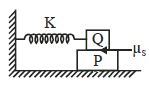
- 8A block $P$ of mass $m$ is placed on a smooth horizontal surface. A block $Q$ of same mass is placed over the block $P$ and the coefficient of static friction between them is ${\mu _S}$. A spring of spring constant $K$ is attached to block $Q$. The blocks are displaced together to a distance $A$ and released. The upper block oscillates without slipping over the lower block. The maximum frictional force between the block isView Solution
- 9A particle is performing simple harmonic motion with amplitude A and angular velocity ${\omega }$. The ratio of maximum velocity to maximum acceleration isView Solution
- 10The motion of a mass on a spring, with spring constant ${K}$ is as shown in figure. The equation of motion is given by $x(t)= A sin \omega t+ Bcos\omega t$ with $\omega=\sqrt{\frac{K}{m}}$ Suppose that at time $t=0$, the position of mass is $x(0)$ and velocity $v(0)$, then its displacement can also be represented as $x(t)=C \cos (\omega t-\phi)$, where $C$ and $\phi$ areView Solution