Question
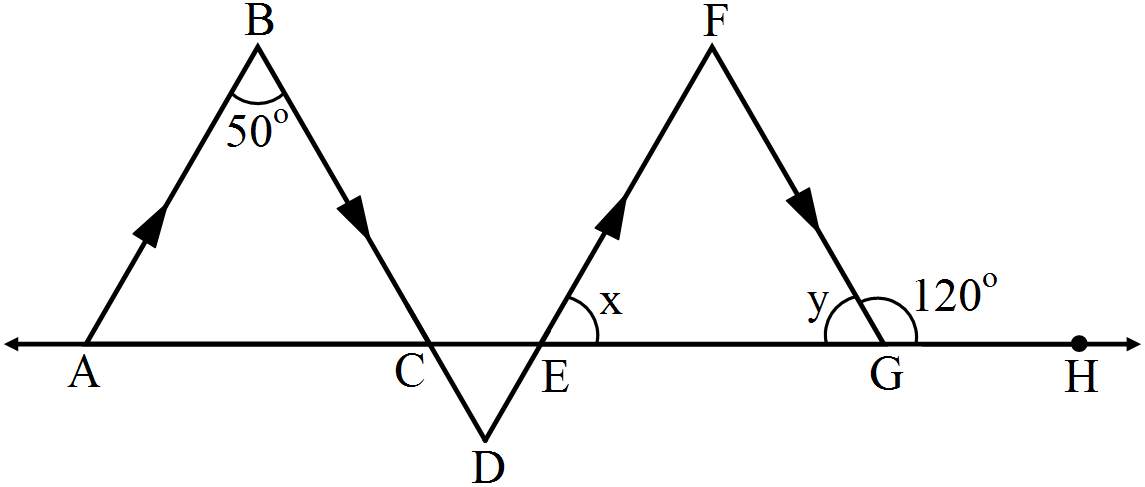
In the given figure, AB || DE and BD || FG such that $\angle\text{ABC}=50^\circ$ and $\angle\text{FGH}=120^\circ.$ Find the value of x and y.
Answer

$\angle\text{FGH}+\angle\text{FGE}=180^\circ$ (linear pair)$\Rightarrow120^\circ+\text{y}=180^\circ$
$\Rightarrow\text{y}=60^\circ$
AB || DF and BD is the transversal.
$\Rightarrow\angle\text{CDE}=50^\circ$
BD || FG and DF is the transversal.
$\Rightarrow\angle\text{EFG}=\angle\text{CDE}$ (alternate angles)
$\Rightarrow\angle\text{EFD}=50^\circ$
In $\triangle\text{EFG},$ by angle sum property,
$\angle\text{FEG}+\angle\text{FGE}+\angle\text{EFG}=180^\circ$
$\Rightarrow\text{x}+\text{y}+50^\circ=180^\circ$
$\Rightarrow\text{x}+60^\circ+50^\circ=180^\circ$
$\Rightarrow\text{x}=70^\circ$

Need a full question paper?

Generate a complete, print-ready paper with questions like this in minutes — across 16+ boards, with answer keys.

Start Generating Free

Similar questions

There are 40 students in a class, out of them 15 are boys. The mean of marks obtained by boys is 33 and that for girls is 35. Find out the mean of all students in the class.
How many lines are there which are parallel to X-axis and having a distance 5 units?
In the following, using the remainder theorem, find the remainder when f(x) is divided by g(x) and verify the by actual division:
$f(x) = x^4 - 3x^2 + 4, g(x) = x - 2$
A solid cylinder has a total surface area of $462 cm^2$. Its curved surface area is one-third of its total surface area.
Find the radius and height of the cylinder.
In the following, using the remainder theorem, find the remainder when $f(x)$ is divided by $g(x)$ and verify the by actual division:
$f(x) = x^3 + 4x^2 - 3x + 10, g(x) = x + 4$
The dimentional of rectangular box are inthe ratio of $2: 3: 4$ and the difference between the cost of covering it with sheet of paper at the rates of $₹ 8$ and $₹ 9.50$ per $m ^2$ is $₹ 1248$. Find the dimensions of the box.
Plot the following points on the graph paper:(-3, 2)
Simplify:
$(a + b + c)^2- (a - b + c)^2$
Find a rational number and also an irrational number lying between the numbers 0.3030030003... and 0.3010010001...
By using data in example (6), and taking classes 30 – 40, 40 – 50,… prepare equal to or more than type cumulative frequency table and answer the following questions based on it.
i. How many students have scored marks 70 or more than 70?
ii. How many students have scored marks 30 or more than 30?