Question
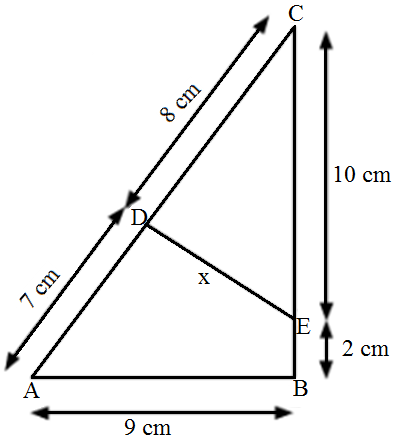
In the given figure, $\angle\text{A}=\angle\text{CED},$ prove that $\triangle\text{CAB}\sim\triangle\text{CED}.$ Also, find the value of x.
Answer

We have,
$\angle\text{A}=\angle\text{CED}$
In $\triangle\text{CAB}$ and $\triangle\text{CED}$
$\angle\text{A}=\angle\text{CED}$
$\angle\text{C}=\angle\text{C}$
$\triangle\text{CAB}\sim\triangle\text{CED}$ (By AA criteria)
Now, $\frac{\text{CA}}{\text{CE}}=\frac{\text{AB}}{\text{ED}}$
$\Rightarrow\frac{7+8}{10}=\frac{9}{\text{x}}$
$\Rightarrow\text{x}=\frac{9\times10}{15}$
$\Rightarrow\text{x}=\frac{90}{15}$
$\Rightarrow\text{x}=6\text{cm}.$

Need a full question paper?

Generate a complete, print-ready paper with questions like this in minutes — across 16+ boards, with answer keys.
Start Generating Free

Similar questions

Draw a right triangle ABC in which $A B=6 cm$, $B C=8 cm$ and $\angle B=90^{\circ}$. Draw $B D$ perpendicular from $B$ on $A C$ and draw a circle passing through the points $B, C$ and $D$. Construct tangents from $A$ to this circle.
Equal circles with centres $O$ and $O\ '$ touch each other at $X. OO\ '$ produced to meet a circle with centre $O\ ', $ at $A. AC$ is a tangent to the circle whose centre is $O. O\ ' \ D$ is perpendicular to $AC$. Find the value of $\frac{ DO ^{\prime}}{ CO }$
Image
Express the following as a fraction in simplest form:
$0.\overline{365}$
If $\alpha$ and $\beta$ are the zeroes of the quadratic polynomial $f(x) = ax^2 + bx + c$, find evaluate: $\text{a}\Big(\frac{\alpha^2}{\beta}+\frac{\beta^2}{\alpha}\Big)+\text{b}\Big(\frac{\alpha}{\beta}+\frac{\beta}{\alpha}\Big)$
The area of a rectangular plot is $462m^2$​​​​​​​ and its length is 28m. Find the perimeter of the plot.
The age of the father is twice the sum of the ages of his two children. After 20 years, his age will be equal to the sum of the ages of his children. Find the age of the father.
Find the sum of first n even natural numbers.
The sum of first $m$ terms of an A.P. is $4 m^2-m$. If its $n^{\text {th }}$ term is 107 . find the value of $n$. Also, find the $21^{\text {st }}$ term of this A.P.
At t minutes past $2$ pm, the time needed by the minutes hand of a clock to show $3$ pm was found to be $3$ minutes less than $\frac{\text{t}^2}{4}$ minutes. Find t.
Find the sum of first 22 terms of an AP in which d = 7 and 22nd term is 149.