MCQ
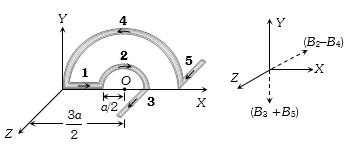
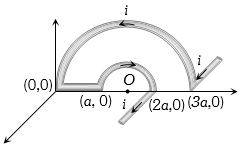
In the given figure net magnetic field at $O$ will be
  • A
    $\frac{{2{\mu _0}i}}{{3\pi a}}\sqrt {4 - {\pi ^2}} $
  • $\frac{{{\mu _0}i}}{{3\pi a}}\sqrt {4 + {\pi ^2}} $
  • C
    $\frac{{2{\mu _0}i}}{{3\pi {a^2}}}\sqrt {4 + {\pi ^2}} $
  • D
    $\frac{{2{\mu _0}i}}{{3\pi a}}\sqrt {(4 - {\pi ^2})} $

Answer

Correct option: B.
$\frac{{{\mu _0}i}}{{3\pi a}}\sqrt {4 + {\pi ^2}} $
b
(b) Magnetic field at $O$ due to Part $(1)$ : ${B_1} = 0$

Part $(2)$: ${B_2} = \frac{{{\mu _0}}}{{4\pi }}.\frac{{\pi \,i}}{{(a/2)}} \otimes $(along $-Z-$axis)

Part $(3)$: ${B_3} = \frac{{{\mu _0}}}{{4\pi }}.\frac{i}{{(a/2)}}\left( \downarrow \right)$(along $-Y-$axis)

Part $(4)$: ${B_4} = \frac{{{\mu _0}}}{{4\pi }}.\frac{{\pi i}}{{(3a/2)}}\odot$(along $+Z-$axis)

Part $(5)$: ${B_5} = \frac{{{\mu _0}}}{{4\pi }}.\frac{i}{{(3a/2)}}\left( \downarrow \right)$(along -$Y$ $-$ axis) ${B_2} - {B_4} = \frac{{{\mu _0}}}{{4\pi }}.\frac{{\pi i}}{a}\left( {2 - \frac{2}{3}} \right) = \frac{{{\mu _0}i}}{{3a}} \otimes $(along -$Z$ $-$ axis) ${B_3} + {B_5} = \frac{{{\mu _0}}}{{4\pi }}.\frac{1}{a}\left( {2 + \frac{2}{3}} \right) = \frac{{8{\mu _0}i}}{{12\pi a}}\left( \downarrow \right)$ (along -$Y$$ -$ axis)

Hence net magnetic field ${B_{net}} = \sqrt {{{({B_2} - {B_4})}^2} + {{({B_3} + {B_5})}^2}} $$ = \frac{{{\mu _0}i}}{{3\pi a}}\sqrt {{\pi ^2} + 4} $
Need a full question paper?

Generate a complete, print-ready paper with questions like this in minutes — across 16+ boards, with answer keys.

Start Generating Free

Similar questions

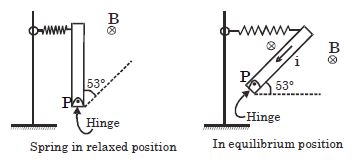
A thin uniform rod with negligible mass and length $l$ is attached to the floor by a frictionless hinge at point $P$ . A horizontal spring with force constant $k$ connects the other end to wall. The rod is in a uniform magnetic field $B$ directed into the plane of paper. What is extension in spring in equilibrium when a current $i$ is passed through the rod in direction shown. Assuming spring to be in natural length initially.
In a cathode ray tube, what is the effect on the beam of particles if a hotter filament is used?
An object is placed at a distance of $12\,cm$ in front of a plane mirror. The virtual and erect image is formed by the mirror. Now the mirror is moved by $4\,cm$ towards the stationary object. The distance by which the position of image would be shifted, will be:
A transistor has a current amplification factor of $60$ . In a $CE$ amplifier, input resistance is $1 \,k \Omega$ and output voltage is $0.01 \,V$. The transconductance is (in $SI$ units)
A current of $5$ $ampere$ is flowing in a wire of length $1.5$ $metres$. A force of $7.5\, N$ acts on it when it is placed in a uniform magnetic field of $2\, Tesla$. The angle between the magnetic field and the direction of the current is......$^o$
The colour of the second line of Balmer series is
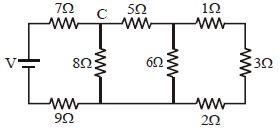
In the ladder network shown, current through the resistor $3\, \Omega$ is $0.25\,A$. The input voltage $'V'$ is equal to:- ........... $V$
Beta particle An unknown particle is being studied in a magnetic field of variable intensity and direction. When the magnetic field is turned off, the particle is observed to move toward the earth. When the magnetic field is turned on, the particle is observed to continue to move toward the earth, no matter the strength or the direction of the magnetic field. Which of the particles listed below is most likely the unknown particle?
In $NPN$ transistor, $10^{10}$ electrons enters in emitter region in $10^{-6}$ sec. If $2\%$ electrons are lost in base region then collector current and current amplification factor ($\beta$) respectively are
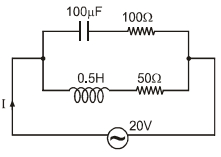
In the given circuit, the $AC$ source has $\omega=100 \ rad / s$. considering the inductor and capacitor to be ideal, the correct choice $(s)$ is(are)

$(A)$ The current through the circuit, $I$ is $0.3 \ A$

$(B)$ The current through the circuit, I is $0.3 \sqrt{2} \ A$.

$(C)$ The voltage across $100 \Omega$ resistor $=10 \sqrt{2} \ V$

$(D)$ The voltage across $50 \Omega$ resistor $=10 \ V$