Question
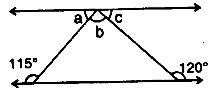
In the given figure, the directed lines are parallel to each other. Find the unknown angles.
Answer

∵ Lines are parallel
∠a = ∠1 and ∠c = ∠2 .........(alternate angles)
But ∠1 + 115° = 180° .........(linear pair)
∴ ∠1 = 180°− 115° = 65°
Similarly ∠2 + 120° = 180°
∴ ∠2 = 180°− 120° = 60°
∴ ∠a = ∠1 = 65°, ∠c = ∠2 = 60°
But a + c + c = 180° ............(angles on a line)
⇒ 65° + b + 60° = 180°
⇒ b + 125° = 180°
⇒ b = 180°− 125° = 55°
Hence a = 65°, b = 55°, c =60°

Need a full question paper?

Generate a complete, print-ready paper with questions like this in minutes — across 16+ boards, with answer keys.

Start Generating Free

Similar questions

Find each angle shown in the diagram.
The base of a parallelogram is thrice it height. If its area is $768 cm^2$, find the base and the height of the parallelogram.
A number when divided by 4 is reduced by 21 . Find the number.
Evaluate: $\frac{-3}{8}+\frac{-5}{12}$
Today is Eid. Ameena is very happy. Everyone in her family gave her a few coins in her bag. She now has 25 one rupee coins, 20 two rupee coins and 15 five rupee coins in her bag.
Q.1. The number of five rupee coins is what per cent of the total number of coins in the bag?
(a) $15 \%$ $\quad$$\quad$(b) $20 \%$ $\quad$$\quad$(c) $25 \%$ $\quad$$\quad$(d) $30 \%$
Q.2. The value of two rupee coins is what per cent of the total value of coins in the bag?
(a) $4 \frac{3}{4} \%$ $\quad$$\quad$(b) $33 \frac{1}{3} \%$ $\quad$$\quad$(c) $32 \%$ $\quad$$\quad$(d) $28 \frac{4}{7} \%$
Q.3. The number of five rupee coins is what per cent less than that of two rupee coins?
(a) $17 \frac{1}{2} \%$ $\quad$$\quad$(b) $20 \%$ $\quad$$\quad$(c) $25 \%$$\quad$$\quad$ (d) $33 \frac{1}{3} \%$
Q.4. The value of five rupee coins is what per cent more than that of two rupee coins?
(a) $70 \%$ $\quad$$\quad$(b) $75 \frac{1}{2} \%$$\quad$$\quad$ (c) $80 \%$ $\quad$$\quad$(d) $87 \frac{1}{2} \%$
Evaluate: $3 \frac{5}{12}-1 \frac{2}{3}$
Shaheed can prepare one wooden chair in 3 days and Shaif can prepare the same chair in 4 days. If they work together, in how many days will they prepare:
(i) one chair?
(ii)14 chairs of the same kind?
Rajan runs a typing company that processes the manuscript obtained from publishing companies. There are two proceses in his work typing and typesetting. He owns a team each for the two processes. He received a manucript from a publishing company RBC. He knows that his team of 25 typists can type 225 pages in a day. Also, his team of 7 typesetters can typeset 90 pages in 5 days.
Q.1. If the manuscript from RBC needs 1350 pages to be typed, how many days will Rajan's team take to type it?
(a) 5 $\quad$$\quad$(b) 6 $\quad$$\quad$(c) 7 $\quad$$\quad$(d) 9
Q.2. If Rajan employs 5 more typists in his team, in how many days can the work of RBC be completed?
(a) 4$\quad$$\quad$ (b) 5 $\quad$$\quad$(c) 6$\quad$$\quad$ (d) 8
Q.3. In how many days will Rajan's team of typesetters typeset the work from RBC?
(a) 50 $\quad$$\quad$(b) 60$\quad$$\quad$ (c) 75 $\quad$$\quad$(d) 85
Q.4. If typesetting work begins only after the typing work is finished, what is the least number of days Rajan needs to get the work from RBC done by his existing team of 30 typists and 7 typesetters?
(a) 75 $\quad$$\quad$(b) 80 $\quad$$\quad$(c) 81 $\quad$$\quad$(d) 85
Evaluate: $-\frac{2}{3}+\frac{5}{2}+2$
Subtract the sum of $3a^2 – 2a + 5$ and $a^2 – 5a – 7$ from the sum of $5a^2 -9a + 3$ and $2a – a^2 – 1 $