Question
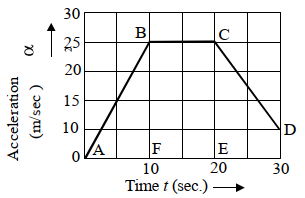
In the given figure the time-acceleration graph of an object moving in a straight line is given. Determined from graph :(i) Average acceleration in the first 20 sec.(ii) From what time tell what time the force acts on the object?Image
Answer

 (i) Velocity change can be determined from time acceleration graph. This time is equal to the area between the acceleration graph and the zero acceleration axis. So in the first 20 sec .
$\begin{array}{l}
\text { Change in velocity }=\text { Area } ABCE \\
\text { Change in velocity }=\text { Area } A B F+\text { Area BCEF } \\
=\frac{1}{2} \times 10 \times 20+20 \times(20-10) \\
=100+200=300 m / s
\end{array}
$
Average acceleration
$\begin{array}{l}
=\frac{\text { Change in velocity }}{\text { Time interval }} \\
=\frac{300}{20}=15 m / s^2
\end{array}$
(ii) Force $=$ Mass $\times$ acceleration
If acceleration remains constant, force will also remain constant. It is clear from the graph that the acceleration remain constant from 10 sec to 20 sec . Hence the force on the object is 10 cm to 20 cm .

Need a full question paper?

Generate a complete, print-ready paper with questions like this in minutes — across 16+ boards, with answer keys.

Start Generating Free

Similar questions

A ring, a disc and a sphere all of the same radius and same mass roll down on an inclined plane from the same height h. Which of the three reaches the bottom (i) earliest (ii) latest?
Suppose you are told that the linear size of everything in the universe has been doubled overnight. Can you test this statement by measuring sizes with a metre stick? Can you test it by using the fact that the speed of light is a universal constant and has not changed? What will happen if all the clocks in the universe also start running at half the speed?
A cylinder of diameter exactly 1cm at 30°C is to be slid into a hole in a steel plate. The hole has a diameter of 0.99970cm at 30°C. To what temperature must the plate be heated? For steel $\alpha-1.1\times10^{-5}(^\circ\text{C}^{-1}).$
What are longitudinal waves? Give examples too.
A gas is enclosed in a cylindrical vessel fitted with a frictionless piston. The gas is slowly heated for some time. During the process, $10\ J$ of heat is supplied and the piston is found to move out $10\ cm$ . Find the increase in the internal energy of the gas. The area of cross section of the cylinder $=4 \mathrm{~cm}^2$ and the atmospheric pressure $=100 \mathrm{kPa}$.
What do you mean by inertia of motion? Give an example to illustrate it.
If $\text{Y}=3\sin(36\text{t}+.018\text{x}+\frac{\pi}{4})\text{cm}$ find the amplitude and velocity of the wave.
What do you understand by resonant oscillation ?
What are the three Newtons Laws of Motion.
Find the total kinetic energy of one mole of nitrogen gas at 27°C.