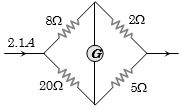
In the given figure, when galvanometer shows no deflection, the current (in $A$) flowing through $5\,\Omega $ resistance will be
Medium
Download our app for free and get started
Let current through $5\,\Omega $ resistance be $i$.
Then $i \times 25 = (2.1 - i)\,10$
$i = \frac{{10}}{{35}} \times 2.1 = 0.6\,A$

Download our appand get started for free
Experience the future of education. Simply download our apps or reach out to us for more information. Let's shape the future of learning together!No signup needed.*
Similar Questions
- 1Resistance of tungsten wire at $150\,^oC$ is $133\,\Omega $. Its resistance temperature coefficient is $0.0045\,^oC$. The resistance of this wire at $500\,^oC$ will be .............. $\Omega$View Solution
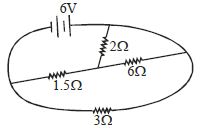
- 2What amount of heat will be generated in a coil of resistance $R$ due to a charge $q$ passing through it if the current in the coil decreases to zero uniformly during a time interval $\Delta t$View Solution
- 3In a potentiometer arrangement, a cell of $emf$ $1.25\,V$ gives a balance point at $35.0\,cm$ length of the wire. If the cell is replaced by another cell and the balance point shifts to $63.0\,cm,$ the $emf$ of the second cell ............... $V$View Solution
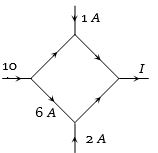
- 4The figure shows a network of currents. The magnitude of currents is shown here. The current $I$ will be ........... $A$View Solution
- 5Consider a block of conducting material ofresistivity '$\rho$' shown in the figure. Current '$I$' enters at '$A$' and leaves from '$D$'. We apply superp osition principle to find voltage '$\Delta V$ ' developed between '$B$' and '$C$'. The calculation is done in the following steps:View Solution
$(i)$ Take current '$I$' entering from '$A$' and assume it to spread over a hemispherical surface in the block.
$(ii)$ Calculatefield $E(r)$ at distance '$r$' from $A$ by using Ohm's law $E = \rho j$, where j is the current per unit area at '$r$'.
$(iii)$ From the '$r$' dependence of $E(r)$, obtain the potential $V(r)$ at $r$.
$(iv)$ Repeat $(i), (ii)$ and $(iii)$ for current '$I$' leaving '$D$' and superpose results for '$A$' and '$D$'.For current entering at $A$, the electric field at a distance '$r$'
from $A$ is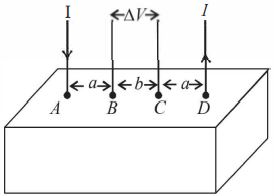
- 6In a potentiometer wire experiment the $\mathrm{emf}$ of a battery in the primary circuit is $20\,V$ and its internal resistance is $5\,\Omega$ . There is a resistance box in series with the battery and the potentiometer wire, whose resistance can be varied from $120\,\Omega$ to $170\,\Omega$ . Resistance of the potentiometer wire is $75\,\Omega$ . The following potential differences can be measured using this potentiometer.View Solution
- 7Two wires each of radius of cross section $r$ but of different materials are connected together end to end (in series). If the densities of charge carriers in the two wires are in the ratio $1 : 4$, the drift velocity of electrons in the two wires will be in the ratio:View Solution
- 8Water fall from a $40\,m$ high dam at the rate of $9 \times 10^{4}\,kg$ per $hour$. Fifty percentage of gravitational potential energy can be converted into electrical energy. Using this hydroelectric energy number of $100\,W$ lamps, that can be lit, isView Solution
(Take $\left.g=10\,ms ^{-2}\right)$
- 9An electric lamp is marked $60\, W$, $230\, V$. The cost of a $1\, kWh$ of energy is Rs. $1.25$. The cost of using this lamp $8$ hrs a day for $30$ day is Rs. ...............View Solution
- 10Find the value of current from battery in the circuit ............... $A$View Solution