MCQ
In the given reactions identify the reagent $A$ and reagent $B$
  • A
    $\mathrm{A}-\mathrm{CrO}_3$     $\mathrm{B}-\mathrm{CrO}_3$
  •  $\mathrm{A}-\mathrm{CrO}_3$     $B-$ $\mathrm{CrO}_2 \mathrm{Cl}_2 $
  • C
     $\mathrm{A}-\mathrm{CrO}_2 \mathrm{Cl}_2$     $B-$ $\mathrm{CrO}_2 \mathrm{Cl}_2 $
  • D
     $\mathrm{A}-\mathrm{CrO}_2 \mathrm{Cl}_2$        $B-$ $\mathrm{CrO}_3$

Answer

Correct option: B.
 $\mathrm{A}-\mathrm{CrO}_3$     $B-$ $\mathrm{CrO}_2 \mathrm{Cl}_2 $
b

Need a full question paper?

Generate a complete, print-ready paper with questions like this in minutes — across 16+ boards, with answer keys.

Start Generating Free

Similar questions

$Assertion :$ A brass tumbler feels much colder than a wooden tray on a chilly day.

$Reason :$ The thermal conductivity of brass is more than the thermal conductivity of wood.

A man runs towards a mirror at a speed $15 \,m/s $ The speed of the image relative to the man is......$m{s^{ - 1}}$
If the dimensions of length are expressed as ${G^x}{c^y}{h^z}$; where $G,\,c$ and $h$ are the universal gravitational constant, speed of light and Planck's constant respectively, then
$TV$ waves have a wavelength range of $1-10 \,meter$. Their frequency range in $MHz$ is
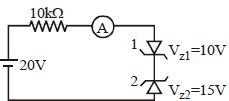
The reading of ammeter in the following circuit will be....$mA$
A circular disc of radius $0.2\;meter$ is placed in a uniform magnetic field of induction $\frac{1}{\pi }\;Wb/m^2$ in such a way that its axis makes an angle of $60^o$ with $\vec B$. The magnetic flux linked with the disc is.....$Wb$
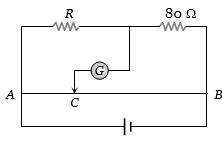
$AB$ is a wire of uniform resistance. The galvanometer $G$ shows no current when the length $AC = 20\,cm$ and $CB = 80\, cm$. The resistance $R$ is equal to .............. $\Omega $
The dimensions of inter atomic force constant are
A particle of mass $'{m}'$ is moving in time $'t'$ on a trajectory given by

$\overrightarrow{{r}}=10 \alpha {t}^{2}\, \hat{{i}}+5 \beta({t}-5)\, \hat{{j}}$

Where $\alpha$ and $\beta$ are dimensional constants. The angular momentum of the particle becomes the same as it was for ${t}=0$ at time ${t}=$ .....$seconds.$

A gas is compressed from a volume of $2\,m^3$ to a volume of $1\, m^3$ at a constant pressure of $100\, N/m^2$. Then it is heated at constant volume by supplying $150\, J$ of energy. As a result, the internal energy of the gas