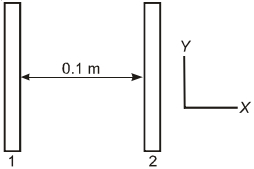
In the $RC$ circuit shown, switch is closed at $t = 0$ . Graphs showing variation of potential $(V_R)$ across resistor and potential $(V_C)$ across capacitor are given. Time constant of circuit is approximately equal to.....$ms$
Diffcult
Download our app for free and get started
$\mathrm{V}_{\mathrm{R}}=\varepsilon \cdot \mathrm{e}^{-t / \mathrm{RC}}$
${{\rm{V}}_C} = \varepsilon \left[ {1 - {{\rm{e}}^{ - t/{\rm{RC}}}}} \right]$
At $t=100 \mathrm{\,ms}$
${{\rm{V}}_{\rm{R}}} = {{\rm{V}}_{\rm{C}}} \Rightarrow {{\rm{e}}^{ - t/{\rm{RC}}}} = 1 - {{\rm{e}}^{ - t/{\rm{RC}}}} \Rightarrow 2{{\rm{e}}^{ - t/{\rm{RC}}}} = 1$
$ \Rightarrow {{\rm{e}}^{ - t/{\rm{RC}}}} = 1/2 \Rightarrow {{\rm{e}}^{ - t/{\rm{RC}}}} = 2 \Rightarrow \frac{{\rm{t}}}{{{\rm{RC}}}} = \ell {\rm{n}}2$
$ \Rightarrow \frac{{100}}{{{\rm{RC}}}} = \ell {\rm{n}}2 \Rightarrow {\rm{RC}} = \frac{{100}}{{\ell {\rm{n}}(2)}} = 145.45\,{\rm{ms}}$
(as $\ln 2 = 0.693 \simeq 0.7$)

Download our appand get started for free
Experience the future of education. Simply download our apps or reach out to us for more information. Let's shape the future of learning together!No signup needed.*
Similar Questions
- 1A combination of parallel plate capacitors is maintained at a certain potential difference When a $3\, mm$ thick slab is introduced between all the plates, in order to maintain the same potential difference, the distance between the plates is increased by $2.4\, mm$. Find the dielectric constant of the slab.View Solution
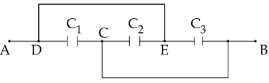
- 2A parallel plate air capacitor is charged to a potential difference of $V$ volts. After disconnecting the charging battery the distance between the plates of the capacitor is increased using an insulating handle. As a result the potential difference between the platesView Solution
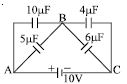
- 3View SolutionIn the circuit shown in figure, four capacitors are connected to a battery. A capacitor is connected to a battery. The force of attraction between the plates when the separation between them is halved
- 4A charge of $8\; mC$ is located at the origin. Calculate the work done in $J$ in taking a small charge of $-2 \times 10^{-9} \;C$ from a point $P (0,0,3\; cm )$ to a point $Q (0,4\; cm , 0),$ via a point $R (0,6\; cm , g \;cm )$View Solution
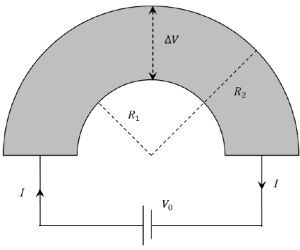
- 5Shown in the figure is a semicircular metallic strip that has thickness $t$ and resistivity $\rho$. Its inner radius is $R_1$ and outer radius is $R_2$. If a voltage $V_0$ is applied between its two ends, a current $I$ flows in it. In addition, it is observed that a transverse voltage $\Delta V$ develops between its inner and outer surfaces due to purely kinetic effects of moving electrons (ignore any role of the magnetic field due to the current). Then (figure is schematic and not drawn to scale)-View Solution
$(A)$ $I =\frac{V_0 t}{\pi \rho} \ln \left(\frac{R_2}{R_1}\right)$
$(B)$ the outer surface is at a higher voltage than the inner surface
$(C)$ the outer surface is at a lower voltage than the inner surface
$(D)$ $\Delta V \propto I ^2$
- 6Electric charges of $+10\,\mu\, C, +5\,\mu\, C, -3\,\mu\, C$ and $+8\,\mu\, C$ are placed at the corners of a square of side$\sqrt 2\,m$ . The potential at the centre of the square isView Solution
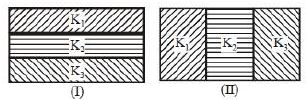
- 7Two identical parallel plate capacitors, of capacitance $C$ each, have plates of area $A$, separated by a distance $d$. The space between the plates of the two capacitors, is filled with three dielectrics, of equal thickness and dielectric constants $K_1$ , $K_2$ and $K_3$ . The first capacitor is filled as shown in fig. $I$, and the second one is filled as shown in fig. $II$. If these two modified capacitors are charged by the same potential $V$, the ratio of the energy stored in the two, would be ( $E_1$ refers to capacitor $(I)$ and $E_2$ to capacitor $(II)$)View Solution
- 8The area of each plate of a parallel plate capacitor is $100\,c{m^2}$and the distance between the plates is $1\,mm$. It is filled with mica of dielectric $6$. The radius of the equivalent capacity of the sphere will be.......$m$View Solution
- 9View SolutionAssertion : The electrostatic force between the plates of a charged isolated capacitor decreases when dielectric fills whole space between plates.
Reason : The electric field between the plates of a charged isolated capacitance increases when dielectric fills whole space between plates.
- 10Two insulating plates are both uniformly charged in such a way that the potential difference between them is $V_2 - V_1 = 20\ V$. (i.e., plate $2$ is at a higher potential). The plates are separated by $d = 0.1\ m$ and can be treated as infinitely large. An electron is released from rest on the inner surface of plate $1. $ What is its speed when it hits plate $2?$View Solution
$(e = 1.6 \times 10^{-19}\ C, m_e= 9.11 \times 10^{-31}\ kg)$