MCQ
A parallel plate air capacitor is charged to a potential difference of $V$ volts. After disconnecting the charging battery the distance between the plates of the capacitor is increased using an insulating handle. As a result the potential difference between the plates
  • A
    decreases
  • increases
  • C
    does not change
  • D
    becomes zero

Answer

Correct option: B.
increases
b
Capacitance of a parallel plate capacitor

$C=\frac{\varepsilon_{0} A}{d}$     $...(i)$

Also capacitance = potential difference$/$charge     $.....(ii)$

When battery is disconnected and the distance between the plates of the capacitor is increased then capacitance increases and charge remains constant.

since capacitance $=$ potential difference$/$charge

$\therefore$ Potential difference increases.

Need a full question paper?

Generate a complete, print-ready paper with questions like this in minutes — across 16+ boards, with answer keys.

Start Generating Free

Similar questions

In the relation $n = \frac{{PV}}{{RT}},n = $
The initial speed of a bullet fired from a rifle is $630\, m/s$. The rifle is fired at the centre of a target $700\, m$ away at the same level as the target. How far above the center of the target $($in $m$) the rifle must be aimed in order to hit the target? $($Take $g=10 \;m/s^2)$
This question has statement $1$ and statement $2$ . Of the four choices given after the statements, choose the one that best describes the two statements. 
Statement $- 1$: A point particle of mass m moving with speed $u$ collides with stationary point particle of mass $M$. If the maximum energy loss possible is given as $f$ $\left( {\frac{1}{2}m{v^2}} \right)$ then $ f = \left( {\frac{m}{{M + m}}} \right)$ 

Statement $-2$: Maximum energy loss occurs when the particles get stuck together as a result of the collision.

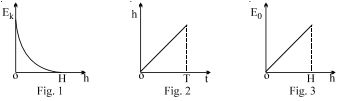
$A$ ball is projected vertically upwards. Air resistance  variation in $g$ may be neglected. The ball rises to its maximum height $H$ in a time $T$, the height being $h$ after a time $t$

$[1]$ The graph of kinetic energy $E_k$ of the ball against height $h$ is shown in figure $1$

$[2]$ The graph of height $h$ against time $t$ is shown in figure $2$

$[3]$ The graph of gravitational energy $E_g$ of the ball against height $h$ is shown in figure $3$

Which of $A, B, C, D, E$ shows the correct answers?

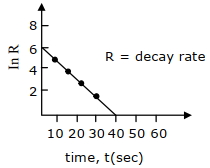
For a certain radioactive process the graph between $In\, {R}$ and ${t}\,({sec})$ is obtained as shown in the figure. Then the value of half life for the unknown radioactive material is approximately $....\,{sec}.$
The first member of the Paschen series in hydrogen spectrum is of wavelength $18,800 \,\mathring A $ The short wavelengths limit of Paschen series is......$ \,\mathring A $
When ${10^{14}}$ electrons are removed from a neutral metal sphere, the charge on the sphere becomes......$\mu C$
A particle of mass $m$ projected with a velocity ' $u$ ' making an angle of $30^{\circ}$ with the horizontal. The magnitude of angular momentum of the projectile about the point of projection when the particle is at its maximum height $\mathrm{h}$ is :
A dimensionally consistent relation for the volume V of a liquid of coefficient of viscosity ' $\eta$ ' flowing per second, through a tube of radius $r$ and length / and having a pressure difference $P$ across its ends, is
Choose the correct match

List I 

List II

 $(i)$ Curie

 $(A)$ $ML{T^{ - 2}}$

 $(ii)$ Light year 

 $(B)$ $M$

 $(iii)$ Dielectric strength

 $(C)$ Dimensionless

 $(iv)$ Atomic weight

 $(D)$ $T$

 $(v)$ Decibel

 $(E)$ $M{L^2}{T^{ - 2}}$


 $(F)$ $M{T^{ - 3}}$


 $(G)$ ${T^{ - 1}}$


 $(H)$ $L$


 $(I)$ $ML{T^{ - 3}}{I^{ - 1}}$


 $(J)$ $L{T^{ - 1}}$