MCQ
In the reaction, product $P$ is
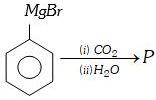
- A

- ✓

- C

- D${C_6}{H_5} - \mathop {\mathop C\limits^{||} }\limits^O - {C_6}{H_5}$
Generate a complete, print-ready paper with questions like this in minutes — across 16+ boards, with answer keys.
| column $(I)$ | column $(II)$ | ||
| $(A)$ | Kohlraush law | $(i)$ | $\Lambda _{eq}^o = \Lambda _c^o + \Lambda _a^o$ |
| $(B)$ | Molar Conductivity |
$(ii)$ | $\Lambda _m = \frac{{K \times 1000}}{M}$ |
| $(C)$ | Degree of Dissociation |
$(iii)$ | $\alpha = {\Lambda _m}/\Lambda _m^o$ |
| $(D)$ | Dissociation Constant |
$(iv)$ | ${k_a} = C{\alpha ^2}/1 - \alpha $ |
| Pressue $(mm\, Hg)$ | $50$ | $100$ | $200$ |
| Half-life period $(hrs.)$ | $3.52$ | $1.76$ | $0.88$ |
What will be the pressure when the half-life period is $2.5$ hours
${\log _{10}}K = - \frac{{2000}}{T} + 6.0$ Activation energy is ....... $kcal$
$(1)$ $\begin{matrix}
C{{H}_{3}} \\
|\,\,\,\,\,\, \\
ZNH\,C\,HC{{O}_{2}}H \\
\end{matrix}$ $(2)$ $\begin{matrix}
C{{H}_{3}}\,\,\,\,\,\,\,\,\,\,\,\,\,\,\,\,\,\,\,\, \\
|\,\,\,\,\,\,\,\,\,\,\,\,\,\,\,\,\,\,\,\,\,\,\,\,\,\,\,\, \\
{{H}_{2}}N\,C\,HC{{O}_{2}}C{{H}_{2}}{{C}_{6}}{{H}_{5}} \\
\end{matrix}$
$(3)$ $\begin{matrix}
\,\,\,\,\,\,\,\,\,\,\,\,C{{H}_{3}}{{C}_{6}}{{H}_{5}} \\
|\,\,\,\,\, \\
ZNH\,C\,HC{{O}_{2}}H \\
\end{matrix}$ $(4)$ $\begin{matrix}
C{{H}_{2}}{{C}_{6}}{{H}_{5}}\,\,\,\,\, \\
|\,\,\,\,\,\,\,\,\,\,\,\,\,\,\,\,\,\,\,\,\,\,\,\,\,\,\, \\
{{H}_{2}}N\,CHC{{O}_{2}}C{{H}_{2}}{{C}_{6}}{{H}_{5}} \\
\end{matrix}$
Time Rate (mole $litre^{-1}\,sec^{ -1}$ )
$0$ $2.8 \times {10^{ - 2}}$
$10$ $2.78 \times {10^{ - 2}}$
$20 $ $2.81 \times {10^{ - 2}}$
$30$ $2.79 \times {10^{ - 2}}$
The reaction is