MCQ
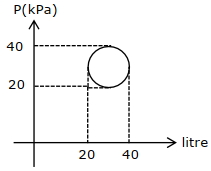
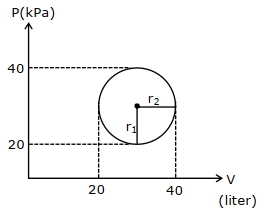
In the reported figure, heat energy absorbed by a system in going through a cyclic process is $......\,\pi J$
  • A
    $50$
  • B
    $150$
  • $100$
  • D
    $200$

Answer

Correct option: C.
$100$
c
For complete cyclic process

$\Delta U=0$

$\therefore \text { from } \Delta Q=\Delta U+W$

$=0+W$

$\Delta Q=W$

$=\text { Area }$

$=\pi r_{1} \cdot r_{2}$

$=\pi \times\left(10 \times 10^{3}\right)\left(10 \times 10^{-3}\right)$

$\Delta Q=100 \pi$

$\therefore \text { Ans. }=100$
Need a full question paper?

Generate a complete, print-ready paper with questions like this in minutes — across 16+ boards, with answer keys.
Start Generating Free

Similar questions

For an object projected from ground with speed $u$ horizontal range is two times the maximum height attained by it. The horizontal range of object is ..........
A ring solid sphere and a disc are rolling down from the top of the same height, then the sequence to reach on surface is 
The fundamental frequency of a vibrating organ pipe is 200Hz.
  1. The first overtone is 400Hz.
  2. The first overtone may be 400Hz.
  3. The first overtone may be 600Hz.
  4. 600Hz is an overtone.
The fundamental frequency of a string is proportional to:
  1. Inverse of its length.
  2. The diameter.
  3. The tension.
  4. The density.
The dimensions of ${e^2}/4\pi {\varepsilon _0}hc$, where $e,\,{\varepsilon _0},\,h$ and $c$ are electronic charge, electric permittivity, Planck’s constant and velocity of light in vacuum respectively
If force and displacement of particle in direction of force are doubled. Work would be
A shell of mass $m$ is at rest initially. It explodes into three fragments having mass in the ratio $2: 2: 1$. If the fragments having equal mass fly off along mutually perpendicular directions with speed $v$, the speed of the third (lighter) fragment is :
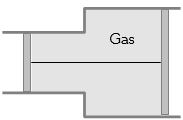
A gas is filled in the cylinder shown in the figure. The two pistons are joined by a string. If the gas is heated, the pistons will
When Neils Bohr shook hand with Werner Heisenberg, what kind of force they exerted?
  1. Gravitational.
  2. Electromagnetic.
  3. Nuclear.
  4. Weak.
A particle is projected vertically upwards from $O$ with velocity $v$ and a second particle is projected at the same instant from $P$ (at a height h above $O$) with velocity $v$ at an angle of projection $\theta$ . The time when the distance between them is minimum is