Question
In the visible region the dispersive powers and the mean angular deviations for crown and flint glass prisms are $\omega , \omega '$ and $d, d' $ respectively. The condition for getting deviation without dispersion when the two prisms are combined is
Answer

(c) ${\theta _{net}} = \theta + \theta ' = 0$$ \Rightarrow \omega d + \omega 'd' = 0$

($\theta $= Angular dispersion =$\omega .\;{\delta _y}$)

Need a full question paper?

Generate a complete, print-ready paper with questions like this in minutes — across 16+ boards, with answer keys.

Start Generating Free

Similar questions

The ends of a stretched wire of length $L$ are fixed at $x = 0$ and $x = L.$ In one experiment, the displacement of the wire is ${y_1} = A\sin (\pi x/L)\sin \omega t$ and energy is ${E_1}$, and in another experiment its displacement is ${y_2} = A\sin (2\pi x/L)\sin 2\omega t$ and energy is ${E_2}$. Then
In Bainbridge mass spectrograph a potential difference of $1000 V$ is applied between two plates distant $1$ cm apart and magnetic field in $B = 1T$. The velocity of undeflected positive ions in m/s from the velocity selector is
A material has Poisson's ratio $0.5$. If a uniform rod of it suffers a longitudinal strain of $3 \times 10^{-3}$, what will be percentage increase in volume is .......... $\%$
Two particles of charges $+Q$ and $-Q$ are projected from the same point with a velocity $v$ in a region of uniform magnetic field $B$ such that the velocity vector makes an angle $q$ with the magnetic field. Their masses are $M$ and $2M,$ respectively. Then, they will meet again for the first time at a point whose distance from the point of projection is
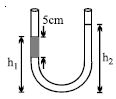
An open-ended $U$-tube of uniform cross-sectional area contains water (density $1.0 $ gram/centimeter$^3$) standing initially $20$ centimeters from the bottom in each arm. An immiscible liquid of density $4.0$ grams/ centimeter $^3$ is added to one arm until a layer $5$ centimeters high forms, as shown in the figure above. What is the ratio $h_2/h_1$ of the heights of the liquid in the two arms?
Let $\vec A\, = \,(\hat i\, + \,\hat j)\,$  and $\vec B\, = \,(2\hat i\, - \,\hat j)\,.$  The magnitude of a coplanar vector $\vec C$ such that  $\vec A\cdot \vec C\, = \,\vec B\cdot \vec C\, = \vec A\cdot \vec B$ is given by
A man cannot see clearly the objects beyond a distance of $20\, cm$ from his eyes. To see distant objects clearly he must use which kind of lenses and of what focal length
A parallel beam of light of wavelength $900\,nm$ and intensity $100\,Wm ^{-2}$ is incident on a surface perpendicular to the beam. Tire number of photons crossing $1\,cm ^{2}$ area perpendicular to the beam in one second is :
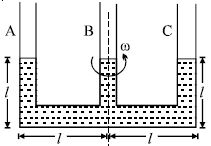
Figure shows a three arm tube in which a liquid is filled upto levels of height $l$. It is now rotated at an angular frequency $\omega$ about an axis passing through arm $B$. The angular frequency $\omega$ at which level of liquid in arm $B$ becomes zero. 
The ratio of the frequencies of the long wavelength limits of Lyman and Balmer series of hydrogen spectrum is