MCQ
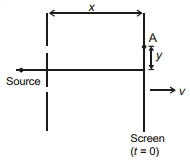
In the Young's arrangement, screen starts moving towards right with constant speed $v$. Initial distance between screen and plane of slits is $x$. At $t=0$, 1st order maxima is lying at point A. After how much time first order minima lies at point $A$ ?
  • A
    $\frac{x}{2 v}$
  • $\frac{x}{v}$
  • C
    $\frac{x}{3 v}$
  • D
    $\frac{2 x}{3 v}$

Answer

Correct option: B.
$\frac{x}{v}$
b
(b)

Distance of $1^{\text {st }}$ maxima from central fringe $=\frac{\lambda D}{d} \quad[D=x]$

Distance of 1 st minima $=\frac{\lambda D}{2 d}$

$D$ at time $t=D_t=x+V t$

$\frac{\lambda x}{d}=\frac{\lambda(x+V t)}{2 d}$

$x=V t$

or $\quad t=\frac{x}{V}$

Need a full question paper?

Generate a complete, print-ready paper with questions like this in minutes — across 16+ boards, with answer keys.

Start Generating Free

Similar questions

The magnetic field of Earth can be modelled by that of a point dipole placed at the centre of the Earth. The dipole axis makes an angle of $11.3^\circ $ with the axis of Earth. At Mumbai, declination is nearly zero. Then:
 A nucleus  $_n{X^m}$ emits one $\alpha$ particle and two $\beta$ particles. The resulting nucleus is
Which of the following statement is not correct
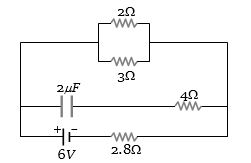
In the figure shown, the capacity of the condenser $C$ is $2\,\mu F$. The current in $2\,\Omega $ resistor is ............... $A$
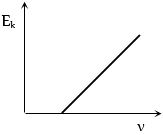
For the photoelectric effect, the maximum kinetic energy ${E_k}$ of the emitted photoelectrons is plotted against the frequency $v$ of the incident photons as shown in the figure. The slope of the curve gives
Two resistances $R_1$ and $R_2$ when connected in series and parallel with 120 V line, power consumed will be 25 W and 100 W respectively. Then the ratio of power consumed by $R_1$ to that consumed by $R_2$ will be
If the work function for a certain metal is $3.2\times 10^{-19}$  joule and it is illuminated with light of frequency $8\times 10^{14}$  Hz. The maximum kinetic energy of the photo-electrons would be ($\mathrm{h} = 6.63\times 10^{-34}\mathrm{Js})$
Which of the following element was discovered by study of Fraunhofer lines
If the flux of the electric field through a closed surface is zero, then:
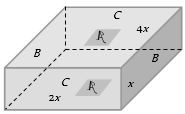
In figure shows a rectangular block with dimensions $x,\, 2x$ and $4x$. Electrical contacts can be made to the block between opposite pairs of faces (for example, between the faces labelled $A-A, B-B$ and $C-C$). Between which two faces would the maximum electrical resistance be obtained ($A-A$ : Top and bottom faces, $B-B$ : Left and right faces, $C-C$ : Front and rear faces)