MCQ
In thermal compression, the body's:
  • A
    pressure decreases
  • B
    temperature decreases
  • temperature increases
  • D
    heat increases

Answer

Correct option: C.
temperature increases
C

Need a full question paper?

Generate a complete, print-ready paper with questions like this in minutes — across 16+ boards, with answer keys.

Start Generating Free

Similar questions

Two bodies are projected from ground with same speeds $40 ms ^{-1}$ at two different angles with respect to horizontal. The bodies were found to have same range. If one of the body was projected at an angle of $60^{\circ}$, with horizontal then sum of the maximum heights, attained by the two projectiles, is $.......m$. (Given $g =10 ms ^{-2}$ )
In the Ingen Hauz’s experiment the wax melts up to lengths $10$ and $25 cm$ on two identical rods of different materials. The ratio of thermal conductivities of the two materials is
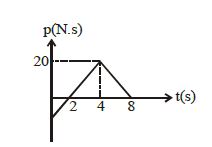
From the following graph find the magnitude of negative force ............ $N$
Why are drops and bubbles spherical?
Surface tension of a liquid is found to be influenced by
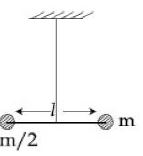
Two masses $m$ and $\frac{m}{2}$ are connected at the two ends of a massless rigid rod of length $l$. The rod is suspended by a thin wire of torsional constant $k$ at the centre of mass of the rodmass system (see figure). Because of torsional constant $k$, the restoring torque is $\tau  = k\,\theta $ for angular displacement $\theta $. If the rod is rotated by $\theta _0$ and released, the tension in it when it passes through its mean position will be
A boy is standing on top of a tower of height $85 \,m$ and throws a ball in the vertically upward direction with a certain speed. If $5.25$ s later he hears the ball hitting the ground, then the speed with which the boy threw the ball is .......... $m / s$ (take, $g=10 \,m / s ^2$ and speed of sound in air $=340 \,m / s$ )
A metallic rod of length $I$ and cross-sectional area $A$ is made of a material of Young's modulus $Y$. If the rod is elongated by an amount $y$, then the work done is proportional to ......
During an adiabatic process, the pressure of a gas is found to be proportional to the cube of its absolute temperature. The ratio $\frac{\text{C}_\text{P}}{\text{C}_\text{V}}$ for gas is:
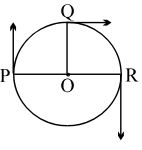
Three point particles $P, Q, R$ move in circle of radius $‘r’$ with different but constant speeds. They start moving at $t = 0$ from their initial positions as shown in the figure. The angular velocities (in rad/ sec) of $P, Q$ and $R$ are $5\pi , 2\pi$ & $3\pi$ respectively, in the same sense.  the number of times $P$ and $Q$ meet in that time interval is: