Question
In vector combination, commutative and associative rules are followed. Explain.
Answer

(i) Permutation rule of vector combination : If vectors $\vec{a}$ and $\vec{b}$ are two vectors then,
$\vec{a}+\vec{b}=\vec{b}+\vec{a}$
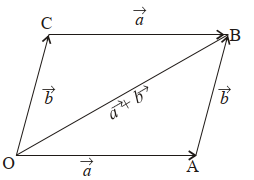
Proof : Let $\vec{a}$ and $\vec{b}$ are denoted by $\overrightarrow{ OA }$ and $\overrightarrow{ OB }$ respectively. Hence,
$\overrightarrow{ OA }=\vec{a}$ and $\overrightarrow{ AB }=\vec{b}$
By vector addition rule of triangle,
$\begin{array}{l}
\overrightarrow{OB}=\overrightarrow{OA}+\overrightarrow{AB} \\
\overrightarrow{OB}=\vec{a}+\vec{b} \ldots(1)
\end{array}$
Image

The parallelogram completes OABC whose two adjacent sides are $O A$ and $A B$ :$
\begin{array}{l}
\overrightarrow{CD}=\overrightarrow{OA}=\vec{a} \\
\overrightarrow{OC}=\overrightarrow{AB}=\vec{b}
\end{array}$
Again, by triangle law of vector addition
$\begin{array}{l}
\overrightarrow{OB}=\overrightarrow{OC}+\overrightarrow{CB}=\vec{b}+\vec{a} \\
\overrightarrow{OB}=\vec{b}+\vec{a} \ \ldots(2)
\end{array}$
From equations (1) and (2)
$\vec{a}+\vec{b}=\vec{b}+\vec{a}$So, this proves the rule.
(ii) Associative rule in vector addition : If $\vec{a}, \vec{b}$ and $\vec{c}$ are three vectors.
Then, $(\vec{a}+\vec{b})+\vec{c}=\vec{a}+(\vec{b}+\vec{c})$
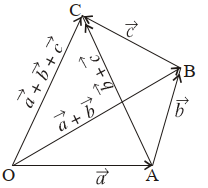
Proof : Three vectors $\vec{a}, \vec{b}$ and $\vec{c}$ are represented by $\overrightarrow{ OA }, \overrightarrow{ AB }$ and $\overrightarrow{ BC }$ respectively.
Hence, $\overrightarrow{ OA }=\vec{a}, \overrightarrow{ AB }=\vec{b}, \overrightarrow{ BC }=\vec{c}$
By applying triangle law of vector addition in $\triangle OAB$ and $\triangle OBC , \overrightarrow{ OB }=\overrightarrow{ OA }+\overrightarrow{ AB }$
$\begin{array}{l}
\overrightarrow{OB}=\vec{a}+\vec{b} \\
\overrightarrow{OC}=\overrightarrow{OB}+\overrightarrow{BC}
\end{array}$$=(\vec{a}+\vec{b})+\vec{c} \ \ldots(1)$
Image
In $\triangle ABC$ and $\triangle OAC$, we get
$\begin{aligned}
\overrightarrow{AC} & =\overrightarrow{AB}+\overrightarrow{BC}=\vec{b}+\vec{c} \\
\overrightarrow{OC} & =\overrightarrow{OA}+\overrightarrow{AC} \\
& =\vec{a}+(\vec{b}+\vec{c}) \ \ldots(2)
\end{aligned}$
From equations (1) and (2)
$(\vec{a}+\vec{b})+\vec{c}=\vec{a}+(\vec{b}+\vec{c})$

Need a full question paper?

Generate a complete, print-ready paper with questions like this in minutes — across 16+ boards, with answer keys.

Start Generating Free

Similar questions

Given below are observations on molar specific heats at room temperature of some common gases.
Gas Molar specific heat (Cv)
(cal $mo1^{–1} K^{–1}$)
Hydrogen 4.87
Nitrogen 4.97
Oxygen 5.02
Nitric oxide 4.99
Carbon monoxide 5.01
Chlorine 6.17
The measured molar specific heats of these gases are markedly different from those for monatomic gases. Typically, molar specific heat of a monatomic gas is 2.92 cal/ mol K. Explain this difference. What can you infer from the somewhat larger (than the rest) value for chlorine?
Prove that when the vector sum of all external forces acting on a system is zero, then the center of mass remains constant.
A person of mass $60kg$ wants to lose $5kg$ by going up and down a $10m$ high stairs. Assume he burns twice as much fat while going up than coming down. If $1kg$ of fat is burnt on expending $7000$ kilo calories, how many times must he go up and down to reduce his weight by $5kg$?
A projectile is fired horizontally with a velocity of $98ms^{-1}$ from the hill 490m high. Find (i) time taken to reach the ground (ii) the distance of the target from the hill and (iii) the velocity with which the body strikes the ground.
A disc of radius R is rotating with an angular speed $\omega_\text{o}$ about a horizontal axis. It is placed on a horizontal table. The coefficient of kinetic friction is $\mu_\text{k}{:}$
  1. What was the velocity of its centre of mass before being brought in contact with the table?
  2. What happens to the linear velocity of a point on its rim when placed in contact with the table?
  3. What happens to the linear speed of the centre of mass when disc is placed in contact with the table?
  4. Which force is responsible for the effects in (b) and (c).
  5. What condition should be satisfied for rolling to begin?
  6. Calculate the time taken for the rolling to begin.
The radius of atom is of the order of $\mathring{\text{A}}$ and radius of nucleus is of the order of fermi. How many magnitudes higher is the volume of atom as compared to the volume of nucleus?
A current i is passed through a silver strip of width d and area of cross-section A. The number of free electrons per unit volume is n.
  1. Find the drift velocity v of the electrons.
  2. If a magnetic field B exists in the region, as shown in the figure, what is the average magnetic force on the free electrons?
  3. Due to the magnetic force, the free electrons get accumulated on one side of the conductor along its length. This produces a transverse electric field in the conductor, which opposes the magnetic force on the electrons. Find the magnitude of the electric field which will stop further accumulation of electrons.
  4. What will be the potential difference developed across the width of the conductor due to the electron-accumulation? The appearance of a transverse emf, when a current-carrying wire is placed in a magnetic field, is called Hall effect.
Assuming the length of a chain to be L and coefficient of static friction $\mu,$ calculate the maximum length of the chain which can be held outside a table without sliding.
Use the formula $\text{v}=\sqrt{\frac{\gamma\text{P}}{\rho}}$ to explain why the speed of sound in air:
Is independent of pressure,
A person travelling in a fast spaceship measures the distance between the earth and the moon. Is it the same, smaller or larger than the value quoted in this book?