In which case there is maximum extension in the wire, if same force is applied on each wire
Medium


Download our appand get started for free
Experience the future of education. Simply download our apps or reach out to us for more information. Let's shape the future of learning together!No signup needed.*
Similar Questions
- 1When a certain weight is suspended from a long uniform wire, its length increases by one $cm$. If the same weight is suspended from another wire of the same material and length but having a diameter half of the first one, the increase in length will be ......... $cm$View Solution
- 2Match the type of elasticity involvedView Solution
$(i)$ Suspension fibre of galvanometer $(a)$ Linear $(ii)$ Bending of beam $(b)$ Shear $(iii)$ cutting piece of paper $(c)$ Bulk $(iv)$ mechanical waves in fluid $(d)$ Shear - 3A thick rope of density $\rho$ and length $L$ is hung from a rigid support. The Young's modulus of the material of rope is $Y$. The increase in length of the rope due to its own weight isView Solution
- 4A fixed volume of iron is drawn into a wire of length $L.$ The extension $x$ produced in this wire by a constant force $F$ is proportional toView Solution
- 5In a series combination of copper and steel wires of same length and same diameter, a force is applied at one of their ends while the other end is kept fixed. The combined length is increased by $2\, cm$. The wires will have ..........View Solution
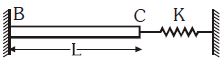
- 6A rod $BC$ of negligible mass fixed at end $B$ and connected to a spring at its natural length having spring constant $K = 10^4\ N/m$ at end $C$, as shown in figure. For the rod $BC$ length $L = 4\ m$, area of cross-section $A = 4 × 10^{-4}\ m^2$, Young's modulus $Y = 10^{11} \ N/m^2$ and coefficient of linear expansion $\alpha = 2.2 × 10^{-4} K^{-1}.$ If the rod $BC$ is cooled from temperature $100^oC$ to $0^oC,$ then find the decrease in length of rod in centimeter.(closest to the integer)View Solution
- 7A stone of mass $20\, {g}$ is projected from a rubber catapult of length $0.1\, {m}$ and area of cross section $10^{-6} \,{m}^{2}$ stretched by an amount $0.04\, {m}$. The velocity of the projected stone is $....\,m\,/s.$ (Young's modulus of rubber $=0.5 \times 10^{9}\, {N} / {m}^{2}$ )View Solution
- 8The elastic limit of brass is $379\,MPa.$ .......... $mm$ should be the minimum diameter of a brass rod if it is to support a $400\,N$ load without exceeding its elastic limit .View Solution
- 9A rubber cord catapult has cross-sectional area $25\,m{m^2}$ and initial length of rubber cord is $10\,cm.$ It is stretched to $5\,cm.$ and then released to project a missile of mass $5gm.$ Taking ${Y_{rubber}} = 5 \times {10^8}N/{m^2}$ velocity of projected missile is ......... $ms^{-1}$View Solution
- 10View SolutionWith rise in temperature, the Young's modulus of elasticity