MCQ
In which of the following the final image is erect?
  • Simple microscope
  • B
    Compound microscope
  • C
    Astronomical telescope
  • D
    none of the above

Answer

Correct option: A.
Simple microscope
a
Only in simple microscope the image formed is erect, while it is inverted in compound microscope and astronomical telescope.

Need a full question paper?

Generate a complete, print-ready paper with questions like this in minutes — across 16+ boards, with answer keys.
Start Generating Free

Similar questions

Which of the following about potential difference between any two points is true?
$i.$ It depends only on the initial and final position.
$ii.$ It is the work done per unit positive charge in moving from one point to other.
$iii.$ It is more for a positive charge of two units as compared to a positive charge of one unit.
A wire loop is rotated in a magnetic field. The frequency of change of direction of the induced $e.m.f.$ is.
An electron is moving in electric field and magnetic field it will gain energy from
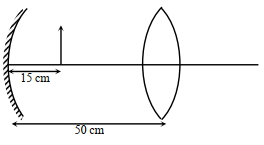
Consider a concave mirror and a convex lens (refractive index $=1.5$ ) of focal length $10 \ cm$ each, separated by a distance of $50 \ cm$ in air (refractive index $=1$ ) as shown in the figure. An object is placed at a distance of $15 \ cm$ from the mirror. Its erect image formed by this combination has magnification $M _1$. When the set- up is kept in a medium of refractive index $7 / 6$, the magnification becomes $M _2$. The magnitude $\left|\frac{ M _2}{ M _1}\right|$ is
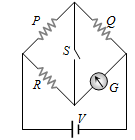
In the circuit shown P ≠ R, the reading of the galvanometer is same with switch S open or closed. Then

A coil of $100$ turns carries a current of $5\, mA$ and creates a magnetic flux of $10^{-5 }$ $weber$. the inductance is.....$mH$
As a result of interference of two coherent sources of light, energy is
The capacitor of capacitance $4\,\mu F$ and $6\,\mu F$ are connected in series. A potential difference of $500\;volts$ applied to the outer plates of the two capacitor system. Then the charge on each capacitor is numerically
In a Millikan's oil drop experiment the charge on an oil drop is calculated to be $6.35 \times 10^{-19} \mathrm{C}$. The number of excess electrons on the drop is
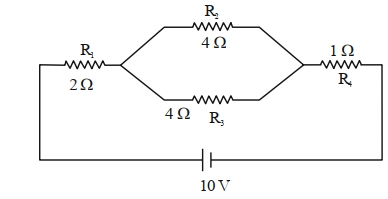
 In the given circuit, the current in resistance $\mathrm{R}_3 $ is :