MCQ
In which of the following transitions will the wavelength be minimum?
  • A
    $n = 5$ to $n = 4$
  • B
    $n = 4$ to $n = 3$
  • C
    $n = 3$ to $n = 2$
  • $n = 2$ to $n = 1$

Answer

Correct option: D.
$n = 2$ to $n = 1$

For the transition in the hydrogen-like atom, the wavelength of the emitted radiation is calculated by,
$\frac{1}{\lambda}=\text{RZ}^2\Big(\frac{1}{\text{n}_1}-\frac{1}{\text{n}_2}\Big)$
Here, $R$ is the Rydberg constant.
For the transition from $n = 5$ to $n = 4$, the wavelength is given by,
$\frac{1}{\lambda}=\text{RZ}^2\Big(\frac{1}{4^2}-\frac{1}{5^2}\Big)$
$\lambda=\frac{400}{9\text{RZ}^2}$
For the transition from $n = 4$ to $n = 3$, the wavelength is given by,
$\frac{1}{\lambda}=\text{RZ}^2\Big(\frac{1}{3^2}-\frac{1}{4^2}\Big)$
$\lambda=\frac{144}{7\text{RZ}^2}$
For the transition from $n = 3$ to $n = 2$, the wavelength is given by,
$\frac{1}{\lambda}=\text{RZ}^2\Big(\frac{1}{2^2}-\frac{1}{3^2}\Big)$
$\lambda=\frac{36}{5\text{RZ}^2}$
For the transition form $n = 2$ to $n = 1$, the wavelength is given by,
$\frac{1}{\lambda}=\text{RZ}^2\Big(\frac{1}{1^2}-\frac{1}{2^2}\Big)$
$\lambda=\frac{2}{\text{RZ}^2}$
From the above calculations, it can be observed that the wavelength of the radiation emitted for the transition from $n = 2$ to $n = 1$ will be minimum.

Need a full question paper?

Generate a complete, print-ready paper with questions like this in minutes — across 16+ boards, with answer keys.
Start Generating Free

Similar questions

$_{6}^{12} C$absorbs an energetic neutron and emits beta particles. The resulting nucleus is
 
The patient is asked to drink BaSO$_4$ for examining the stomach by X-rays because X-rays are
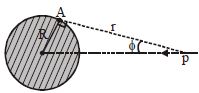
A dipole having dipole moment $p$ is placed in front of a solid uncharged conducting sphere as shown in the diagram. The net potential at point $A$ lying on the surface of the sphere is :-
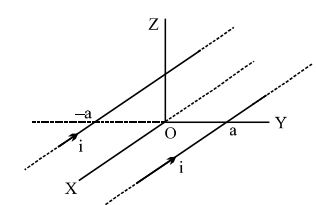
Two long thin, parallel conductors carrying equal currents in the same direction are fixed parallel to the $x$-axis, one passing through $y = a$ and the other through $y = -a$. The resultant magnetic field due to the two conductors at any point is $B$. Which of the following are correct?
An elastic circular wire of length l carries a current I. It is placed in a uniform magnetic field $\vec B$ (Out of paper) such that its plane is perpendicular to the direction of $\vec B$. The wire will experience
An ammeter of $100$ $\Omega$ resistance gives full deflection for the current of $10^{-5} \,amp$. Now the shunt resistance required to convert it into ammeter of $1\, amp$. range, will be
In the Young's double slit experiment, if the phase difference between the two waves interfering at a point is $\phi$, the intensity at that point can be expressed by the expression
The effect of increase in temperature on the number of electrons in conduction band $\left( n _{ e }\right)$ and resistance of a semiconductor will be as:
The vertical component of the earth's magnetic field is $6 \times 10^{-5} T$ at any place where the angle of dip is $37^{\circ}$. The earth's resultant magnetic field at that place will be $\left(\right.$ Given $\left.\tan 37^{\circ}=\frac{3}{4}\right)$
At neutral temperature, the thermoelectric power $\left(\frac{\mathrm{dE}}{\mathrm{dT}}\right)$ has the value