MCQ
In Young's double slit experiment, the phase difference between the light waves reaching third bright fringe from the central fringe will be ($\lambda$ $=6000 Å$ )
  • A
    Zero
  • B
    $2\pi $
  • C
    $4\pi $
  • $6\pi $

Answer

Correct option: D.
$6\pi $
d
(d)$\because n = 3,\;\;\therefore 2n\pi  = 2 \times 3\pi  = 6\pi $

Need a full question paper?

Generate a complete, print-ready paper with questions like this in minutes — across 16+ boards, with answer keys.

Start Generating Free

Similar questions

A beam of electromagnetic radiation of intensity $6.4 \times 10^{-5}\; \mathrm{W} / \mathrm{cm}^{2}$ is comprised of wavelength, $\lambda=310 \;\mathrm{nm} .$ It falls normally on a metal (work function $\varphi=2 \;\mathrm{eV}$ ) of surface area of $1\; \mathrm{cm}^{2} .$ If one in $10^{3}$ photons ejects an electron, total number of electrons ejected in $1 \;s$ is $10^{\mathrm{x}}$.then $\mathrm{x}$ is

$\left(\mathrm{hc}=1240\; \mathrm{eV} \mathrm{nm}, 1\; \mathrm{eV}=1.6 \times 10^{-19} \;\mathrm{J}\right)$
If a conductor has a potential $V \neq 0$ and there are no charges anywhere else outside, then:
An electric dipole placed in a uniform elecrtric field exepriences:
An ionic atom equivalent to hydrogen atom has wavelength equal to 1/4 of the wavelengths of hydrogen lines. The ion will be
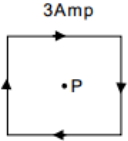
Find magnetic field at centre $P$ if length of side of square loop is $20\, cm$
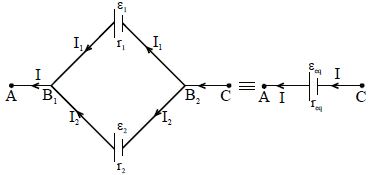
Consider a parallel combination of the cellsshown in the figure.The potential difference in between $B_1$ and $B_2$ is
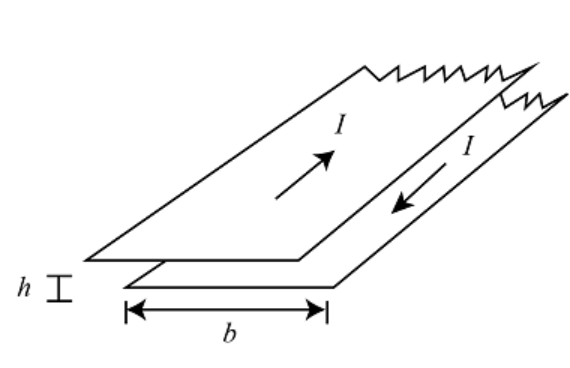
Calculate the inductance of a unit length of a double tape line as shown in figure. The tapes are separated by a distance h which is considerably less than their width b.
Image
Speed of light is maximum in
A 2 volt battery, a 15 Ω resistor and a potentiometer of 100 cm length, all are connected in series. If the resistance of potentiometer wire is 5 Ω, then the potential gradient of the potentiometer wire is
A particle of charge $q$ and mass $m$ is subjected to an electric field $E = E _{0}\left(1- ax ^{2}\right)$ in the $x-$direction, where $a$ and $E _{0}$ are constants. Initially the particle was at rest at $x=0 .$ Other than the initial position the kinetic energy of the particle becomes zero when the distance of the particle from the origin is