MCQ
In Young's double slit interference experiment, the slit separation is made $3$ folds. The fringe width becomes ......... times
  • $\frac{1}{3}$
  • B
    $\frac{1}{9}$
  • C
    $3$
  • D
    $9$

Answer

Correct option: A.
$\frac{1}{3}$
a
(a)

Fringe width $\beta=\frac{\lambda D}{d}$

$\beta^{\prime}=\frac{\lambda D}{3 d}=\frac{\beta}{3}$

Need a full question paper?

Generate a complete, print-ready paper with questions like this in minutes — across 16+ boards, with answer keys.
Start Generating Free

Similar questions

Consider three quantities $\text{x}=\frac{\text{E}}{\text{B}},\ \text{y}=\sqrt{\frac{1}{\mu_0\in_0}}$ and $\text{z}=\frac{1}{\text{CR}}.$ Here, l is the length of a wire, C is a capacitance and R is a resistance. All other symbols have standard meanings.
Which among the following is false?
Two identical conducting spheres $A$  and $B,$  carry equal charge. They are separated by a distance much larger than their diameter, and the force between them is $F$ . A third identical conducting sphere, $C,$  is uncharged. Sphere $C$  is first touched to $A,$ then to $B,$  and then removed. As a result, the force between $A$  and $B$  would be equal to
When we rub our comb with hair and then take near to the paper pieces, all pieces get stuck to the comb. This happens due tyo which phenomena?
For equal point charges $Q$ each are placed in the $xy$ plane at $(0, 2), (4, 2), (4, -2)$ and $(0, -2)$. The work required to put a fifth change $Q$ at the origin of the coordinate system will be
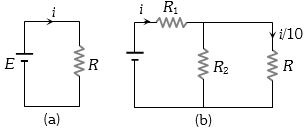
Consider the circuits shown in the figure. Both the circuits are taking same current from battery but current through $R$ in the second circuit is $\frac{1}{{10}}$$^{th}$ of current through $R$ in the first circuit. If $R$ is $11$ $\Omega$, the value of $ R_1$ ................  $\Omega$
The electric field between the two spheres of a charged spherical condenser
When a bar magnet is freely suspended for oscillation then time period is $T$. If it is cut in $3$ equal parts perpendicular to its length then time period of oscillation for each part will be
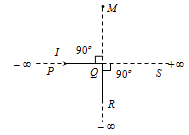
An infinitely long conductor PQR is bent to form a right angle as shown. A current I flows through PQR The magnetic field due to this current at the point M is $H_1$. Now another infinitely long straight conductor QS is connected at Q so that the current is I/2 in QR as well as in QS, The current in PQ remaining unchanged. The magnetic field at M is now $H_2$. The ratio $H_1/H_2$ is given by

If an alternating voltage is represented as $E = 141\,sin\, (628\,t),$ then the rms value of the voltage and the frequency are respectively