Question
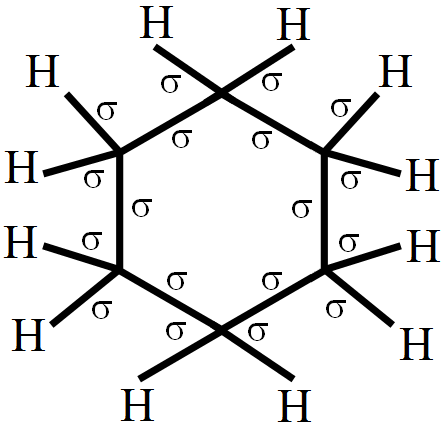
Indicate the $\sigma$ and $\pi$ bonds in the following molecules:
$\mathrm{C}_6 \mathrm{H}_{12}$,

Answer

The $\sigma$ and $\pi$ bonds are indicated below:

$\begin{matrix}6\text{C} - \text{C} & \sigma- \text{ bonds}\\12 \text{C} - \text{H} & \sigma-\text{bonds} \end{matrix}\Bigg\}$ Other cyclic isomers will also have same no. of $\sigma$ and $\pi$-bonds.

Need a full question paper?

Generate a complete, print-ready paper with questions like this in minutes — across 16+ boards, with answer keys.
Start Generating Free

Similar questions

Assuming the water vapor to be a perfect gas, calculate the internal energy change when 1 mol of water at $100^{\circ} C$ and 1 bar pressure is converted to the ice at $0^{\circ} C$. Given the enthalpy of fusion of ice is 6.00 kJ mol 1 heat capacity of water is $4.2 J / g ^{\circ} C$.
  1. Discuss the harmful effects of photochemical smog.
  2. Write any two effects of acid rain.
  3. Define soil pollution.
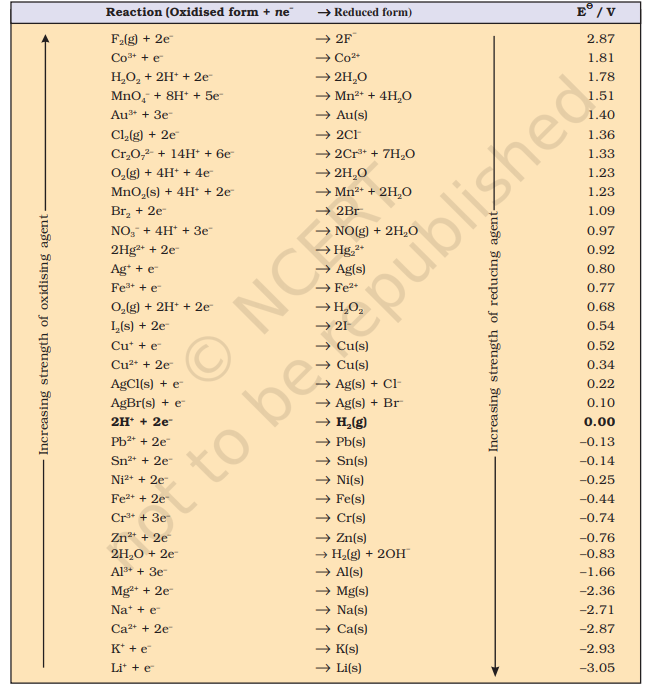
Using the standard electrode potentials given in the Table, predict if the reaction between the following is feasible:

$\mathrm{Ag}(\mathrm{s})$ and $\mathrm{Fe}^{3+}(\mathrm{aq})$
  1. Account for the following:
  1. Boron halides do not dimerise like $BH_3$.
  2. Carbon shows catenation remarkably.
  3. $PbCl_4$ is a good oxidising agent.
  1. Complete the following reactions:
  1. $\text{Na}_{2}\text{B}_{4}\text{O}_{7} + 2\text{HCl} + \text{5H}_{2}\text{O} \xrightarrow{\ \ \ \ \ \ \ \ }$
  2. $\text{B}_{2}\text{H}_{6} + 6\text{NH}_{3} \xrightarrow[\ \ \ \ \ \ ]{\Delta}$
When a metal of group 1 was dissolved in liquid ammonia, the following observations were obtained:
  1. Blue solution was obtained initially.
  2. On concentrating the solution, blue colour changed to bronze colour.
How do you account for the blue colour of the solution? Give the name of the product formed on keeping the solution for some time.
How can the production of dihydrogen, obtained from ‘coal gasification’, be increased?
Calculate the equilibrium constant for the following reaction at 298K and 1atm pressure $\text{NO(g)}+\frac{1}{2}\text{O}_2(\text{g})\rightleftharpoons\text{NO}_2(\text{g})$
Given $\Delta \mathrm{H}_{\mathrm{f}}^{\circ}$ at $298 \mathrm{~K}^{-20} \mathrm{NO}(\mathrm{g})=90.4 \mathrm{~kJ} \mathrm{~mol}^{-1}$ and $\mathrm{NO}_2(\mathrm{~g})=33.8 \mathrm{~kJ} \mathrm{~mol}^{-1}, \Delta \mathrm{~S}^{\circ}$ at $298 \mathrm{~K}^{-}$for the reaction $=-70.0 \mathrm{JK}^{-}$ ${ }^1 \mathrm{~mol}^{-1}, \mathrm{R}=8.31 \mathrm{JK}^{-1} \mathrm{~mol}^{-1}$.
Which atoms are indicated by the following configurations?
  1. $[He] 2s^1.$
  2. $[Ne] 3s^2 3p^3.$
  3. $[Ar] 4s^2 3d^1.$
Why is water molecule polar?
Why solution of sugar in water does not conduct electricity whereas that of common salt in water does?