Question
Indicate the $\sigma$ and $\pi$ bonds in the following molecules: $\mathrm{CH}_2 \mathrm{H}_2$.
Answer


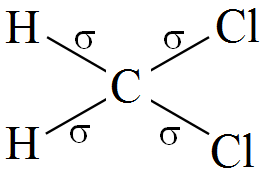
The $\sigma$ and $\pi$ bonds are indicated below:

$2\text{C}-\text{H }\sigma-\text{bonds}$
$2\text{C}-\text{Cl }\sigma-\text{bonds}$

Need a full question paper?

Generate a complete, print-ready paper with questions like this in minutes — across 16+ boards, with answer keys.

Start Generating Free

Similar questions

  1. How would you prepare dihydrogen from water by using a reducing agent?
  2. How would you prepare dihydrogen from a substance other than water?
  3. How would you prepare very pure $\text{H}_2$ in the laboratory?
  4. How would you prepare heavy hydrogen in the laboratory?
Write equations for the preparation of
  1. $\text{HC}\equiv\text{CD}$
  2. $\text{DC}\equiv\text{CD}$
  1. What are fullerenes? How are they prepared?
  2. Classify the following compounds into acidic, basic and amphoteric oxides:
$\mathrm{Al}_2 \mathrm{O}_3, \mathrm{Cl}_2 \mathrm{O}_7$
A human adult breathes in approximately 0.50L of air at 1atm with each breath. If an air tank holds 10L of air at 200atm, how many breaths the tank will supply?
Why is $\mathrm{BF}_3$ planar molecule but $\mathrm{NH}_3$ is pyramidal?
If the amount of ionization of 0.01 M aqueous solution of $NH _3$ is $2 \%$, then calculate its dissociation constant.
(a) Name one element in which the number of $s$ electrons is equal to the numbers of p-electrons.
(b) Tell the number of radial nodes in 1 s and 2 s orbitals.
(a) If there is only one electron in the 3 p subshell, then in which of the $3 p _x, 3 p _y$ and $3 p _z$ orbitals will this electron be present?
(b) What are the quantum numbers representing the following :
(i) Size of orbitals
(ii) Shape of orbitals
(iii) Orientation of orbitals
(c) If the mass number of an element is double its atomic number and it has four electrons in its 2 p subshell, then write the name and electronic of this element.
Why do alkali metals impart colour to the flame?
What is the difference between extensive and intensive properties? Explain.