Question 12 Marks
Will $\mathrm{CCl}_4$ give white precipitate of AgCl on heating it with silver nitrate? Give reason for your answer.
AnswerNo. $\mathrm{CCl}_4$ is a completely non-polar covalent compound whereas $\mathrm{AgNO}_3$ is ionic in nature. Therefore they are not expected to react and thus a white ppt. of silver chloride will not be formed.
View full question & answer→Question 22 Marks
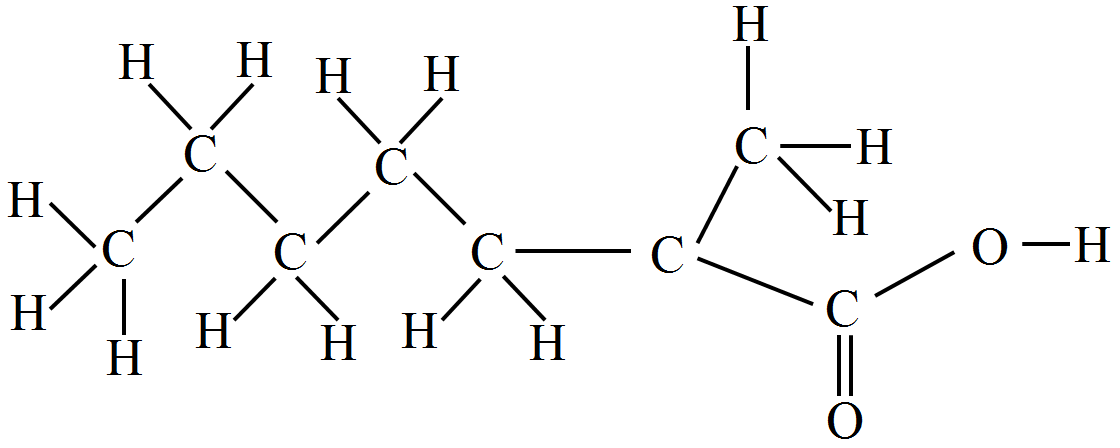
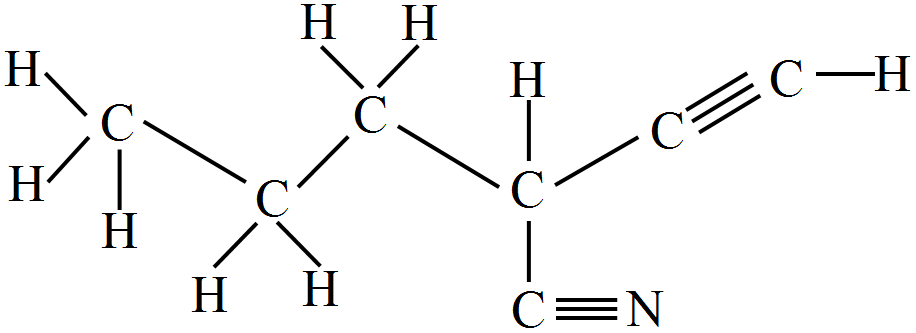
Identify the functional groups in the following compounds:
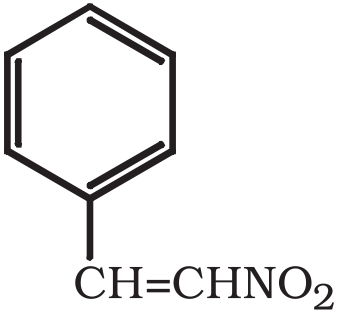
Question 32 Marks
Draw formulas for the first five members of homologous series beginning with the following compounds.
H-COOH.
AnswerThe first five members of each homologous series beginning with the given compounds are shown as follows:
$\mathrm{H}-\mathrm{COOH}:$ Methanoic acid
$\mathrm{CH}_3-\mathrm{COOH}$ : Ethanoic acid
$\mathrm{CH}_3-\mathrm{CH}_2-\mathrm{COOH}$ : Propanoic acid
$\mathrm{CH}_3-\mathrm{CH}_2-\mathrm{CH}_2-\mathrm{COOH}$ : Butanoic acid
$\mathrm{CH}_3-\mathrm{CH}_2-\mathrm{CH}_2-\mathrm{CH}_2-\mathrm{COOH}:$ Pentanoic acid.
View full question & answer→Question 42 Marks
Draw formulas for the first five members of homologous series beginning with the following compounds.
$\mathrm{CH}_3 \mathrm{COCH}_3$.
AnswerThe first five members of each homologous series beginning with the given compounds are shown as follows:
$\mathrm{CH}_3 \mathrm{COCH}_3$ : Propanone
$\mathrm{CH}_3 \mathrm{COCH}_2 \mathrm{CH}_3$ : Butanone
$\mathrm{CH}_3 \mathrm{COCH}_2 \mathrm{CH}_2 \mathrm{CH}_3$ : Pentan-2-one
$\mathrm{CH}_3 \mathrm{COCH}_2 \mathrm{CH}_2 \mathrm{CH}_2 \mathrm{CH}_3$ : Hexan-2-one
$\mathrm{CH}_3 \mathrm{COCH}_2 \mathrm{CH}_2 \mathrm{CH}_2 \mathrm{CH}_2 \mathrm{CH}_3$ : Heptan-2-one.
View full question & answer→Question 52 Marks
Draw formulas for the first five members of homologous series beginning with the following compounds.
$\mathrm{H}-\mathrm{CH}=\mathrm{CH}_2$.
AnswerThe first five members of each homologous series beginning with the given compounds are shown as follows:
$\mathrm{H}-\mathrm{CH}=\mathrm{CH}_2$ : Ethene
$\mathrm{CH}_3-\mathrm{CH}=\mathrm{CH}_2$ : Propene
$\mathrm{CH}_3-\mathrm{CH}_2-\mathrm{CH}=\mathrm{CH}_2$ : 1-Butene
$\mathrm{CH}_3-\mathrm{CH}_2-\mathrm{CH}_2-\mathrm{CH}=\mathrm{CH}_2$ : 1-Pentene
$\mathrm{CH}_3-\mathrm{CH}_2-\mathrm{CH}_2-\mathrm{CH}_2-\mathrm{CH}=\mathrm{CH}_2:$ 1-Hexene.
View full question & answer→Question 62 Marks
Indicate the $\sigma$ and $\pi$ bonds in the following molecules:
$\mathrm{CH}_3 \mathrm{NO}_2$.
Answer
The $\sigma$ and $\pi$ bonds are indicated below:
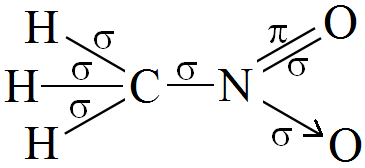
$3\text{C}-\text{H }\sigma-\text{bonds}$
$1\text{C}-\text{N }\sigma-\text{bonds}$
$1\text{N}-\text{O }\sigma-\text{bond}$
$1\text{N}-\text{O }\pi -\text{bond}$ View full question & answer→Question 72 Marks
Indicate the $\sigma$ and $\pi$ bonds in the following molecules: $\mathrm{CH}_2 \mathrm{H}_2$.
Answer
The $\sigma$ and $\pi$ bonds are indicated below:
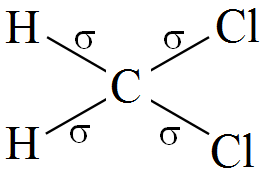
$2\text{C}-\text{H }\sigma-\text{bonds}$
$2\text{C}-\text{Cl }\sigma-\text{bonds}$ View full question & answer→Question 82 Marks
Indicate the $\sigma$ and $\pi$ bonds in the following molecules:$\mathrm{CH}_2=\mathrm{C}=\mathrm{CH}_2$.
Answer
The $\sigma$ and $\pi$ bonds are indicated below:
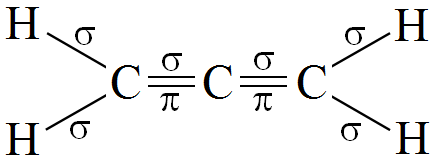
$4\text{C}-\text{H }\sigma-\text{bonds}$
$2\text{C}-\text{C }\sigma-\text{bonds}$
$2\text{C}-\text{C }\pi-\text{bonds}$ View full question & answer→Question 92 Marks
Why is it necessary to use acetic acid and not sulphuric acid for acidification of sodium extract for testing sulphur by lead acetate test?
AnswerAlthough the addition of sulphuric acid will precipitate lead sulphate, the addition of acetic acid will ensure a complete precipitation of sulphur in the form of lead sulphate due to common ion effect. Hence, it is necessary to use acetic acid for acidification of sodium extract for testing sulphur by lead acetate test.
View full question & answer→Question 102 Marks
Indicate the $\sigma$ and $\pi$ bonds in the following molecules: $\mathrm{HCONHCH}_3$.
Answer=
The $\sigma$ and $\pi$ bonds are indicated below:
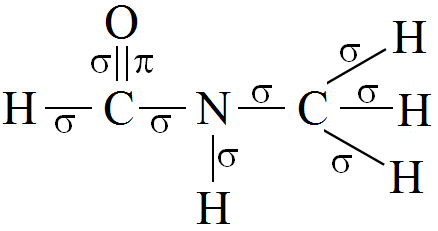
$4\text{C}-\text{H }\sigma-\text{bonds}$
$1\text{N}-\text{H }\sigma-\text{bonds}$
$1\text{C}-\text{O }\pi-\text{bond}$
$1\text{C}-\text{O }\sigma -\text{bond}$
$1\text{C}-\text{N }\sigma-\text{bonds}$ View full question & answer→Question 112 Marks
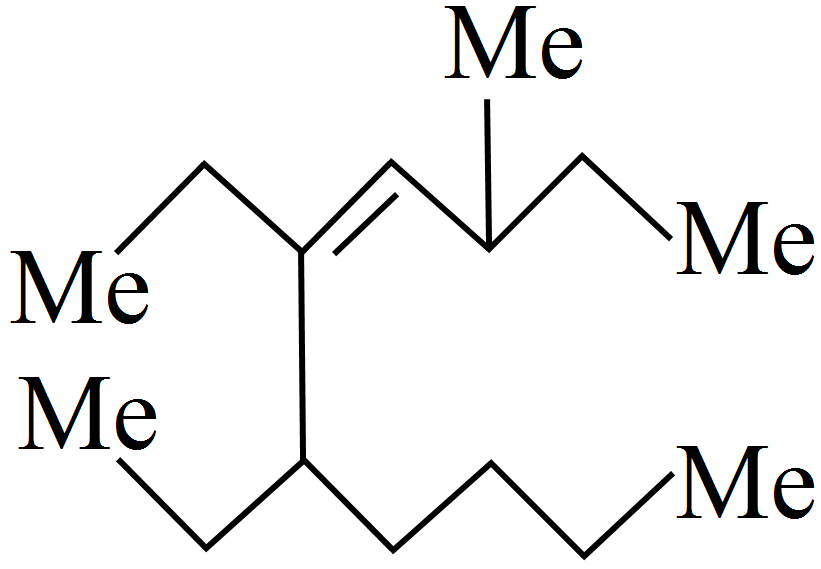
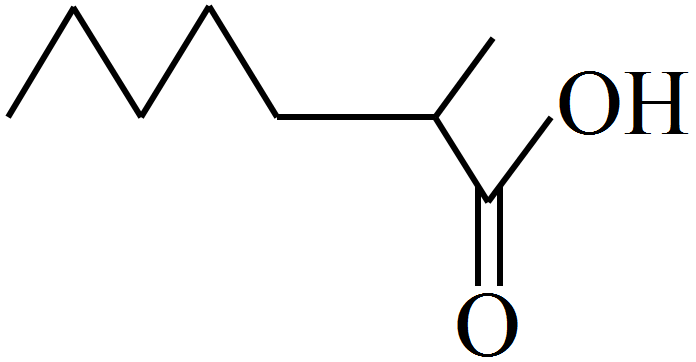
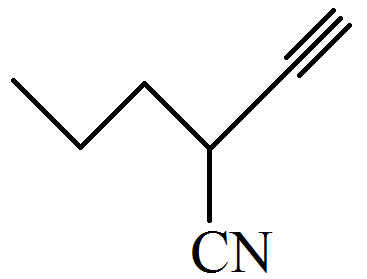
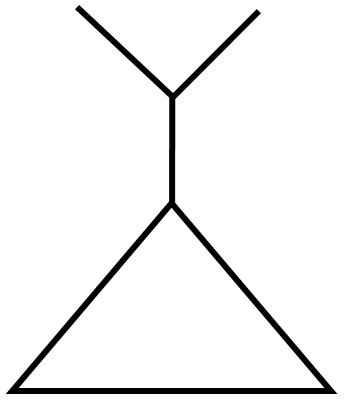
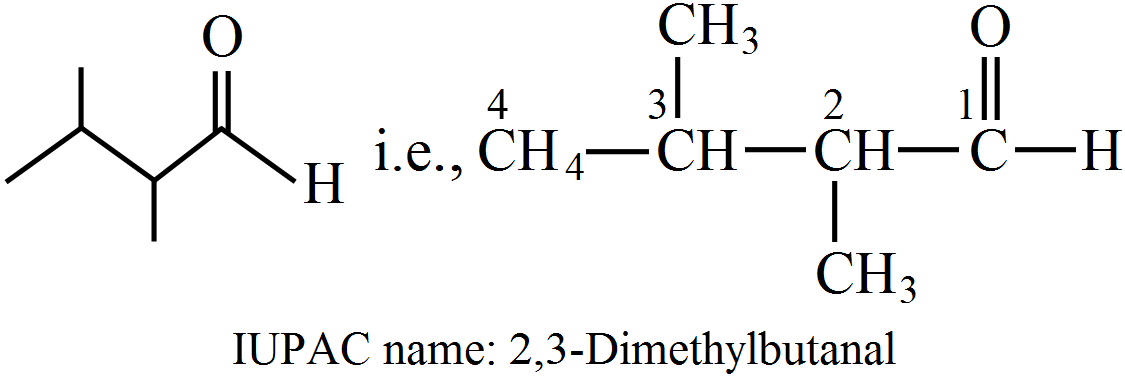
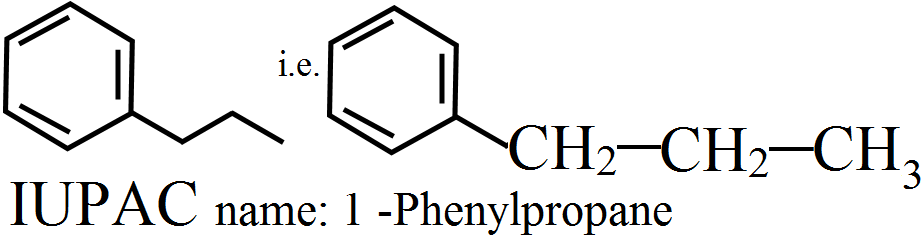
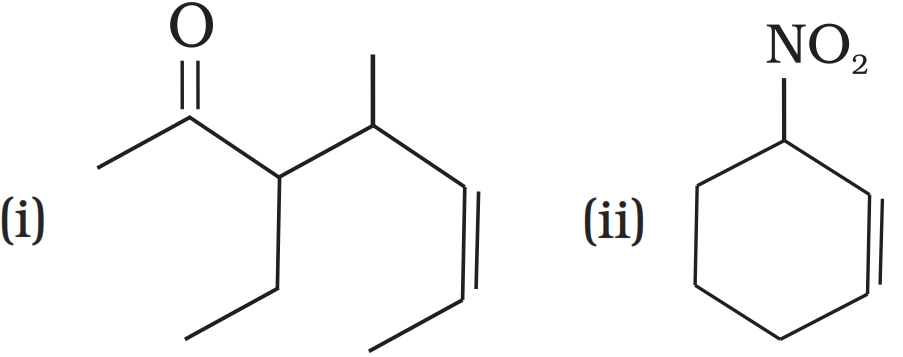
Name the compounds whose line formulae are given below:
Question 122 Marks
Write all the possible isomers of aromatic compound $\mathrm{C}_8 \mathrm{H}_{10}$.
View full question & answer→Question 132 Marks
Explain why the name butanol is not specific whereas the name butanone represents a specific compound?
AnswerButanol may have -OH group on the first or on the second carbon atom as
$\text{CH}_3\text{CH}_2\text{CH}_2\text{CH}_2\text{OH}\\ \\ \ \ \ \ \ \ \ \ \ \text{Butan-1o1}$
$\text{CH}_3\text{CH}_2\text{CHCH}_3 \ \ \ \ \\ \ \ \ \ \ \ \ \ \ \ \ \ \ \ \ \ |\\ \ \ \ \ \ \ \ \ \ \ \ \ \ \ \text{OH}\\ \\ \ \ \ \text{Butan-2-o1}$
Therefore, butanol does not represent a specific compound. Whereas, butanone cannot have a carbonyl group at any other position.
$ \ \ \ \ \ \ \ \ \text{O}\\ \ \ \ \ \ \ \ \ ||\\\text{CH}_3\text{C}\text{CH}_2\text{CH}_3$
Therefore, it represents a specific compound.
View full question & answer→Question 142 Marks
Give IUPAC name of the following:
-
$\ \ \ \ \ \ \ \ \ \ \ \ \stackrel{8\ \ \ \ }{\text{CH}_2}-\stackrel{9\ \ \ \ }{\text{CH}_3}\ \ \ \ \ \ \ \ \ \ \ \ \ \text{CH}_3\ \ \ \text{CH}_2-\text{CH}_3\\\ \ \ \ \ \ \ \ \ \ \ \ \ \ |\ \ \ \ \ \ \ \ \ \ \ \ \ \ \ \ \ \ \ \ \ \ \ \ \ \ \ \ \ \ \ \ \ \ |\ \ \ \ \ \ \ \ \ | \\\text{CH}_3-\text{CH}-\text{CH}_2-\text{CH}_2-\text{CH}-\text{CH}-\text{CH}_2-\text{CH}_3\\\ \ \ \ \ \ \ \ \ \ \ \ \ \ ^{7\ \ \ \ \ \ \ \ \ \ \ \ \ 6\ \ \ \ \ \ \ \ \ \ \ \ \ \ \ 5\ \ \ \ \ \ \ \ \ \ \ \ \ \ \ 4\ \ \ \ \ \ \ \ \ \ \ \ \ \ \ 3\ \ \ \ \ \ \ \ \ \ \ \ \ \ \ 2\ \ \ \ \ \ \ \ \ \ \ \ \ \ 1}$
-
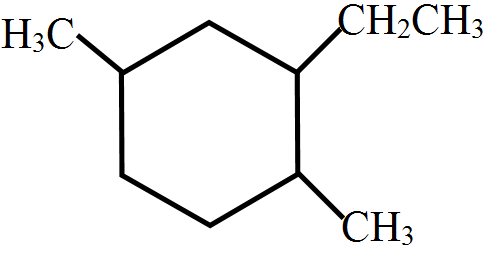
Answer
- 3-Ethyl-4,7-dimethyl nonane.
- 1-Ethyl-2,5-dimethyl cyclohexane.
View full question & answer→Question 152 Marks
Answer
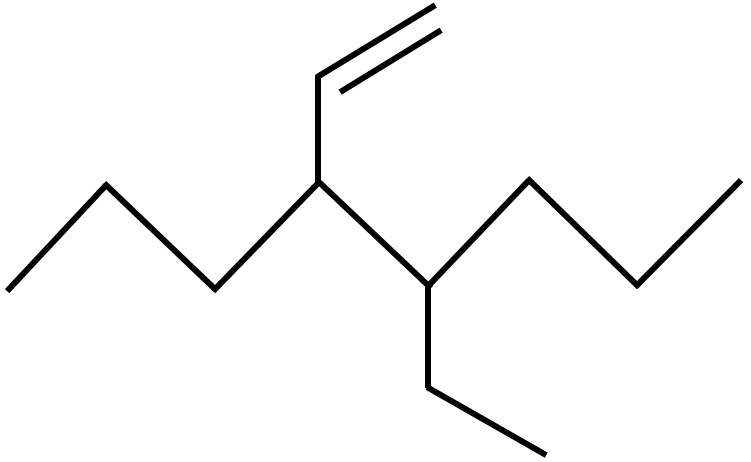
- 4-ethyl-3-propylhept-1-ene.
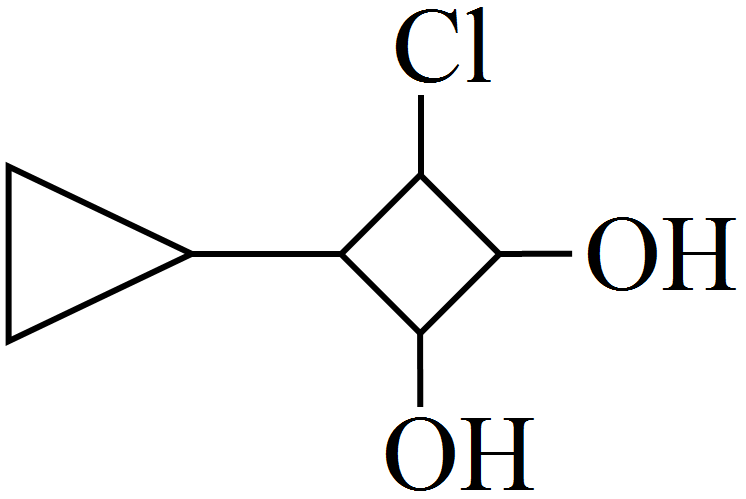
- 3-chloro-4-cyclopropyl-1,2 cyclobutandiol.
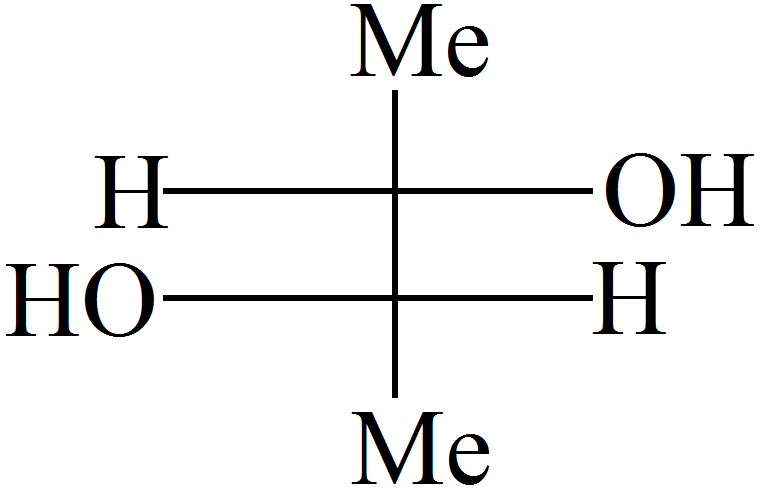
- Butan-2, 3-diol.
View full question & answer→Question 162 Marks
Arrange the following in increasing order of base strength:
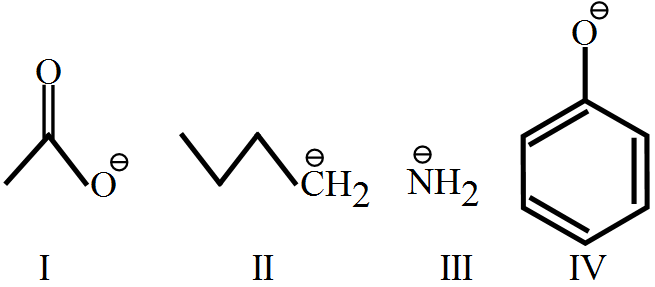
AnswerIII > II > IV > I is increasing order of base strength because
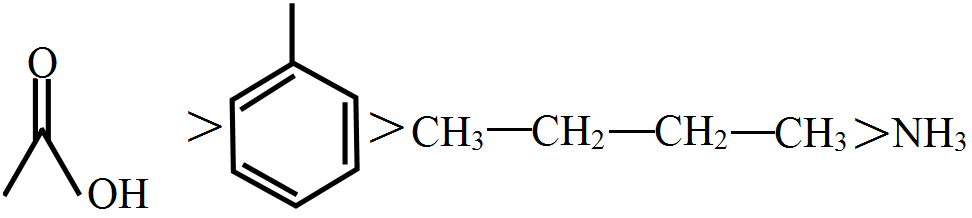
is order of acidic character. Greater the acidic strength, weaker will be conjugate base and vice-versa.
View full question & answer→Question 172 Marks
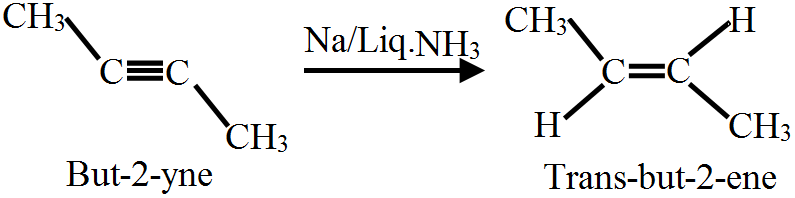
Name the reagent used to reduce alkynes to trans alkenes.
Answer$\mathrm{Na} / \mathrm{liq} \mathrm{~NH}_3$. It is called birch reduction.
View full question & answer→Question 182 Marks
Write structural formulae for compounds named as:
- 1-bromoheptane.
- 5-bromoheptanoic acid.
Answer
- $\stackrel{{7} \ \ \ \ }{\hbox{CH}_3}-\stackrel{{6} \ \ \ \ }{\hbox{CH}_2}-\stackrel{{5} \ \ \ \ }{\hbox{CH}_2}-\stackrel{{4} \ \ \ \ }{\hbox{CH}_2}-\stackrel{{3} \ \ \ \ }{\hbox{CH}_2}-\stackrel{{2} \ \ \ \ }{\hbox{CH}_2}-\stackrel{{1} \ \ \ \ }{\hbox{CH}_2}-\text{Br}\\ \ \ \ \ \ \ \ \ \ \ \ \ \ \ \ \ \ \ \ \ \ \ \ \ \ \ _{1-\text{bromoheptane}}$
- $\stackrel{{7} \ \ \ \ }{\hbox{CH}_3}-\stackrel{{6} \ \ \ \ }{\hbox{CH}_2}-\stackrel{{5} \ \ \ \ }{\hbox{CH}_2}-\stackrel{{4} \ \ \ \ }{\hbox{CH}_2}-\stackrel{{3} \ \ \ \ }{\hbox{CH}_2}-\stackrel{{2} \ \ \ \ }{\hbox{CH}_2}-\stackrel{{1} }{\hbox{C}}-\text{O}-\text{H}\\ \ \ \ \ \ \ \ \ \ \ \ \ \ \ \ \ \ \ \ \ \ \ \ \ \ \ \ | \ \ \ \ \ \ \ \ \ \ \ \ \ \ \ \ \ \ \ \ \ \ \ \ \ \ \ \ \ \ \ \ \ \ \ \ \ \ \ \ \ \ \ \ \ \ \ \ \ \ \|\\ \ \ \ \ \ \ \ \ \ \ \ \ \ \ \ \ \ \ \ \ \ \ \ \ \ \ \text{Br}\ \ \ \ \ \ \ \ \ \ \ \ \ \ \ \ \ \ \ \ \ \ \ \ \ \ \ \ \ \ \ \ \ \ \ \ \ \ \ \ \ \ \ \ \ \ \ \text{O}\\ \ \ \ \ \ \ \ \ \ \ \ \ \ \ \ \ \ \ \ \ \ \ \ \ \ \ _{5-\text{bromoheptanoic acid}}$
View full question & answer→Question 192 Marks
Classify each of the following carbon intermediates:
- $(\text{CH}_3)\text{C}^\bullet$
- $\text{CH}_3-\stackrel{{\ominus}}{\hbox{C}}\text{H}-\text{CH}_3$
- $\text{CH}_2=\text{CH}-\stackrel{{\ominus}}{\hbox{C}}\text{H}_2$
- $:\text{CCl}_2$
Answer
- Free radical.
- Carbanion.
- Carbocation.
- Carbene.
View full question & answer→Question 202 Marks
Write the product of the following reactions:
-
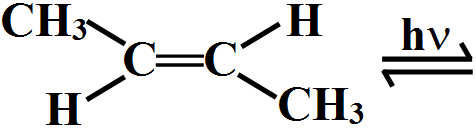
- $\text{CH}_3-\text{CH}_2-\text{CH}_2-\text{CH}_3\xrightarrow[{\Delta}]{\text{AlCl}_3}$
Answer
-
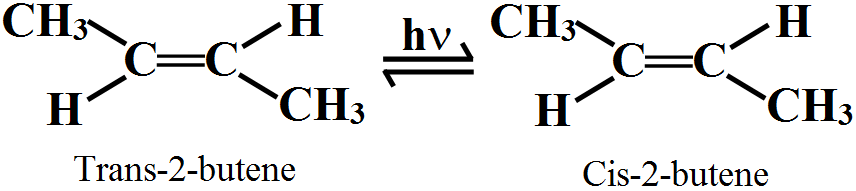
- $\text{CH}_3-\text{CH}_2-\text{CH}_2-\text{CH}_3\xrightarrow[{\Delta}]{\text{AlCl}_3}\text{CH}_3-\text{CH}-\text{CH}_3\\\ \ \ \ \ \ \ \ \ \ \ \ \ \ \ \ \ \ \ \ \ \ \ \ \ \ \ \ \ \ \ \ \ \ \ \ \ \ \ \ \ \ \ \ \ \ \ \ \ \ \ \ \ \ \ \ \ \ \ \ \ \ \ \ \ \ \ \ \ \ |\\\ \ \ \ \ \ \ \ \ \ \ \ \ \ \ \ \ \ \ \ \ \ \ \ \ \ \ \ \ \ \ \ \ \ \ \ \ \ \ \ \ \ \ \ \ \ \ \ \ \ \ \ \ \ \ \ \ \ \ \ \ \ \ \ \ \ \ \ \ \text{CH}_3$
View full question & answer→Question 212 Marks
- Which of the following species act as nucleophiles?

- Identify the nucleophilic centre in $\mathrm{CH}_3 \mathrm{Br}$.
Answer
-
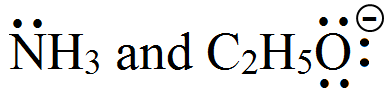
act as nucleophilic due to presence of lone pair and negative charge.
-
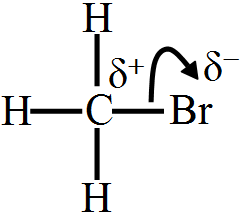
'C' is positively charged therefore, it is electrophilic centre, Br is negatively charged,
$\therefore$ it is nucleophilic centre. View full question & answer→Question 222 Marks
Resonance structures of propenal are given below. Which of these resonating structures is more stable? Give reason for your answer.
$\ \ \ \ \ \ \ \ \ \ \ \ \ \ \ \ \ \ \ \ \ \ \ \ \ \ \ \ \ \ \ \ \ \ \ \ \ \ \ \ \ \ \ \ _{\oplus}\ \ \ \ \ \ \ \ \ \ \ \ \ \ \ \ \ \ \ \ \ \ \ _{\ominus}\\\text{CH}_2-\text{CH}-\text{CH}=\text{O}\leftrightarrow\text{CH}_2-\text{CH}=\text{CH}-\text{O}\\\ \ \ \ \ \ \ \ \ \ \ \ \ \ \ \ \ \text{I}\ \ \ \ \ \ \ \ \ \ \ \ \ \ \ \ \ \ \ \ \ \ \ \ \ \ \ \ \ \ \ \ \ \ \ \ \ \ \ \ \ \ \text{II}$
AnswerStructure I of propenal is more stable because structure having more covalent bonds in a resonating structure, has more stability, hi structure II, the terminal carbon has only six electrons which makes it less stable.
$\mathrm{CH}_2=\mathrm{CH}-\mathrm{CH}=0$ (Structure I) $\mathrm{CH}_2-\mathrm{CH}=\mathrm{CH}-\mathrm{O}$ (Structure II)
View full question & answer→Question 232 Marks
Show the polarisation of carbon-magnesium bond in the following structure.
$\text{CH}_3-\text{CH}_2-\text{CH}_2-\text{CH}_2-\text{Mg}-\text{X}$
AnswerCarbon is more electronegative then magnesium therefore, Mg has partially positive change and C has partially negative chang because bonded pair of electrons attracted towards carbon.
$\ \ \ \ \ \ \ \ \ \ \ \ \ \ \ \ \ \ \ \ \ \ \ \ \ \ \ \ \delta-\ \ \ \ \ \ \ \ \ \ \ \ \ \ \ \ \ \ \ \delta+\\\text{CH}_3-\text{CH}_2-\text{CH}_2-\text{CH}_2<-\text{Mg}-\text{X}$
View full question & answer→Question 242 Marks
View full question & answer→Question 252 Marks
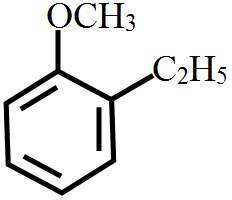
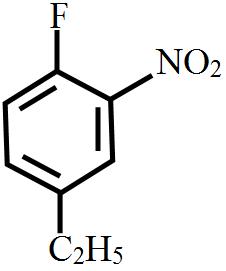
Write the structural formula of:
- o-Ethyl anisole.
- 4-Ethyl-1-fluoro-2-nitro benzene.
Question 262 Marks
Benzylic free radical is more stable than allylic free radical. Explain with resonance.
Answer
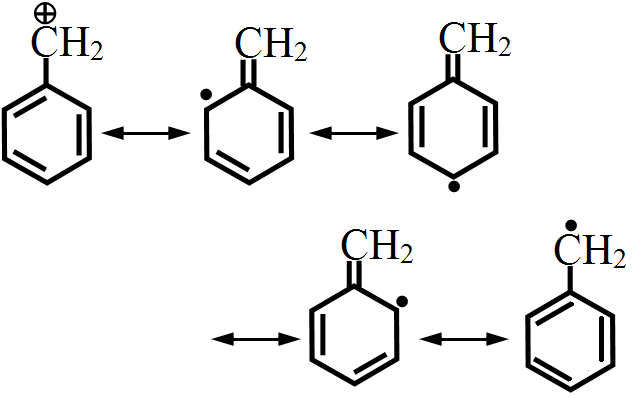
It has five resonating structures therefore, more stable.
$\text{CH}_2=\stackrel{\bf.\ \ \ \ }{\text{CH}}-\text{CH}_2\leftrightarrow\stackrel{\bf.}{\text{CH}_2}-\text{CH}=\text{CH}_2$
It has two resonating structures therefore, less stable. View full question & answer→Question 272 Marks
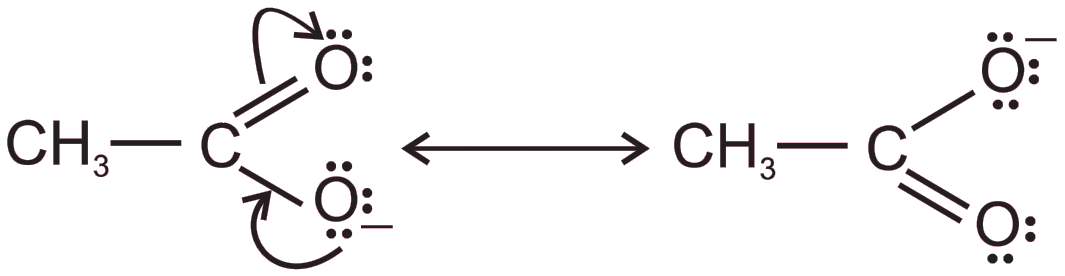
Which of the two structures (A) and (B) given below is more stabilised by resonance? Explain. $\ \ \ \ \ \ \ \ \ \ \ \ \ \ \ \ \ \ \ \ \ \ \ \ \ \ \ \ \ \ \ \ \ \ \ \ \ \ \ \ \ \ \ \ _{\ominus}\\\text{CH}_3\text{COOH}\ \ \text{and}\ \ \text{CH}_3\text{COO}\\\ \ \ \ \ \ \ \ \ \ \text{(A)}\ \ \ \ \ \ \ \ \ \ \ \ \ \ \ \ \ \ \ \ \text{(B)}$
Answer
(B) is more stable because it does not involve change separation.
-
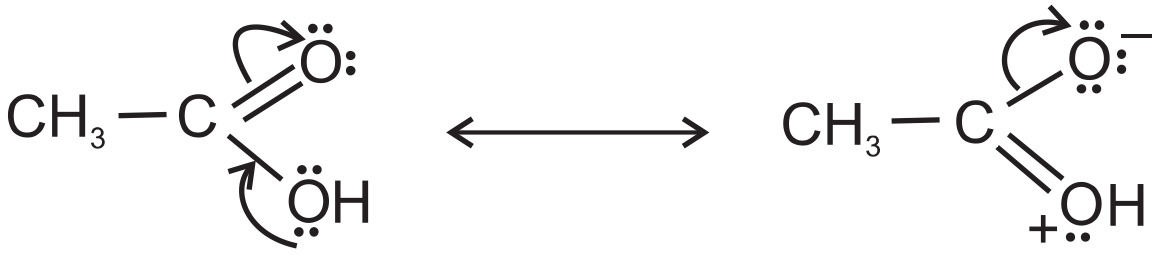
-
View full question & answer→Question 282 Marks
Draw the possible resonance structures for
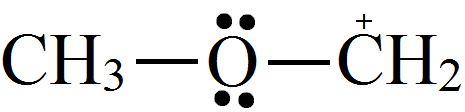
and predict which of the structures is more stable.Give reason for your answer.
AnswerThe given carbocation has two resonance structures. Structure (II) is more stable because both the carbon atoms and the oxygen atom have an octet of electrons.
View full question & answer→Question 292 Marks
“Stability of carbocations depends upon the electron releasing inductive effect of groups adjacent to positively charged carbon atom involvement of neighbouring groups in hyperconjugation and resonance.”
Draw the possible resonance structures for
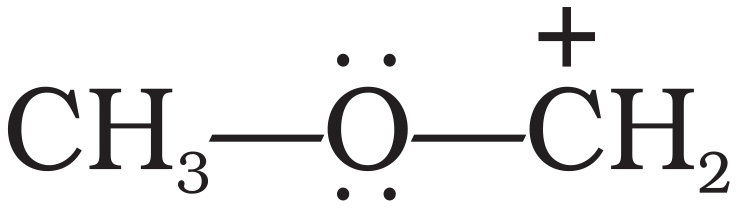
and predict which of the structures is more stable. Give reason for your answer.
Question 302 Marks
How does (i) an electron withdrawing group (EWG) and (ii) an electron donating group (EDG) influence the acid strength of carboxylic end?
AnswerThe influence of the inductive effect on acidity is best understood in terms of the conjugate base, $\text{RCOO}^-$ and can be summarised as follows.

- EWG stabilises $\text{RCOO}^-$.
- EDG destabilises $\text{RCOO}^-$ and hence weakens the acid.
View full question & answer→Question 312 Marks
Give the IUPAC nomenclature of the following compounds.
-
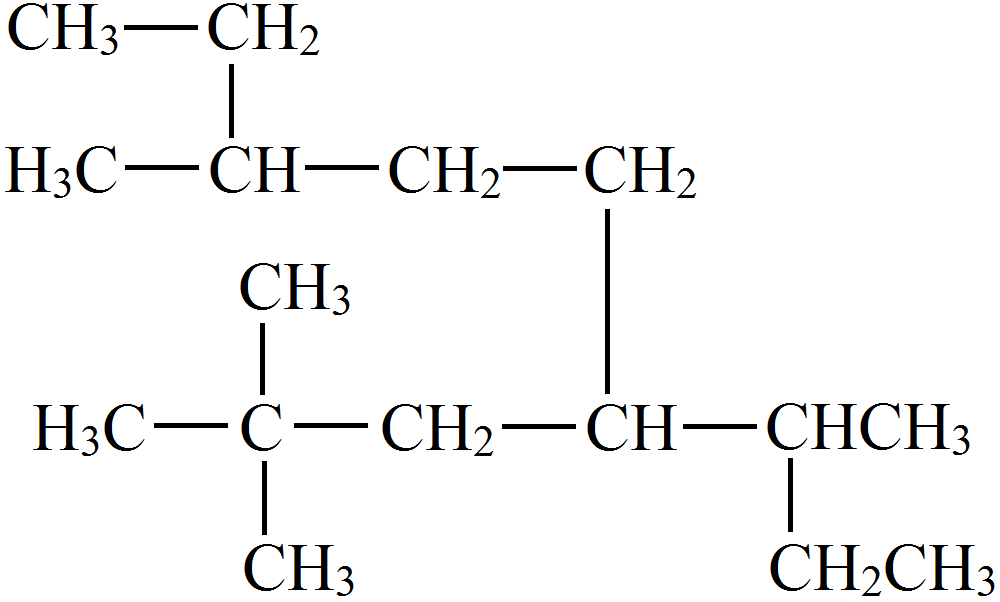
-

- $ \ \ \ \ \ \ \ \ \ \ \ \ \ \ \ \ \ \ \ \ \ \ \ \ \ \text{C}_2\text{H}_5 \ \ \text{CH}_3\\ \ \ \ \ \ \ \ \ \ \ \ \ \ \ \ \ \ \ \ \ \ \ \ \ \ \ |\ \ \ \ \ \ \ \ \ \ |\\\text{CH}_3-\text{CH}_2-\text{CH}-\text{CH}-\text{CH}_2-\text{CH}_3$
Question 322 Marks
Two liquids (A) and (B) can be separated by the method of fractional distillation. The boiling point of liquid (A) is less than boiling point of liquid (B). Which of the liquids do you expect to come out first in the distillate? Explain.
AnswerThe liquid (A) is expected to come out first in the distillate. On boiling the vapours of lower boiling component are formed first. The vapours are condensed to get the liquid in a receiver.
View full question & answer→Question 332 Marks
Draw structure of 3-isopropyl-2-methyl hexane.
Answer$\ \ \ \ \ \ \ \ \ \ \ \ \text{CH}_3\\ \ \ \ \ \ \ \ \ \ \ \ \ \ |\\\text{CH}_3-\text{CH}-\text{CH}-\text{CH}_2-\text{CH}_3\\ \ \ \ \ \ \ \ \ \ \ \ \ \ |\\\text{CH}_3-\text{CH}-\text{CH}_3$
View full question & answer→Question 342 Marks
What is meant by delocalization.
AnswerDelocalisation: Delocalisation means that pairs of bonding electrons extend over three or more atoms and belong to the whole molecule. Delocalised orbital are much larger than the localised it orbital and are therefore more stable.
View full question & answer→Question 352 Marks
Identify the most stable species in the following set of ions giving reasons:
$+\ \ \ \ \ \ +\ \ \ \ \ \ \ \ \ \ +\ \ \ \ \ \ \ \ \ \ \ +\\\text{CH}_3,\ \text{CH}_2\text{Br},\ \text{CH}\ \text{Br}_2,\ \text{C}\ \text{Br}_3$
Answer$+\\\text{CH}_3$ is the most stable. the replacement of H by increases positive charge on carbon atom because Br is more electeonegative then H and consequently the species becomes less stable.
View full question & answer→Question 362 Marks
Write the state of hybridisation of central carbon atom in the following compounds and shapes of each of the molecules.
- $ \ \ \ \ \ \ \ \ \ \ \ \ \ \text{O}\\ \ \ \ \ \ \ \ \ \ \ \ \ \ ||\\\text{CH}_3-\text{C}-\text{CH}_3$
- $(\text{CH}_3)_3\text{CCl}$
- $\text{HC}\equiv\text{N}$
Answer
- $\text{sp}^2$ hybridised, trigonal planar

- $\text{sp}^3$ hybridised, tetrahedral b

- sp hybridised, linear
$\text{H}-\text{C}\equiv\text{N}$ View full question & answer→Question 372 Marks
The following organic compounds are popularly known by their common names:
- Neo-Pentane.
- Acetone.
- Vinyl-Chloride.
- Tert-Amyl alcohol.
- Iso-Butyl bromide.
- Allyl alcohol.
- Formaldehyde.
- Glycerol.
Write the structral formulas and IUPAC names.
Answer
- $ \ \ \ \ \ \ \ \ \ \ \ \ \ \text{CH}_3\\ \ \ \ \ \ \ \ \ \ \ \ \ \ \ |\\\stackrel{{ \ \ \ \ \ \ \ 3} }{\text{H}_3\hbox{C}}-\stackrel{{2} }{\hbox{C}}-\stackrel{{1} \ \ \ \ \ \ }{\hbox{CH}_3}\\ \ \ \ \ \ \ \ \ \ \ \ \ \ \ |\\ \ \ \ \ \ \ \ \ \ \ \ \ \ \text{CH}_3\\ \ \ \ \ _{2,2-\text{Dimethylpropane}}$
- $ \ \ \ \ \ \ \ \ \ \ \ \ \ \text{O}\\ \ \ \ \ \ \ \ \ \ \ \ \ \ \|\\\stackrel{{3} \ \ \ \ }{\hbox{CH}_3}-\stackrel{{2} }{\hbox{C}}-\text{CH}_3\\ \ \ \ \ _{\text{Propan-2-one}}$
- $ \ \ \ \ \ \ \ \ \text{H}\ \ \ \ \ \text{Cl}\\ \ \ \ \ \ \ \ \ \ |\ \ \ \ \ \ \ |\\\text{H}-\text{C}=\text{C}-\text{H}\\\stackrel{\ \ \ \ \ \ \ 2 \ \ \ \ \ \ \ \ 1 }{\hbox{Chloroethene}}$
- $ \ \ \ \ \ \ \ \ \ \ \ \ \ \ \ \ \ \ \ \ \ \ \ \ \ \ \text{CH}_3\\ \ \ \ \ \ \ \ \ \ \ \ \ \ \ \ \ \ \ \ \ \ \ \ \ \ \ \ |\\\stackrel{{4} \ \ \ \ \ \ }{\hbox{CH}_3}-\stackrel{{3} \ \ \ \ \ \ }{\hbox{CH}_2}-\stackrel{{2} }{\hbox{C}}-\stackrel{{1} \ \ \ \ \ }{\hbox{CH}_3}\\ \ \ \ \ \ \ \ \ \ \ \ \ \ \ \ \ \ \ \ \ \ \ \ \ \ \ \ |\\ \ \ \ \ \ \ \ \ \ \ \ \ \ \ \ \ \ \ \ \ \ \ \ \ \ \ \text{OH}\\ \ \ \ \ \ \ \ \ \ \ \ _{2-\text{Methylbutan-2-ol}}$
- $\text{Br}-\stackrel{{1} \ \ \ \ \ }{\hbox{CH}_2}-\stackrel{{2} \ \ \ \ }{\hbox{CH}}-\text{CH}_3\\ \ \ \ \ \ \ \ \ \ \ \ \ \ \ \ \ \ \ \ \ \ \ |\\ \ \ \ \ \ \ \ \ \ \ \ \ \ \ \ \ \ \ \ \ \ \text{CH}_3\\_{1-\text{Bromo-2-methylpropane}}$
- $$$\stackrel{{ \ \ \ \ \ \ \ 3} }{\text{H}_2\hbox{C}}=\stackrel{{2 \ \ \ } }{\hbox{CH}}\stackrel{{1} \ \ \ \ \ }{\hbox{CH}_2}\text{OH}\\ \ \ \ \ \ _{\text{Prop-2-en-1-ol}}$
- $ \ \ \ \ \ \ \ \ \text{O}\\ \ \ \ \ \ \ \ \ \|\\\text{H}-\text{C}-\text{H}\\ \ \ \ _{\text{Methanal}}$
- $\text{CH}_2-\text{CH}-\text{CH}_2\\ \ | \ \ \ \ \ \ \ \ \ \ \ | \ \ \ \ \ \ \ \ \ \ |\\ \text{OH} \ \ \ \ \ \ \text{OH} \ \ \ \ \ \text{OH}\\ \ \ \ _{\text{Propane-1,2,3-trial}}$
View full question & answer→Question 382 Marks
What are reactive intermediates? How are they generated by bond fission?
Answer
The reactive intermediates are those chemical species which are produced during the course of the reaction. There are many reactive intermediate, three of which are carbocation, carbanion and the free radical.
Carbocation and carbanion are generated by the heterolytic bond fission while free radicals are generated by homolytic bond fission.

View full question & answer→Question 392 Marks
Suggest methods for the separation of the following mixtures:
- A mixture of liquid A (bp 365K) and liquid B (bp 355K).
- A mixture of liquid C (bp 348K) and liquid D (bp 478K).
Answer
- Fractional distillation because the boiling points of the two liquids differ by only 10°.
- Simple distillation because the boiling points of the two liquids differ much.
View full question & answer→Question 402 Marks
Draw all polygon formula for the molecular formula $\text{C}_5\text{H}_{10}$.
AnswerThe different polygon formula of the compound having molecular formula $\text{C}_5\text{H}_{10}$ are :

View full question & answer→Question 412 Marks
By mistake, an alcohol (boiling point 97°C) was mixed with a hydrocarbon (boiling point 68°C). Suggest a suitable method to separate the two compounds. Explain the reason for your choice.
AnswerSimple distillation can be used because the two compounds have a difference of more than 20° in their boiling points and therefore, both the liquids can be distilled without any decomposition.
View full question & answer→Question 422 Marks
Why does $\text{SO}_3$ act as an electrophile?
AnswerThree highly electronegative oxygen atoms are attached to sulphur atom. This makes sulphur atom electron deficient. Due to resonance, sulphur also acquires positive charge. Both these factors make $\text{SO}_3$ an electrophile.

View full question & answer→Question 432 Marks
Compounds with same molecular formula but differing in their structures are said to be structural isomers. What type of structural isomerism is shown by.

AnswerThese are position isomers as the function hroup are attached todifferent carbon atom in carbon. they are not metamre because the number of C atom on either side of -S–are same: $\text{CH}_3-\text{S}-\text{CH}_2-\text{CH}_2-\text{CH}_3$ Methyl n-propyl thioether. 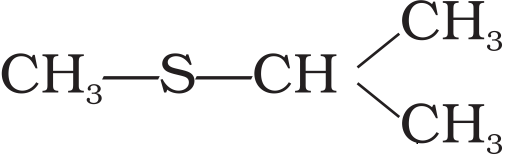 Methyl isopropyl thioether.
 View full question & answer→Question 442 Marks
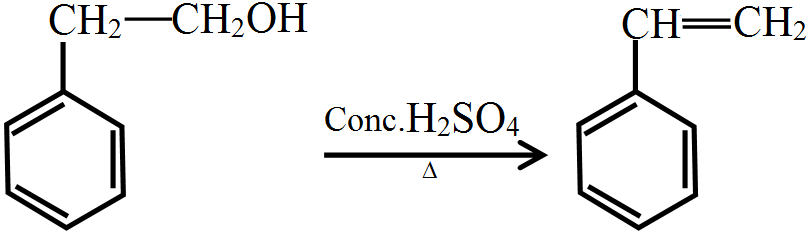
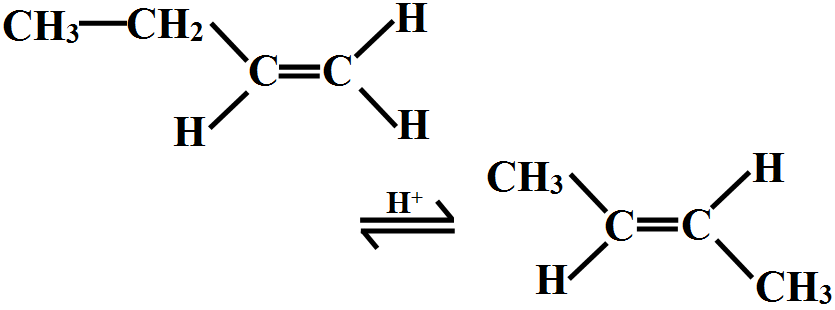
Classify the reaction type as elimination, rearrangement, addition and substitution.
-
-
- $\text{CH}_3-\text{CH(Br)}-\text{CH}(\text{CH}_3)_2\xrightarrow{\text{aq. KOH}}$
$\ \ \ \ \ \ \ \ \ \ \ \ \ \ \ \ \ \ \ \ \ \ \ \text{OH}\\\ \ \ \ \ \ \ \ \ \ \ \ \ \ \ \ \ \ \ \ \ \ \ \ \ \ |\\\text{CH}_3-\text{CH}_2-\text{C}-\text{CH}_3\\\ \ \ \ \ \ \ \ \ \ \ \ \ \ \ \ \ \ \ \ \ \ \ \ \ \ |\\\ \ \ \ \ \ \ \ \ \ \ \ \ \ \ \ \ \ \ \ \ \ \ \text{CH}_3$Answer
- Elimination (Dehydration).
- Rearrangement addition (More alkyl substituted alkenes are more stable).
- Rearrangement substitution (3° carbocation is more stable).
View full question & answer→Question 452 Marks
- Indicate the number of $\sigma$ and $\pi$ bonds in $\mathrm{HCONHCH}_3$.
- Out of benzene, m-dinitrobenzeme and toluene which will undergo nitration most easily and why?
Answer
- $\ \ \ \ \ \ \ \ \ \ \text{O}\ \ \ \ \ \text{H}\ \ \ \ \ \ \ \ \text{H}\\\ \ \ \ \ \ \ \ \ \sigma||\pi\ \ \ \sigma|\ \ \ \ \ \ \ \ |\sigma\\\text{H}-_\sigma\text{C}-_\sigma\text{N}-_\sigma\text{C}-_\sigma\text{H}\\\ \ \ \ \ \ \ \ \ \ \ \ \ \ \ \ \ \ \ \ \ \ \ \ \ \ \ \ \ \ |\\\ \ \ \ \ \ \ \ \ \ \ \ \ \ \ \ \ \ \ \ \ \ \ \ \ \ \ \ \ \text{H}$
Number of $\sigma-$bonds = 8,
Number of $\pi-$bonds = 1
- The order of ease of nitration is,
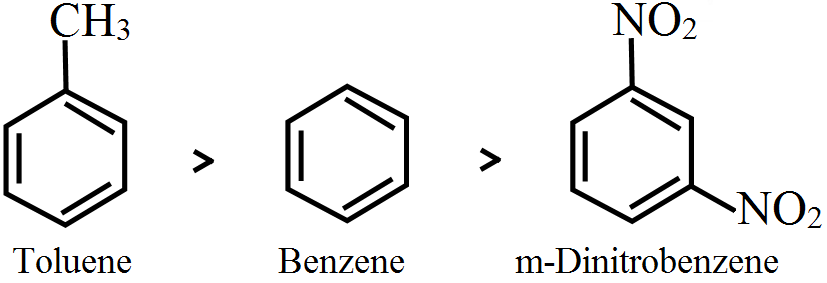
Nitration is an electrophilic substitution reaction. Since -$\mathrm{CH}_3$ group is electron releasing group, i.e. activating, it increases the electron density on the benzene ring thereby facilitating electrophilic substitution reaction. Nitro group on the other hand is electron withdrawing group, therefore, it is deactivating, i.e. decreases the reactivity towards electrophilic substitution reaction. View full question & answer→Question 462 Marks
A student was given the compound $\mathrm{C}_6 \mathrm{H}_4\left(\mathrm{NH}_2\right) \mathrm{SO}_3 \mathrm{H}$ for elemental analysis, while performing Lassaigne's test for 'N' what colour will he get and why?
AnswerBlood red colouration, he will get because compound contains both N and S.
$\text{Na}+\text{S}+\text{C}+\text{N}\xrightarrow{\ \ \ \ \ \ \ \ \ \ }\text{NaSCN}$
$\text{Fe}+\text{3NaSCN}\xrightarrow{\ \ \ \ \ \ \ \ \ \ }\text{Fe}(\text{SCN})_3+3\text{Na}^+\\ \ \ \ \ \ \ \ \ \ \ \ \ \ \ \ \ \ \ \ \ \ \ \ \ \ \ \ \ \ \ \ \ \ \ \text{Blood red colour}$
View full question & answer→Question 472 Marks
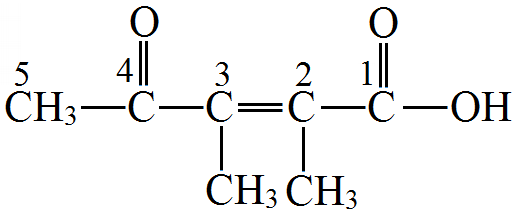
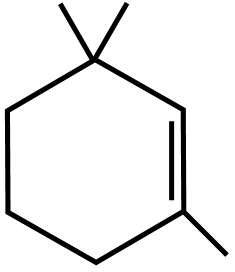
Write IUPAC names of the following:
-
- .
Answer
- 2, 3-dimethyl-4-oxo pent-2-en-oic acid.
- 1, 3, 3-trimethyl cyclohex-1-ene.
View full question & answer→Question 482 Marks
Identify the most stable species in the following set of ions giving reasons:
$_\ominus\ \ \ \ \ \ \ \ _\ominus\ \ \ \ \ \ \ \ \ \ \ \ _\ominus\ \ \ \ \ \ \ \ \ \ \ \ _\ominus\\\text{CH}_3,\ \text{CH}_2\text{Cl},\ \text{CHCl}_2,\ \text{CCl}_3$
Answer$-\\\text{CCl}_3$ is the most stable because Cl is more elecrtonegative then hydrogen. on replacing hydrogen by chlorine, negative on C is reduced and the species becomes stable.
View full question & answer→Question 492 Marks
Resonance structures of propenal are given below. Which of these resonating structures is more stable? Give reason for your answer.
$\text{CH}_2=\text{CH}-\text{CH}=\text{O}\leftrightarrow\stackrel{\oplus \ \ \ \ \ \ }{\text{CH}_2}-\text{CH}=\text{CH}-\stackrel{\ominus}{\text{O}}\\ \ \ \ \ \ \ \ \ \ \ \ \ \ \ \ \ \ \ \ \text{I}\ \ \ \ \ \ \ \ \ \ \ \ \ \ \ \ \ \ \ \ \ \ \ \ \ \ \ \ \ \ \ \ \ \ \ \text{II}$
AnswerThe structure having more covalent bonds in a resonating structure, has more stability. Further, there is charge separation in structure (II) and the terminal carbon has only a sextet of electrons in (II). These two factors makes structure (II) less stable.
$\text{CH}_2=\text{CH}-\text{CH}=\text{O}\leftrightarrow\stackrel{\oplus \ \ \ \ \ \ }{\text{CH}_2}-\text{CH}=\text{CH}-\stackrel{\ominus}{\text{O}}\\ \ \ \ \ \ \ \ \ \ \ \ \ \ \ \ \ \ \ \ \text{I}\ \ \ \ \ \ \ \ \ \ \ \ \ \ \ \ \ \ \ \ \ \ \ \ \ \ \ \ \ \ \ \ \ \ \ \text{II}$
Hence, I > II in terms of stability.
View full question & answer→Question 502 Marks
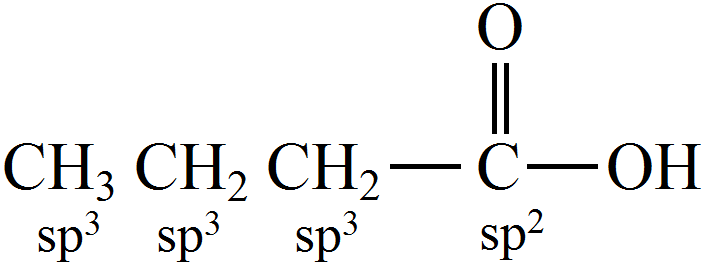
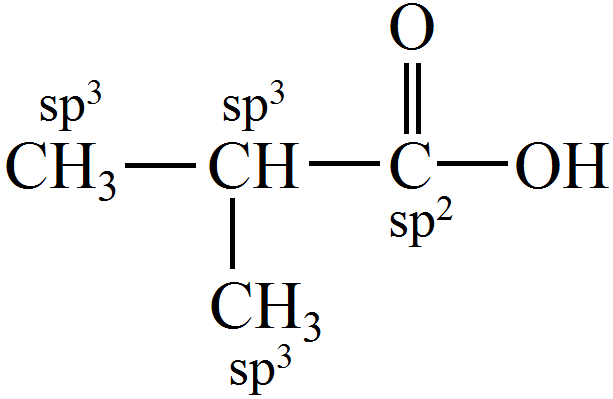
What are the possible structures for a carboxylic acid with a molecular formula $\mathrm{C}_4 \mathrm{H}_8 \mathrm{O}_2$ and label each C atom as $\mathrm{sp}, \mathrm{sp}^2$ and $\mathrm{sp}^3$ ?
AnswerThe possible structures for a carboxylic acid with molecular formula $\mathrm{C}_4 \mathrm{H}_8 \mathrm{O}_2$ are
-
-
View full question & answer→Question 512 Marks
0.35g of an organic compound was Kjeldahlised. The ammonia evolved on distilling the Kjeldahlised extract with 100ml of $\frac{\text{M}}{10\text{ H}_2\text{SO}_4}$ The residual acid required 154ml of $\frac{\text{M}}{10\text{ NaOH}}$ for complete neutralization. Calculate the percentage of nitrogen in organic compound.
Answer$2\text{M}_1\text{V}_1=\text{M}_2\text{V}_2\$\text{H}_2\text{SO}_4)\ \ \ (\text{NaOH})$
[$\because$ $\mathrm{H}_2 \mathrm{SO}_4$ is dibasic acid]
$2\times\frac{1}{10}\times\text{V}_1=\frac{1}{10}\times154$
$\text{V}_1=77\text{ml}$
Volume of neutralised with $\mathrm{NH}_3$
$=100-77=23\text{ml}$
$\%\text{ of N}=\frac{2.8\times\text{M}_\times\text{V}_1}{\text{W}}$
$=\frac{2.8}{0.35}\times\frac{1}{10}\times23=18.4\%$
View full question & answer→Question 522 Marks
An alkane has a molecular mass of 72. Draw all its possible chain isomers and write their IUPAC names.
AnswerFirst of all, we will derive the molecular formula.
Molecular formula of alkane is $\mathrm{C}_n \mathrm{H}_{2 n+2}$.
$\because$ Molecular mass $=72$
$\therefore 12 n+2 n+2=72$
$n=5$
The alkane is $\mathrm{C}_5 \mathrm{H}_{12}$. The possible chain isomers are,
- $\text{CH}_3-\text{CH}_2-\text{CH}_2-\text{CH}_2-\text{CH}_3\\ \ \ \ \ \ \ \ \ \ \ \ \ \ \ \ \ \ \ \ \ _{\text{Pentane}}$
- $\text{CH}_3-\text{CH}-\text{CH}_2-\text{CH}_3\\ \ \ \ \ \ \ \ \ \ \ \ \ \ |\\ \ \ \ \ \ \ \ \ \ \ \ \ \text{CH}_3\\ \ \ \ \ \ \ _{2-\text{methylbutane}}$
- $ \ \ \ \ \ \ \ \ \ \ \ \ \text{CH}_3\\ \ \ \ \ \ \ \ \ \ \ \ \ \ |\\\text{CH}_3-\text{C}-\text{CH}_3\\ \ \ \ \ \ \ \ \ \ \ \ \ \ |\\ \ \ \ \ \ \ \ \ \ \ \ \ \text{CH}_3\\\ \ \ _{2,2-\text{dimethyl propane}}$
View full question & answer→Question 532 Marks
Name the compounds whose line formulae are given below.
-
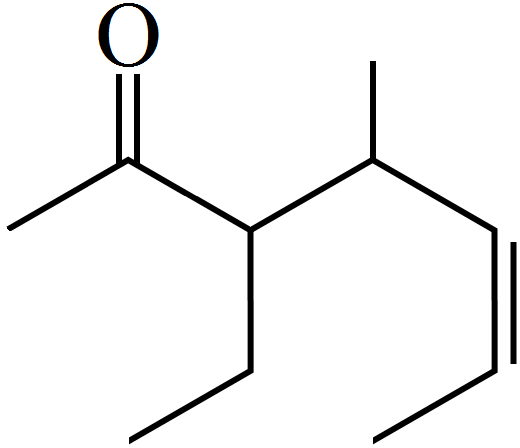
-
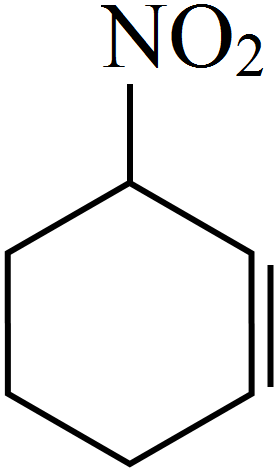
Answer
-
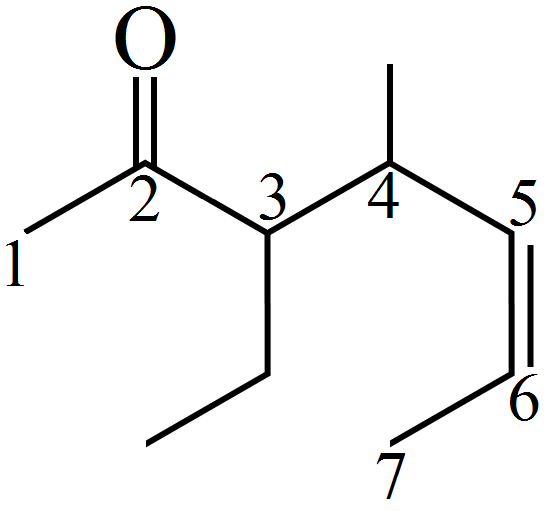
3-ethyl-4-methylhept-5-en-2-one (C-atoms of the longest possible chain are numbered in such a way that the functional group, > C = 0, gets the lowest possible locant)
-
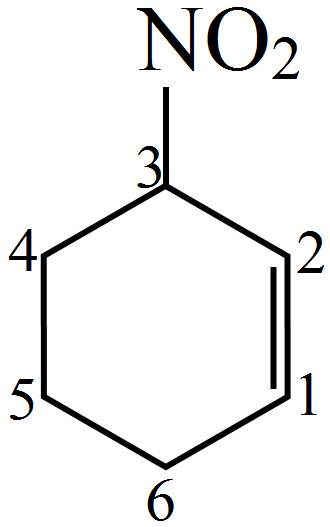
3-nitrocyclohex-1-ene (C-atoms of the ring are numbered in such a manner that double bond gets the lowest possible locant followed by the - $\text{NO}_2$ group) View full question & answer→Question 542 Marks
“Stability of carbocations depends upon the electron releasing inductive effect of groups adjacent to positively charged carbon atom involvement of neighbouring groups in hyperconjugation and resonance.”
Which of the following ions is more stable? Use resonance to explain your answer.
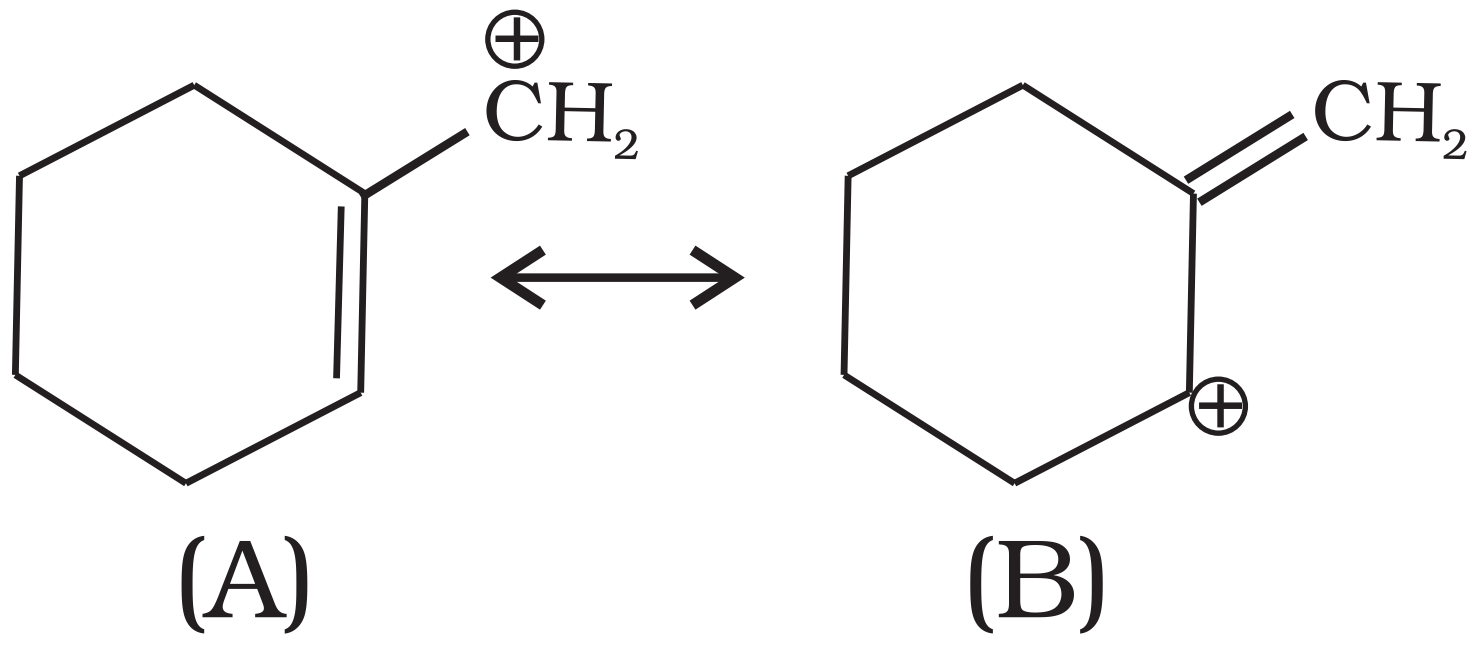
Answer
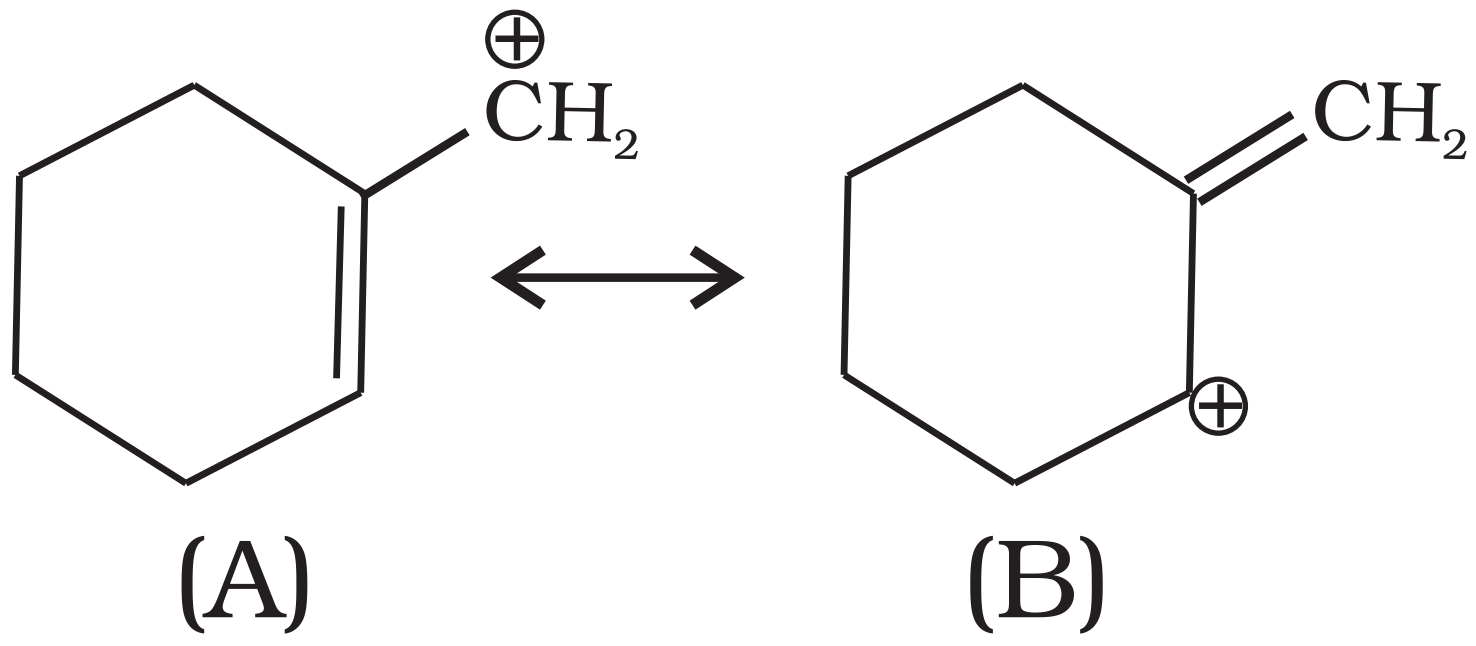
Structure A is more stable than B. Carbocation A is more Planar and electrons from the ring shift to side group $\text{CH}_2^+$and stabilized by resonance. Structure (B) is non-planar and does not undergo resonance. Double bond is more stable with in the ring as compared to side chain. View full question & answer→Question 552 Marks
Why is staggered conformation of ethane more stable than eclipsed conformation?
AnswerIt is because staggered conformation has no torsional strain. It has less repulsion between C-H bonds as these are far away,
$\therefore$ more stable.
View full question & answer→Question 562 Marks
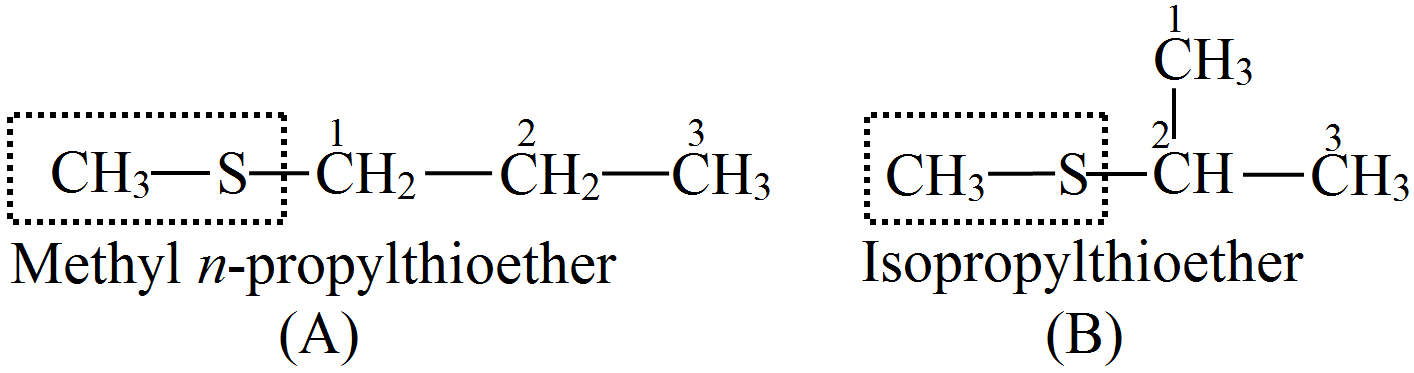
Compounds with same molecular formula but differing in their structures are said to be structural isomers. What type of structural isomerism is shown by $\mathrm{CH}_3-\mathrm{S}-\mathrm{CH}_2-\mathrm{CH}_2-\mathrm{CH}_3$ and
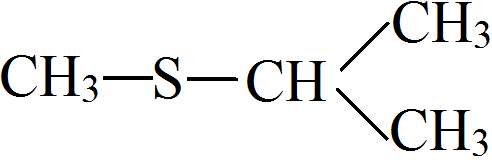
Answer
The two isomers which differ in the position of the functional group on the carbon skeleton are called position isomers and the phenomenon is known as position isomerism. Thus, A and B may be regarded as position isomers but they are not considered as metamers since metamers are those isomers which have different number of carbon atoms on either side of the functional group. But here, the number of carbon atoms on either side of sulphur atom (functional group) is the same, i.e. 1 and 3.
View full question & answer→Question 572 Marks
Draw structure of all isomeric ethers having molecular formula $\mathrm{C}_5 \mathrm{H}_{12} \mathrm{O}$.
AnswerSix different structural isomers of ethers can be drawn from molecular formula $\mathrm{C}_5 \mathrm{H}_{12} \mathrm{O}$.
- $\text{CH}_3-\text{CH}_2-\text{CH}_2-\text{CH}_2-\text{O}-\text{CH}_3$
- $\text{CH}_3-\text{CH}_2-\text{CH}-\text{CH}_3\\ \ \ \ \ \ \ \ \ \ \ \ \ \ \ \ \ \ \ \ \ \ \ \ \ \ \ |\\\ \ \ \ \ \ \ \ \ \ \ \ \ \ \ \ \ \ \ \ \ \ \ \ \ \text{OCH}_3$
- $\text{CH}_3-\text{CH}_2-\text{CH}_2-\text{OCH}_3\\ \ \ \ \ \ \ \ \ \ \ \ \ \ \ \ \ \ \ \ \ \ \ \ \ \ \ |\\ \ \ \ \ \ \ \ \ \ \ \ \ \ \ \ \ \ \ \ \ \ \ \ \ \ \text{CH}_3$
- $ \ \ \ \ \ \ \ \ \ \ \ \ \text{CH}_3\\ \ \ \ \ \ \ \ \ \ \ \ \ \ |\\\text{CH}_3-\text{C}-\text{CH}_3\\ \ \ \ \ \ \ \ \ \ \ \ \ \ |\\ \ \ \ \ \ \ \ \ \ \ \ \ \text{OCH}_3$
- $\text{CH}_3-\text{CH}_2-\text{CH}_2-\text{O}-\text{C}_2\text{H}_5$
- $\text{CH}_3-\text{CH}-\text{CH}_3\\ \ \ \ \ \ \ \ \ \ \ \ \ \ |\\ \ \ \ \ \ \ \ \ \ \ \ \ \text{OC}_2\text{H}_5$
View full question & answer→Question 582 Marks
What is the correct order of priority for following functional groups of organic compound in IUPAC nomenclature?
$\ \ \ \ \ \ \ \ \ \ \ \ \ \ \ \ \ \ \ \ \ \ \ \ \ \ \ \ \ \ \ \ \ \ \ \ \ \ \ \ \ \ \ \ \ \ \ \ {\text{ O}}\\ \ \ \ \ \ \ \ \ \ \ \ \ \ \ \ \ \ \ \ \ \ \ \ \ \ \ \ \ \ \ \ \ \ \ \ \ \ \ \ \ \ \ \ \ \ \ \ \ \ \|\\-\text{COOH}-,-\text{OH},-\text{CHO},-\text{C}-$
Answer$\ \ \ \ \ \ \ \ \ \ \ \ \ \ \ \ \ \ \ \text{O}\ \ \ \ \ \ \ \ \ \ \ \text{O}\ \ \ \ \ \ \ \ \ \ \ \ \ \ \ \ \text{O}\\\ \ \ \ \ \ \ \ \ \ \ \ \ \ \ \ \ \ \ \|\ \ \ \ \ \ \ \ \ \ \ \ \ \|\ \ \ \ \ \ \ \ \ \ \ \ \ \ \ \ \ \|\\-\text{OH}<-\text{C}-<-\text{C}-\text{H}<-\text{C}-\text{OH}$ is order of preference.
View full question & answer→Question 592 Marks
Give the common name of:
- Methanol olido.
- Ethanol.
- Ethoxyethane.
- Ethanoic acid.
- 1, 4-dimethyl benzene.
Answer
- Methyl alcohol.
- Ethyl alcohol.
- Diethyl ether.
- Acetic acid.
- P-xylene.
View full question & answer→Question 602 Marks
Arrange the following in decreasing order of stability:
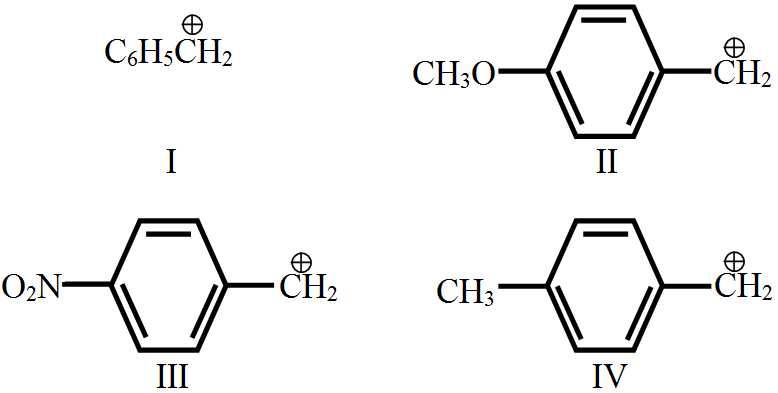
AnswerII > IV > I > III.
$\because \mathrm{OCH}_3$ group has +R effect, $\mathrm{CH}_3$ is electron releasing will destabilize carbocation where $-\mathrm{NO}_2$ group is electron withdrawing, will destabilize carbocation.
View full question & answer→Question 612 Marks
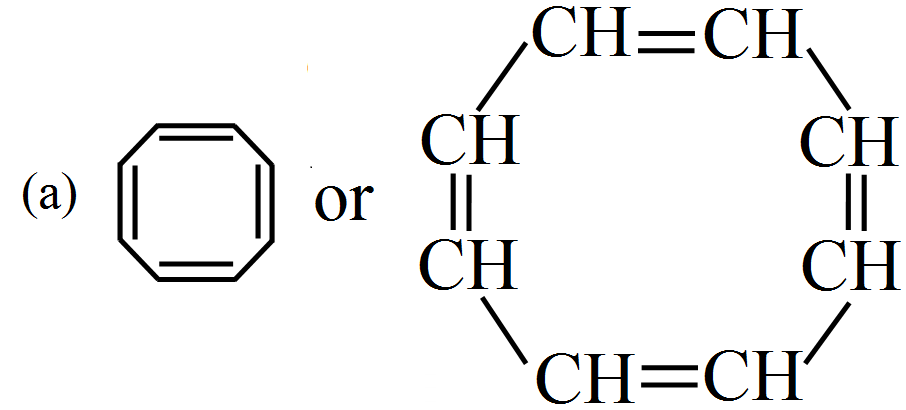
- Give condensed and bond line structural formulae of the following:
- Cyclo octa-1,5-diene.
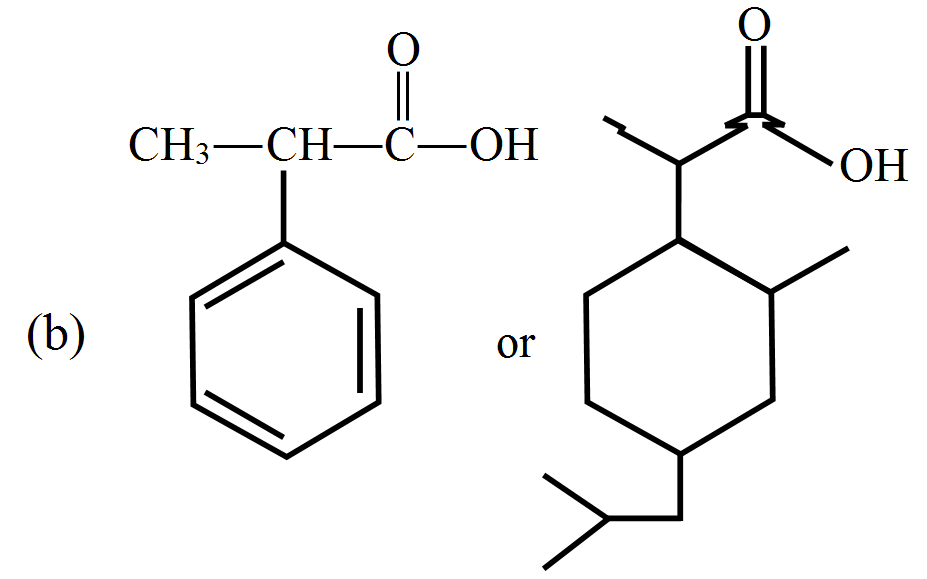
- 2(4-iso butyl phenyl) propanoic.
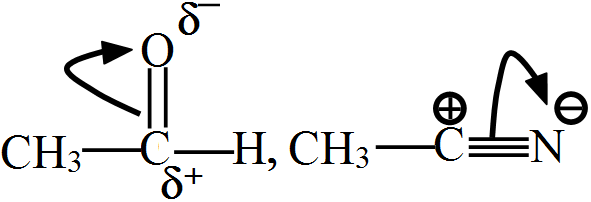
- Identify electrophilic centre in the following $\mathrm{CH}_3 \mathrm{CHO}$ and $\mathrm{CH}_3 \mathrm{CN}$.
Question 622 Marks
How many o and it bonds are present in each of the following molecules?
- $\text{CH}_3\text{CH}_2\text{C}\equiv\text{N}$
- $\text{CH}_3-\text{CH}=\text{CH}-\text{CH}_2-\text{C}\equiv\text{CH}$
- $\text{CH}_2=\text{C}=\text{CH}_2$
Answer
- $\sigma_{\text{C}-\text{C}}=2,$
$\sigma_{\text{C}-\text{H}}=5,$
$\sigma_{\text{C}-\text{N}}=1,$
$\pi_{\text{C}-\text{N}}=2$
- $\text{CH}_3\text{CH}=\text{CHCH}_2\text{C}\equiv\text{CH}$
$\sigma_{\text{C}-\text{C}}=5,$
$\sigma_{\text{C}-\text{H}}=8,$
$\pi_{\text{C}-\text{C}}=3$
- $\text{CH}_2=\text{CH}=\text{CH}_2$
$\sigma_{\text{C}-\text{C}}=2,$
$\sigma_{\text{C}-\text{C}}=4,$
$\pi_{\text{C}-\text{H}}=2,$ View full question & answer→Question 632 Marks
Classify the following pairs as position, chain, functional isomers or metamers:
- Diethylamine and Methylpropylamine.
- Ethanol and Dimethylether.
Answer
- They are metamers.
- They are functional isomers.
View full question & answer→Question 642 Marks
- Mention the type of hybridisation of each carbon in the compound $\mathrm{CH}_3-\mathrm{CN}$.
- Draw the structure of 2-methylpropan-2-ol.
Answer
- 1st carbon is ‘sp' and 2nd carbon is $\mathrm{sp}^3$ hybridised.
$\ \ \ \ \ \ \ \ \ \ \ \ \ | \\\stackrel{2}{\text{CH}_3}-\text{C}\equiv\text{N}$
- $\ \ \ \ \ \ \ \ \ \ \ \ \text{CH}_3\\\ \ \ \ \ \ \ \ \ \ \ \ \ |\\\text{CH}_3-\text{C}-\text{CH}_3\\\ \ \ \ \ \ \ \ \ \ \ \ \ |\\ \ \ \ \ \ \ \ \ \ \ \ \text{OH}\\ 2-\text{Methylpropan-2-ol}$
View full question & answer→Question 652 Marks
Give IUPAC name of the following compounds:
-
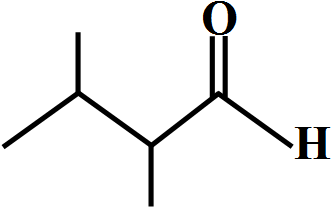
-
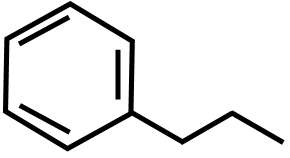
Question 662 Marks
Benzoic acid is a organic compound. Its crude sample can be purified by crystallisation from hot water. What characteristic differences in the properties of benzoic acid and the impurity make this process of purification suitable?
AnswerBenzoic acid is sparingly soluble in water at room temperature but appreciably soluble at higher temperature. The solution is concentrated to get a nearly saturated solution. On cooling the solution, pure compound crystallises out.
View full question & answer→Question 672 Marks
Which of the two structures A and B given below is more stabilised by resonance. Explain $\text{CH}_3\text{COOH}\\ \ \ \ \ \ \ \ \ \text{A}$ and $\text{CH}_3\stackrel{ \ \ \ \ \ \ \ \ \ \ominus}{\text{COO}}\\ \ \ \ \ \ \ \ \ \text{B}$
Answer
Resonating structures of A and B are as follows:
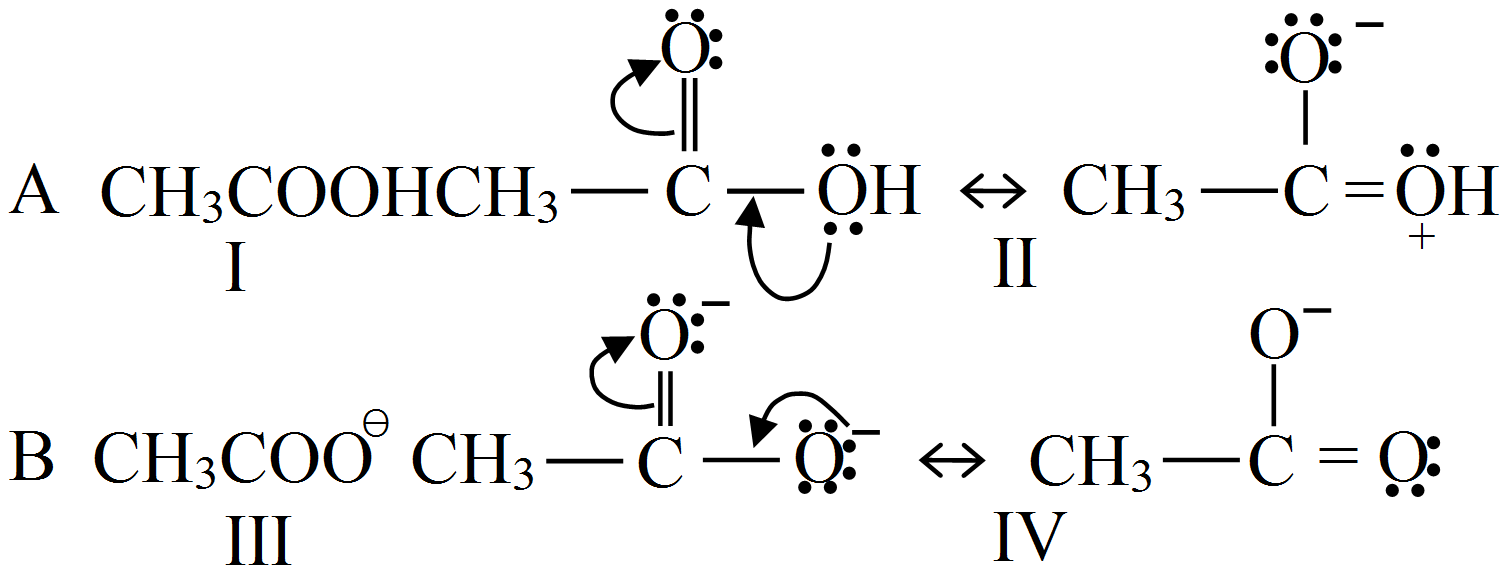
Structure (II) is less stable than structure (I) because later carries separation of positive and negative charges. Therefore, contribution of structure (II) is less than that of (1) towards the resonance hybrid of compound (A), i.e. $\text{CH}_3\text{COOH}_3$ On contrary, structure (III) and (IV) are of equal energy and hence contribute equally towards the resonance hybrid of compound (B). Therefore, structure (B) is more stable than structure (A) i.e. $\text{CH}_3\stackrel{ \ \ \ \ \ \ \ \ \ \ominus}{\text{COO}}.$ View full question & answer→