Question
$\int e ^{5 \log x} dx$ is equal to:

Answer

(c) $\frac{x^6}{6}+C$
Explanation: $\frac{x^6}{6}+C$

Need a full question paper?

Generate a complete, print-ready paper with questions like this in minutes — across 16+ boards, with answer keys.
Start Generating Free

Similar questions

Directions: In the following questions, the Assertions (A) and Reason(s) (R) have been put forward. Read both the statements carefully and choose the correct alternative from the following:
Assertion (A)  $\frac{\text{d}}{\text{dx}}(\text{x}^2+\text{x}+1)^4=(\text{x}^2+\text{x}+1)^3(2\text{x}+1)$
Reason(R)  $(\text{fog}'=\text{f'}[\text{g(x)}].\text{g'(x)}$
  1. Both A and R are true and R is the correct explanation of A
  2. Both A and R are true but R is NOT the correct explanation of A.
  3. A is true but R is false
  4. A is false but R is true
Mark the correct alternative in the following question:
Suppose a random variable X follows the binomial distribution with parameters n and p, where 0 < p < 1. If $\frac{\text{P(X = r})}{\text{P(X = n} -\text{r})}$ is independent of n and r, then p equals:
If $\vec{a}=2 \hat{i}-\hat{j}+2 \hat{k}$ and $\vec{b}=4 \hat{i}+4 \hat{j}-2 \hat{k}$ then find the angle between the vectors $\vec{a}$ and $\vec{b}$.
The position vectors of the points A, B, C are $2\hat{\text{i}}+\hat{\text{j}}-\hat{\text{k}},\ 3\hat{\text{i}}-2\hat{\text{j}}+\hat{\text{k}}$ and $\hat{\text{i}}+4\hat{\text{j}}-3\hat{\text{k}}$ respectively. These points,
  1. Form an isosceles triangle.
  2. Form a right triangle.
  3. Are collinear.
  4. Form a scalene triangle.
The number of arbitrary constants in the particular solution of a differential equation of third order is:
  1. 3
  2. 2
  3. 1
  4. 0
Which of the following is not true about feasibility?
  1. It cannot be determined in a graphical solution of an LPP.
  2. It is independent of the objective function.
  3. It implies that there must be a convex region satisfying all the constraints.
  4. Extreme points of the convex region gives the optimum solution.
Choose the correct answer from the given four options.
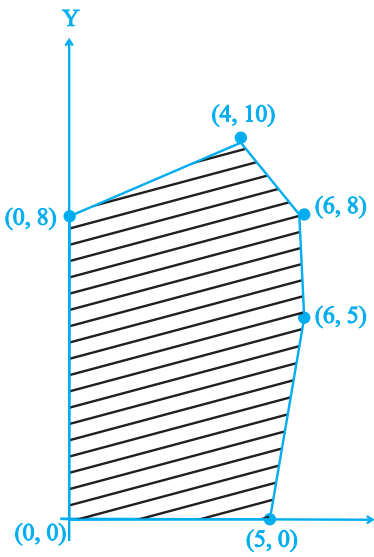
The feasible solution for a LPP is shown in. Let Z = 3x - 4y be the objective function.

Minimum of Z occurs at:
  1. (0, 0)
  2. (0, 8)
  3. (5, 0)
  4. (4, 10)
The number which exceeds its square by the greatest possible quantity is,
 The solution of the differential equation $\frac{\text{dy}}{\text{dx}}+\frac{2\text{y}}{\text{x}}=0$ with y(1) = 1 is given by.
  1. $\text{y}=\frac{1}{\text{x}^{2}}$
  2. $\text{x}=\frac{1}{\text{y}^{2}}$
  3. $\text{x}=\frac{1}{\text{y}}$
  4. $\text{y}=\frac{1}{\text{x}}$ 
The positive integral solution of the equation$\tan^{-1}\text{x}+\cos^{-1}\frac{\text{y}}{\sqrt{1+\text{y}^2}}=\sin^{-1}\frac{3}{\sqrt{10}}$ is:
  1. x = 1, y = 2
  2. x = 2, y = 1
  3. x = 3, y = 2
  4. x = -2, y = -1