MCQ
Inter atomic forces are:
  • A
    Attractive in long range.
  • B
    Repulsive in short range.
  • C
    Negligible in gases.
  • All $(a), (b)$ and $(c).$

Answer

Correct option: D.
All $(a), (b)$ and $(c).$
Interatomic forces are attractive in long range and repulsive in short range and negligible in gases.

Need a full question paper?

Generate a complete, print-ready paper with questions like this in minutes — across 16+ boards, with answer keys.

Start Generating Free

Similar questions

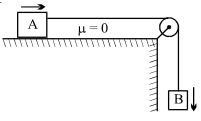
Both the blocks shown here are of mass $m$ and are moving with constant velocity in direction shown in a resistive medium which exerts equal constant force on both blocks in direction opposite to the velocity. The tension in the string connecting both of them will be : (Neglect friction)
A $U-$ tube is such that the diameter of one limb is $0.4\,mm$ and that of other is $d\, mm$ . If the surface tension of water contained in the tube is $0.07\,N/m$ and the difference in the levels of liquid in the limbs is $3.6\,cm,$ then the value of $d$ is
A tuning fork of frequency $280\,\, Hz$ produces $10$ beats per sec when sounded with a vibrating sonometer string. When the tension in the string increases slightly, it produces $11$ beats per sec. The original frequency of the vibrating sonometer string is ... $Hz$
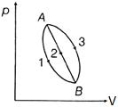
An ideal gas of mass $m$ in a state $A$ goes to another state $B$ via three different processes as shown in figure. If $Q_{1}, Q_{2}$ and $Q_{3}$ denote the heat absorbed by the gas along the three paths, then
A number of holes are drilled along a diameter of a disc of radius $R$. To get minimum time period of oscillations the disc should be suspended from a horizontal axis passing through a hole whose distance from the centre should be 
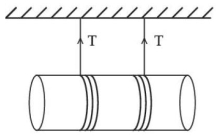
A solid cylinder length is suspended symmetrically through two massless strings, as shown in the figure. The distance from the initial rest position, the cylinder should by unbinding the strings to achieve a speed of $4\,ms ^{-1}$, is$........cm$. $\left(\right.$ take $\left.g=10\,ms ^{-2}\right)$
A rifle bullet loses $1/20th$ of its velocity in passing through a plank. The least number of such planks required just to stop the bullet is
A pendulum is executing simple harmonic motion and its maximum kinetic energy is $K_1$. If the length of the pendulum is doubled and it performs simple harmonic motion with the same amplitude as in the first case, its maximum kinetic energy is $K_2$ then
The damping force on an oscillator is directly proportional to the velocity. The unit of the constant of proportionality is:
Two gases-argon (atomic radius $0.07 \;\mathrm{nm}$,atomic weight $40$ ) and xenon (atomic radius $0.1\; \mathrm{nm},$ atomic weight $140$ ) have the same number density and are at the same temperature. The raito of their respective mean free times is closest to