MCQ
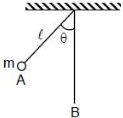
A pendulum is executing simple harmonic motion and its maximum kinetic energy is $K_1$. If the length of the pendulum is doubled and it performs simple harmonic motion with the same amplitude as in the first case, its maximum kinetic energy is $K_2$ then
  • ${K_2} = 2{K_1}$
  • B
    ${K_2} = \frac{{{K_1}}}{2}$
  • C
    ${K_2} = \frac{{{K_1}}}{4}$
  • D
    ${K_2} = {K_1}$

Answer

Correct option: A.
${K_2} = 2{K_1}$
a
Maximum kinetic energy at lowest point $B$ is given by

$\mathrm{K}=\mathrm{mg} \ell(1-\cos \theta)$

where $\theta=$ angular amp.

$\mathrm{K}_{1}=\mathrm{mg} \ell(1-\cos \theta)$

$\mathrm{K}_{2}=\mathrm{mg}(2 \ell)(1-\cos \theta)$

$\mathrm{K}_{2}=2 \mathrm{K}_{1}$

Need a full question paper?

Generate a complete, print-ready paper with questions like this in minutes — across 16+ boards, with answer keys.

Start Generating Free

Similar questions

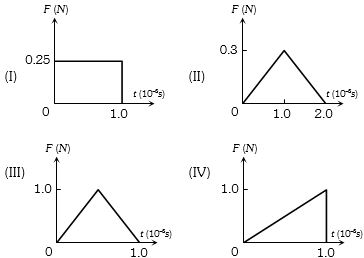
Figures $I, II, III$ and $IV$ depict variation of force with time. The impulse is highest in the case of situations depicted. Figure
A train, standing in a station yard, blows a whistle of frequency $400Hz$ in still air. The wind starts blowing in the direction from the yard to the station with a speed of $10\ m/ s$. Given that the speed of sound in still air is $340\ m/ s,$
The angle of projection at which the horizontal range and maximum height of projectile are equal is
If temperature of gas increases from $27°C$ to $927°C$ the $K.E.$ will be
If $I = 50\,kg-m^2$ , then ......... $N-m$ torque will be applied to stop it in $10\,sec$ . Its initial angular speed is $20\,rad/sec$ 
An engine is supposed to operate between two reservoirs at temperature $727°C$ and $227°C.$ The maximum possible efficiency of such an engine is
Moment of a force of magnitude $20 \,N$ acting along positive $x$ direction at point $(3 \,m , 0,0)$ about the point $(0,2,0)$ (in $Nm$ ) is ...........
A body is in pure rotation. The linear speed $\nu$ of a particle, the distance $r$ of the particle from the axis and the angular velocity $\omega$ of the body are related as $\omega=\frac{\text{v}}{\text{r}}$ Thus:
A transverse progressive wave on a stretched string has a velocity of $10\,m{s^{ - 1}}$ and a frequency of $100 Hz.$ The phase difference between two particles of the string which are $2.5 cm$ apart will be
In a tug-of-war contest, two men pull on a horizontal rope from opposite sides. The winner will be the man who