MCQ
Internal forces acting in a system of particle can change
  • The kinetic energy but not linear momentum of the system
  • B
    Neither linear momentum nor kinetic energy of the system
  • C
    Both kinetic energy and linear momentum of the system
  • D
    The linear momentum but not the kinetic energy of system
Answer

Correct option: A.
The kinetic energy but not linear momentum of the system
a

Need a full question paper?

Generate a complete, print-ready paper with questions like this in minutes — across 16+ boards, with answer keys.

Start Generating Free

Similar questions

On a horizontal smooth surface a disc is placed at rest. Another disc of same mass is coming with impact parameter equal to its own radius. First disc is of radius $r$. What should be the radius of coming disc so that after collision first disc moves at an angle $45^o$ to the direction of motion of incoming disc : 
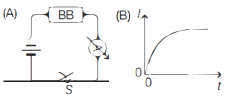
A blackbox $(BB)$ which may contain a combination of electrical circuit elements (resistor, capacitor or inductor) is connected with other external circuit elements as shown below in the figure $(A)$. After the switch $S$ is closed at time $t=0$, the current $I$ as a function of time $t$ is shown in the figure $(B)$. From this we can infer that the blackbox contains
The potential to which a conductor is raised, depends on
A conducting loop carrying a current $I$ is placed in a uniform magnetic field pointing into the plane of the paper as shown. The loop will have a tendency to
Acetaldehyde reacts with semicarbazide product will be
Half mole of an ideal monoatomic gas is heated at constant pressure of $1\, atm$ from $20\,^oC$ to $90\,^oC$. Work done by has is close to ..... $J$ (Gas constant $R = 8.31\, J/mol.K$)
In a Young's double slit experiment, a student observes $8$ fringes in a certain segment of screen when a monochromatic light of $600\,nm$ wavelength is used. If the wavelength of light is changed to $400\,nm$, then the number of fringes he would observe in the same region of the screen is:
At what temperature will the $rms$ speed of oxygen molecules become just sufficient for escaping from the Earth's atmosphere $?$ (Given: Mass of oxygen molecule $(m)= 2.76 \times 10^{-26}\,kg$ Boltzmann's constant $k_B= 1.38 \times 10^{-23}\,\, JK^{-1}$)
Two cells, having the same $e.m.f.$ are connected in series through an external resistance $R.$ Cells have internal resistances $r_1$ and $r_2\,\, (r_1 > r_2)$ respectively. When the circuit is closed, the potential difference across the first cell is zero. The value of $R$ is
Biaxial crystal among the following is