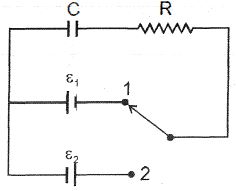
Intially, switch $S$ is connected to position $1$ for a long time shown in figure. The net amount of heat generated in the circuit after it is shifted to position $2$ is
Diffcult
Download our app for free and get started
$U_{i}=\frac{1}{2} C \varepsilon_{1}^{2}$
$U_{f}=\frac{1}{2} C \varepsilon_{2}^{2}, \Delta U=\frac{1}{2} C\left(\varepsilon_{2}^{2}-\varepsilon_{1}^{2}\right)$
$Q_{i n}=+C \varepsilon_{1}, Q_{f}=-C \varepsilon_{2}, \Delta Q=\left|Q_{j}-Q_{i}\right|$
$=C\left(\varepsilon_{2}+\varepsilon_{1}\right)$
Work done-by battery $W_{b}=\varepsilon_{2} \Delta Q=C\left(\varepsilon_{2}+\varepsilon_{1}\right) \varepsilon_{2}$
Heat generated $=W_{b}-\Delta U$
$=C \varepsilon_{2}^{2}+C \varepsilon_{1} \varepsilon_{2}-\frac{1}{2} C\left(\varepsilon_{2}^{2}-\varepsilon_{1}^{2}\right)$
$=\frac{1}{2} C\left(\varepsilon_{2}^{2}+\varepsilon_{1}^{2}+2 \varepsilon_{1} \varepsilon_{2}\right)=\frac{1}{2} C\left(\varepsilon_{1}+\varepsilon_{2}\right)^{2}$

Download our appand get started for free
Experience the future of education. Simply download our apps or reach out to us for more information. Let's shape the future of learning together!No signup needed.*
Similar Questions
- 1If the charge on a capacitor is increased by $2$ coulomb, the energy stored in it increases by $21\%$. The original charge on the capacitor is....$C$View Solution
- 2Charge $q_{2}$ is at the centre of a circular path with radius $r$. Work done in carrying charge $q_{1}$, once around this equipotential path, would beView Solution
- 3Given below are two statements: one is labelled as Assertion $A$ and the other is labelled as Reason $R$.View Solution
Assertion $A$: The potential ( $V$ ) at any axial point, at $2 \mathrm{~m}$ distance ( $r$ ) from the centre of the dipole of dipole moment vector $\vec{P}$ of magnitude, $4 \times 10^{-6} \mathrm{C} \mathrm{m}$, is $\pm 9 \times 10^3 \mathrm{~V}$.
(Take $\frac{1}{4 \pi \epsilon_0}=9 \times 10^9 \mathrm{Sl}$ units)
Reason $R$: $V= \pm \frac{2 P}{4 \pi \epsilon_0 r^2}$, where $r$ is the distance of any axial point, situated at $2 \mathrm{~m}$ from the centre of the dipole.
In the light of the above statements, choose the correct answer from the options given below:
- 4A particle $A$ has charge $+q$ and particle $B$ has charge $+ 4q$ with each of them having the same mass $m$. When allowed to fall from rest through same electrical potential difference, the ratio of their speed $V_A : V_B$ will be :-View Solution
- 5View SolutionWhen a dielectric material is introduced between the plates of a charged condenser then electric field between the plates
- 6Two condensers of capacities $2C$ and $C$ are joined in parallel and charged upto potential $V$. The battery is removed and the condenser of capacity $C$ is filled completely with a medium of dielectric constant $K$. The $p.d.$ across the capacitors will now beView Solution
- 7With the rise in temperature, the dielectric constant $K$ of a liquidView Solution
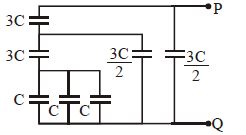
- 8The value of equivalent capacitance of the combination shown in figure between the points $P$ and $Q$ isView Solution
- 9A particle of mass $m$ and charge $q$ is kept at the top of a fixed frictionless sphere. $A$ uniform horizontal electric field $E$ is switched on. The particle looses contact with the sphere, when the line joining the center of the sphere and the particle makes an angle $45^o$ with the vertical. The ratio $\frac{qE}{mg}$ is :-View Solution
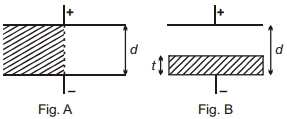
- 10A capacitor is half filled with a dielectric $(K=2)$ as shown in figure A. If the same capacitor is to be filled with same dielectric as shown, what would be the thickness of dielectric so that capacitor still has same capacity?View Solution