MCQ
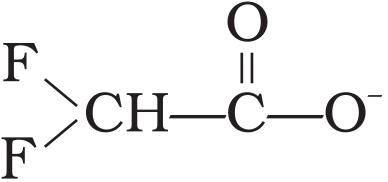
Ionic species are stabilised by the dispersal of charge. Which of the following carboxylate ion is the most stable?
  • A
    $\ \ \ \ \ \ \ \ \ \ \ \ \text{O}\\\ \ \ \ \ \ \ \ \ \ \ \ ||\\\text{CH}_3-\text{C}-\text{O}^-$
  • B
    $\ \ \ \ \ \ \ \ \ \ \ \ \ \ \ \ \ \ \ \ \ \text{O}\\\ \ \ \ \ \ \ \ \ \ \ \ \ \ \ \ \ \ \ \ \ \ ||\\\text{CI}-\text{CH}_2-\text{C}-\text{O}^-$
  • C
    $\ \ \ \ \ \ \ \ \ \ \ \ \ \ \ \ \ \ \ \ \text{O}\\\ \ \ \ \ \ \ \ \ \ \ \ \ \ \ \ \ \ \ \ ||\\\text{F}-\text{CH}_2-\text{C}-\text{O}^-$

Answer

Correct option: D.
The stabilsation of carboxylate ion depends on dispersal of negative charge. The negative charge is dispersed by two factors, i.e., $+ R$ effect of the carboxylate ion and Inductive effect of the halogens. In all the above structures, $R$ effect is common but halogen atoms are different. Therefore, dispersal of negative charge depends upon halogen atoms. $F$ is most electronegative, in structure $(iv)$ two Fatoms are present and more dispersal of negative charge is there.

Need a full question paper?

Generate a complete, print-ready paper with questions like this in minutes — across 16+ boards, with answer keys.

Start Generating Free