Question
Ionisation constant of a weak base MOH, is given by the expression.$\text{K}_\text{b}=\frac{[\text{M}^+][\text{OH}^-]}{[\text{MOH}]}$
Values of ionisation constant of some weak bases at a particular temperature are given below:
Base
Dimethylamine
Urea
Pyridine
Ammonia
$K_b$
$5.4 \times 10^{–4}$
$1.3 \times 10^{–14}$
$1.77 \times 10^{–9}$
$1.77 \times 10^{–5}$
Arrange the bases in decreasing order of the extent of their ionisation at equilibrium. Which of the above base is the strongest?

Answer

Greater is the ionization constant ($K_b$) of a base, greater is the ionization of the base. Order of extent of ionization at equilibrium is dimethylamine > ammonia > pyridine > urea. Dimethylamine is the strongest base due to maximum value of $K_b​​​​​​​$.

Need a full question paper?

Generate a complete, print-ready paper with questions like this in minutes — across 16+ boards, with answer keys.

Start Generating Free

Similar questions

Compare the $\text{H}-\text{N}-\text{H}$ bond angle in the following molecules and ions:
$\text{NH}_3,\text{NH}_4^+,\text{NH}^-_2$
Derive the relationship between isothermal and free expansion of an ideal gas.
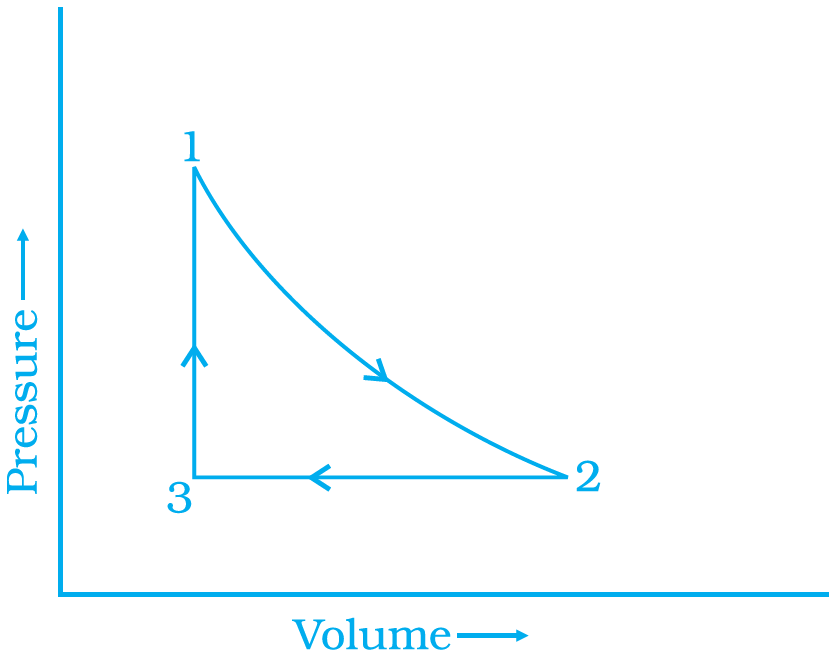
A sample of 1.0mol of a monoatomic ideal gas is taken through a cyclic process of expansion and compression as shown in Fig. What will be the value of $\Delta\text{H}$ for the cycle as a whole?
Name an alkali metal carbonate which is thermally unstable and why? Give its decomposition reaction.
  1. Give condensed and bond line structural formulae of the following:
  1. Cyclo octa-1,5-diene.
  2. 2(4-iso butyl phenyl) propanoic.
  1. Identify electrophilic centre in the following $\mathrm{CH}_3 \mathrm{CHO}$ and $\mathrm{CH}_3 \mathrm{CN}$.
What is the oxidation number of alkali metals in their compounds?
What do you meant by ionisation enthalpy? On basis of this explain the acidic nature of oxides and stability of carbonates.
If 10 volumes of dihydrogen gas reacts with five volumes of dioxygen gas, how many volumes of water vapour would be produced?
Write IUPAC names of the following compound: $\text{CH}_3(\text{CH}_2)_4\text{CH}(\text{CH}_2)_3\text{CH}_3\\\ \ \ \ \ \ \ \ \ \ \ \ \ \ \ \ \ \ \ \ \ |\\\ \ \ \ \ \ \ \ \ \ \ \ \ \ \ \ \ \ \ \text{CH}_2-\text{CH}(\text{CH}_3)_2$
Identify A, B, C and D and give their chemical formulae.
  1. $\text{A}+\text{NaCl}\xrightarrow{\ \ \ \ \ \ \ }\text{NaCl}+\text{NH}_3+\text{H}_2\text{O}$
  2. $\text{NH}_3+\text{CO}_2+\text{H}_2\text{O}\xrightarrow{ \ \ \ \ \ \ \ }\text{B}$
  3. $\text{B}+\text{NaCl}\xrightarrow{ \ \ \ \ \ \ \ \ }\text{C}+\text{NH}_4\text{Cl}$
  4. $\text{C}\xrightarrow{\text{Heat}}\text{Na}_2\text{CO}_3+\text{H}_2\text{O}+\text{D}$