Question
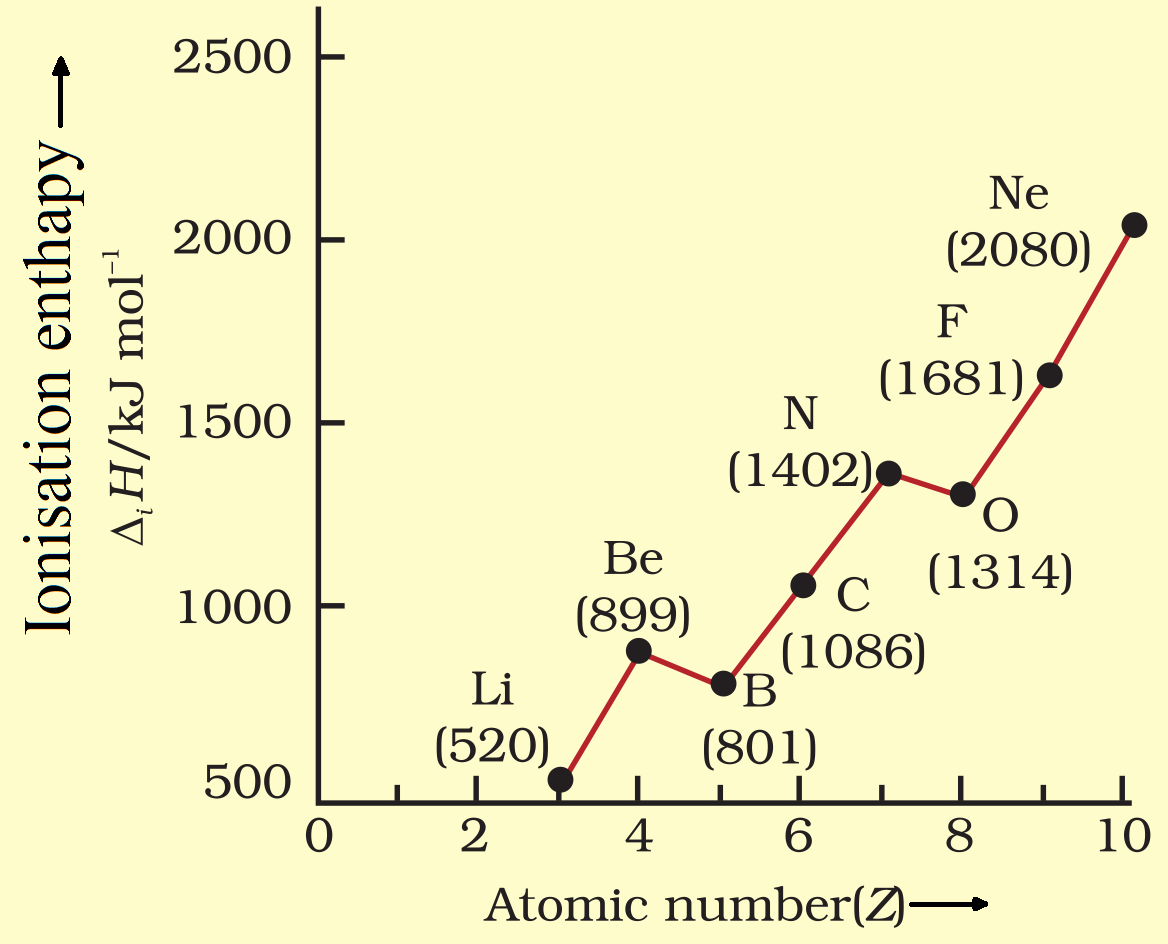
Ionisation enthalpies of elements of second period are given below:
Ionisation enthalpy/ kcal $mol^{-1}, 520, 899, 801, 1086, 1402, 1314, 1681, 2080$.
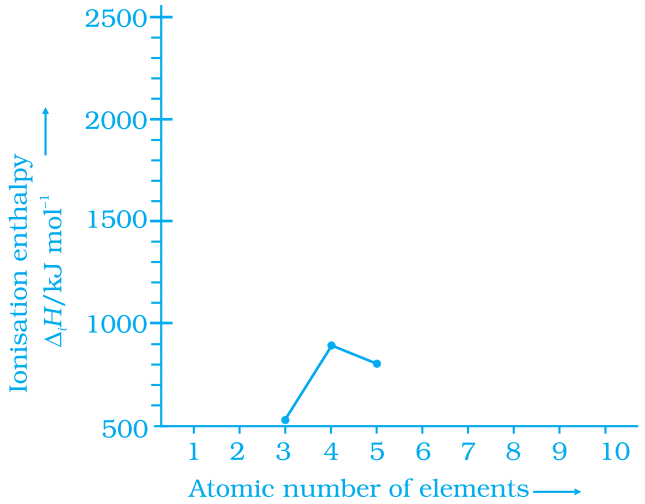
Match the correct enthalpy with the elements and complete the graph given in also write symbols of elements with their atomic number.
Answer

To match the correct enthalpy with the elements and to complete the graph, the following points are taken into consideration. As we move from left to right across a period, the ionization enthalpy keeps on increasing due to increased nuclear charge and simultaneous decrease in atomic radius. However, there are some exceptions given below:
  1. In spite of increased nuclear charge, the first ionisation enthalpy of B is lower than that of Be. This is due to the presence of fully filled 2s-orbital of Be $[1s^22s^2]$ which is a stable electronic arrangement. Thus, higher energy is required to knock out the electron from fully filled 2.v-orbital. While $B [1s^2 2s^2 2p^1]$ contains valence electrons in 2s and 2p-orbitals. It can easily lose its one e– from 2p-orbital in order to achieve noble gas configuration. Thus, first ionisation enthalpy of B is lower than that of Be.
Since the electrons in 2s-orbital are more tightly held by the nucleus than those present in 2p-orbital, therefore, ionisation enthalpy of B is lower than that of Be.
  1. The first ionisation enthalpy of N is higher than that of O though the nuclear charge of O is higher than that of N. This is due to the reason that in case of N, the electron is to be removed from a more stable, exactly half-filled electronic configuration $\big(1\text{s}^2\ 2\text{s}^2\ 2\text{p}^1_\text{x}\ 2\text{p}^1_\text{y}\ 2\text{p}^1_\text{z}\big)$ which is not present in $\text{O}\big(1\text{s}^2\ 2\text{s}^2\ 2\text{p}^2_\text{x}\ 2\text{p}^1_\text{y}\ 2\text{p}^1_\text{z}\big).$
Therefore, the first ionisation enthalpy of N is higher than that of O. The symbols of elements along with their atomic numbers are given in the following graph.

Need a full question paper?

Generate a complete, print-ready paper with questions like this in minutes — across 16+ boards, with answer keys.

Start Generating Free

Similar questions

What is hyperconjugation? Explain with example and with help of this explain the stability of carbocations and alkenes.
Illustrate by taking examples of transition elements and non-transition elements that oxidation states of elements are largely based on electronic configuration.
Prove that solubility of salts of weak acids increases by decreasing the pH.
Define the following:
(i) Isothermal process (ii) Enclosed thermal process (iii) Isobaric process (iv) Isovolumetric process
Define following.
(i) Molarity
(ii) Molality
(iii) Normality
(iv) Formality
The electron energy in hydrogen atom is given by $\text{E}_{\text{n}}=\frac{ (–2.18 \times 10–18 )}{\text{n}^2}\text{J}.$ Calculate the energy required to remove an electron completely from the n = 2 orbit. What is the longest wavelength of light in cm that can be used to cause this transition?
Analyse the modern classification of organic compounds.
  1. Consider the following endothermic reaction:
$\text{CH}_4(\text{g})+\text{H}_2\text{O}(\text{g})\rightleftharpoons\text{CO(g)}+3\text{H}_2(\text{g})$
  1. Write expression for $K_p$ for the above reaction.
  2. How will the values of $K_p$ and composition of equilibrium mixture be affected by.
  1. increasing the pressure.
  2. increasing the temperature.
  3. using a catalyst?
  1. Calculate the pH of the resultant mixture of $10$ml of $0.1$M $H_2SO_4 + 10$ ml of $0.1$M KOH.
Discuss the application of common ion effect and solubility product in analysis of alkaline radicals in laboratory.
Calculate the atomic mass (average) of chlorine using the following data:
 
% Natural Abundance
Molar Mass
${ }^{35} \mathrm{Cl}$
75.77
34.9689
${ }^{37} \mathrm{Cl}$
24.23
36.9659