Question
Is Huygen’s principle valid for longitudunal sound waves?

Answer


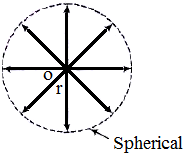
The point source propagates light in all directions symmetrically. Similarly, in case of any point source of sound wave, the disturbance due to the source propagates in spherical symmetry that is in all directions. The formation of wavefront is in accordance with Huygen's principle.
Hence, Huygen's principle is valid for longitudinal sound waves.

Need a full question paper?

Generate a complete, print-ready paper with questions like this in minutes — across 16+ boards, with answer keys.
Start Generating Free

Similar questions

Which of the following will describe the smallest circle when projected with the same velocity perpendicular to the magnetic field B (i) $\alpha$-particle and (ii) $\beta$-particle?
A human body excretes (removes by waste discharge, sweating, etc.) certain materials by a law similar to radioactivity. If technetium is injected in some form in a human body, the body excretes half the amount in 24 hours. A patient is given an injection containing $^{99}Tc$. This isotope is radioactive with a half-life of 6 hours. The activity from the body just after the injection is $6\mu\text{Ci}.$ How much time will elapse before the activity falls to $3\mu\text{Ci}?$
$a.$ Draw the energy level diagram for the line spectra representing Lyman series and Balmer series in the spectrum of hydrogen atom.
$b.$ Using the Rydberg formula for the spectrum of hydrogen atom, calculate the largest and shortest wavelengths of the emission lines of the Balmer series in the spectrum of hydrogen atom. $($ Use the value of Rydberg constant $\left.R =1.1 \times 10^7 m^{-1}\right)$
The potential difference between the terminals of a battery of emf 6.0V and internal resistance $1\Omega$ drops to 5.8V when connected across an external resistor. Find the resistance of the external resistor.
  1. What is linearly polarized light? Describe briefly using a diagram how sunlight is polarised.
  2. Unpolarised light is incident on a polaroid. How would the intensity of transmitted light change when the polaroid is rotated?
n-identical cells, each of emf $\varepsilon,$ internal resistance r connected in series are charged by a dc source of emf $\varepsilon'$ using a resistance R.
  1. Draw the circuit arrangement.
  2. Deduce expressions for (a) the charging current and (b) the potential difference across the combination of cells.
When a block of mass M is suspended by a long wire of length L, the elastic potential energy stored in the wire is $\frac{1}{2}\times$ stress × strain × volume. Show that it is equal to $\frac{1}{2}\text{Mgl}$ where l is the extension. The loss in gravitational potential energy of the Mass-earth sustem is Mgl. does the remaining $\frac{1}{2}\text{Mgl}$ energy go?
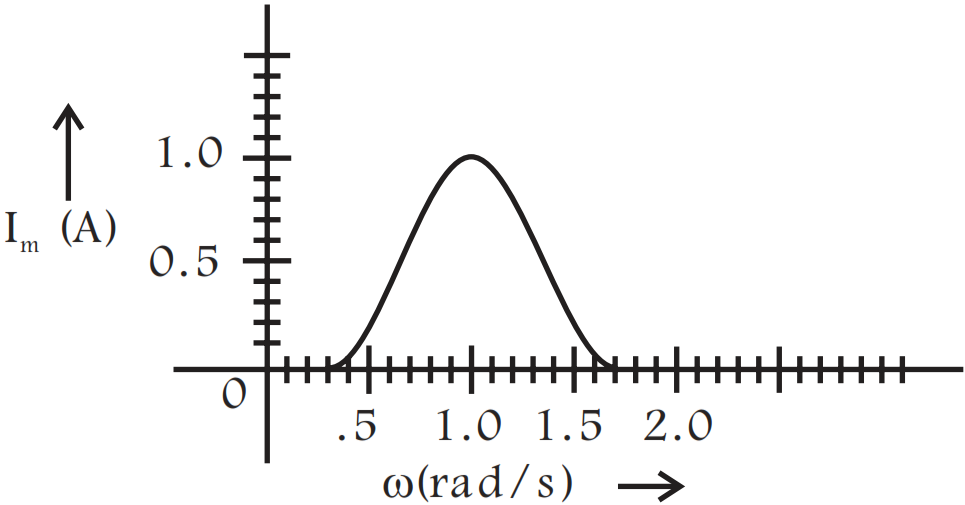
In series LCR circuit, the plot of $I_{max}$ vs $\omega$ is shown in Fig. Find the bandwidth and mark in the figure.
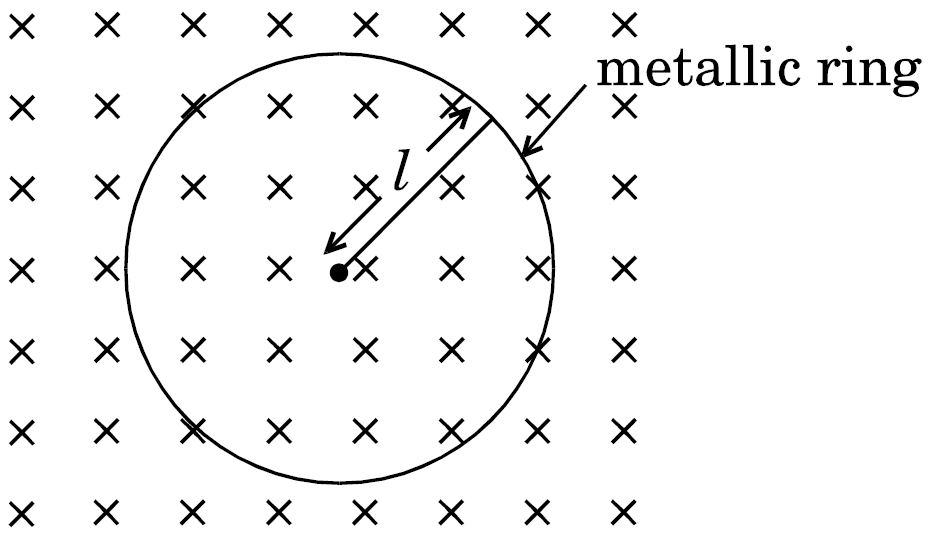
A metallic rod of length ‘l’ is rotated with a frequency ‘v’, with one end hinged at the centre and the other end at the circumference of a circular metallic ring, about an axis passing through the centre and perpendicular to the plane of the ring. A constant and uniform magnetic field B parallel to the axis is present everywhere.
  1. Obtain the expression for the emf induced between the centre and the ring.
  2. Given that the rod has resistance ‘R’, then how much power will be generated?
Find the time required for a 50Hz alternating current to change its value from zero to the rms value.