Question
Why a body weighs more at poles and less at equator?

Answer

The value of g is more at poles than at the equator.
Therefore, a body weighs more at poles than at equator.

Need a full question paper?

Generate a complete, print-ready paper with questions like this in minutes — across 16+ boards, with answer keys.
Start Generating Free

Similar questions

A cricket fielder can throw the cricket ball with a speed V0. If he throws the ball while running with speed u at an angle $\theta$ to the horizontal, find
  1. The effective angle to the horizontal at which the ball is projected in air as seen by a spectator.
  2. What will be time of flight?
  3. What is the distance (horizontal range) from the point of projection at which the ball will land?
  4. Find $\theta$ at which he should throw the ball that would maximise the horizontal range as found in (iii).
  5. how does $\theta$ for maximum range change if $\text{u}>\upsilon_\text{o},\text{u}=\upsilon_\text{o},\text{ u}<\upsilon_\text{o}$?
  6. How does $\theta$ in (v) compare with that for u = 0 (i.e.45° )?
What will be the unit of impulse?
If ball A is released freely and simultaneously ball B is projected with a velocity u in the horizontal direction, then which ball will reach the earth first?
Can an object in linear motion be in equilibrium? Why?
When work done by a force is independent of the path of motion but depends only on the initial and final position of the body displaced. Such force is known as_____________.
All oscillatory motions are periodic and vice-versa. Is it true?
Which of the following examples represent periodic motion?
A swimmer completing one (return) trip from one bank of a river to the other and back.
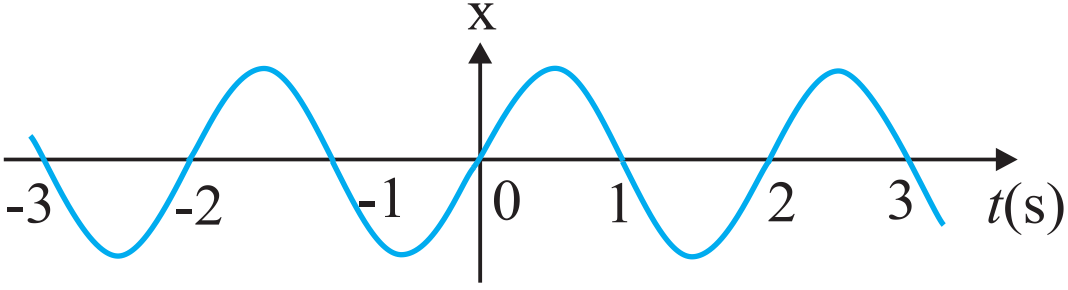
Fig. depicts four x-t plots for linear motion of a particle. Which of the plots represent periodic motion? What is the period of motion (in case of periodic motion)?

Is energy produced when a transformer steps up the voltage?
In a rotating body, $\text{a}=\alpha\text{r}$ and $\text{v}=\omega\text{r}.$ Thus $\frac{\text{a}}{\alpha}=\frac{\text{v}}{\omega}.$ Can a co you use the theorems of ratio and proportion studied in algebra so as to write

$\frac{\text{a}+\alpha}{\text{a}-\alpha}=\frac{\text{v}+\omega}{\text{v}-\omega}$