Question
Is it possible to increase the temperature of a gas without adding heat to it? Explain.

Answer

Yes, it is possible to increase the temperature of a gas without adding heat to it, during adiabatic compression the temperature of a gas increases while no heat is given to it. For an adiabatic compression, no heat is given or taken out in adiabatic process.

Therefore,$\Delta\text{Q}=0$

According to the first law of thermodynamics,

$\Delta\text{Q}=\Delta\text{U}+\Delta\text{W}$

$\Delta\text{U}=-\Delta\text{W}(\Delta\text{Q}=0)$

In compression work is done on the gas, i.e. work done is negativ. Therefore, $\Delta\text{U}=$ positive.

Hence, internal energy of the gas increases due to which its temperature increases.

Need a full question paper?

Generate a complete, print-ready paper with questions like this in minutes — across 16+ boards, with answer keys.
Start Generating Free

Similar questions

100 g of water is supercooled to -10°C. At this point, due to some disturbance mechanised or otherwise some of it suddenly freezes to ice. What will be the temperature of the resultant mixture and how much mass would freeze?
[Sw = 1cal/ g/°C and LWFusion = 80cal/ g]
A certain substance has a mass of $50 g /$ mole. When 300 J of heat is added to 25 g of sample of this material, its temperature rises from $25^{\circ} C$ to $45^{\circ} C$. Calculate
i. the thermal capacity,
ii. specific heat capacity, and
iii. molar heat capacity of the sample.
The moment of inertia of a body about a given axis is 1.2kg/ m2. Initially the body is at rest. In order to produce a rotational K.E. of 1500J, for how much duration, an acceleration of 25 rad/ s2 must be applied about that axis?
The speed of light in glass is 2.0 × 101m/s. Does it violate the second postulate of special relativity?
Two rods A and B are of equal length. Each rod has its ends at temperatures T1 and T2. What are the conditions that will ensure equal rates of flow of heat through the rods A and B?
During a heavy rain, hailstones of average size 1.0cm in diameter fall with an average speed of 20m/s. Suppose 2000 hailstones strike every square meter of a 10m × 10m roof perpendicularly in one second and assume that the hailstones do not rebound. Calculate the average force exerted by the falling hailstones on the roof. Density of a hailstone is 900kg/m3.
Earth can be thought of as a sphere of radius 6400km. Any object (or a person) is performing circular motion around the axis of earth due to earth’s rotation (period 1 day). What is acceleration of object on the surface of the earth (at equator) towards its centre? what is it at latitude $\theta?$ How does these accelerations compare with g = 9.8m/ s2?
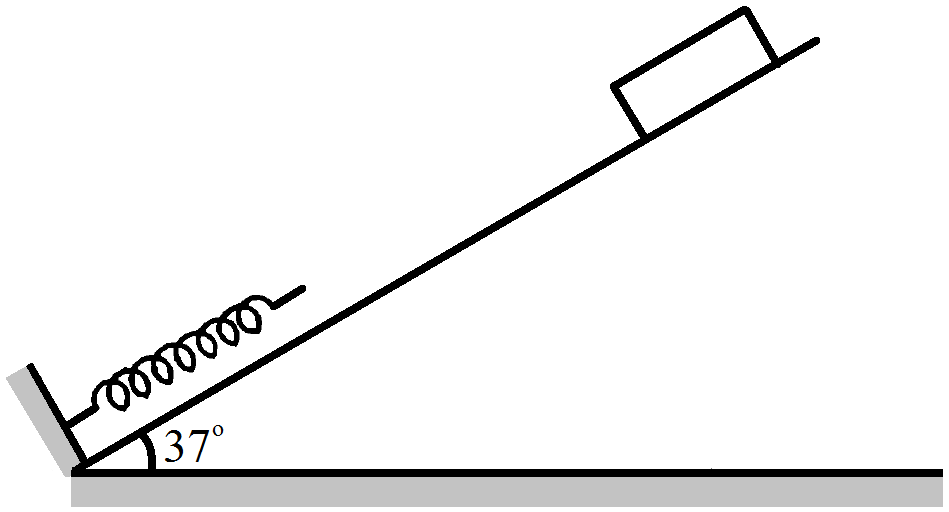
Figure shows a spring fixed at the bottom end of an incline of inclination 37°. A small block of mass 2kg starts slipping down the incline from a point 4.8m away from the spring. The block compresses the spring by 20cm, stops momentarily and then rebounds through a distance of 1m up the incline. Find.
  1. The friction coefficient between the plane and the block.
  2. The spring constant of the spring. Take g = 10m/s2.

A shell of mass 0.020 kg is fired by a gun of mass 100 kg. If the muzzle speed of the shell is 80 $ms ^{-1}$, what is the recoil speed of the gun?
An aeroplane is flying in a horizontal direction with a velocity of 600km/ hr and at a height of 1960m. When it is vertically above the point A on the ground, a body is dropped from it. The body strikes the ground at point B. Calculate the distance AB.