Questions

3 Marks Question

🎯

Test yourself on this topic

4 questions · timed · auto-graded

Question 13 Marks
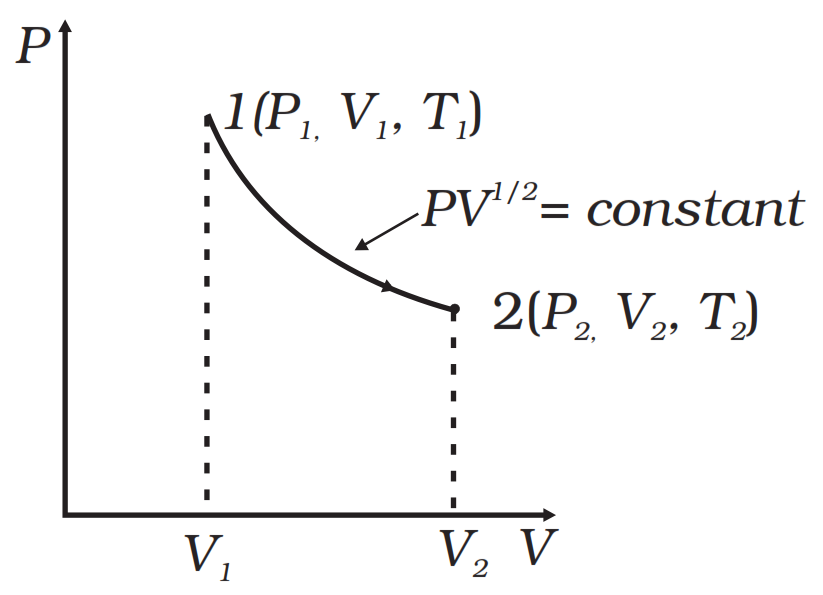
Consider a P-V diagram in which the path followed by one mole of perfect gas in a cylindrical container is shown in Fig.

Given the internal energy for one mole of gas at temperature T is (3/2) RT, find the heat  supplied to the gas when it is taken from state (1) to (2)  with V2 = 2V1.
Answer
$\therefore\ \text{PV}=$ constant = K (given) or $\text{P}_1\text{V}_1^\frac{1}{2}=\text{P}_2\text{V}_2^\frac{1}{2}= \text{K}\ \text{and}\ \text{P}=\frac{\text{K}}{\text{V}^\frac{1}{2}}$

Given that internal energy U of gas is

$\text{U}=\Big(\frac{3}{2}\Big)\text{RT}$

$\Delta\text{U}=\frac{3}{2}\text{RdT}=\frac{3}{2}\text{R}(\text{T}_2-\text{T}_1)$

$\therefore\ \text{T}_2=\sqrt2\text{T}_1,$ from part (b)

$\Delta\text{U}=\frac{3}{2}\text{R}\big[\sqrt2\text{T}_1-\text{T}_1\big]=\frac{3}{2}\text{R}\text{T}_1\big(\sqrt2-1\big)$

Form part (a) $\text{dW}=2\text{P}_1\text{V}^\frac{1}{2}\big(\sqrt{\text{V}_2}-\sqrt{\text{V}_1}\big)$

$\because\ \text{V}_2=2\text{V}_1$ (given)

so, $\sqrt{\text{V}_2}=\sqrt2\sqrt{\text{V}_1}$$$ then 

$\text{dW}=2\text{P}_1\text{V}_1^\frac{1}{2}\big(\sqrt2\sqrt{\text{V}_1}-\sqrt{\text{V}_1}\big)$

$=2\text{P}_1\text{V}_1\sqrt{\text{V}_1}\big[\sqrt2-1\big]$

$\text{dW}=2\text{P}_1\text{V}_1\big(\sqrt2-1\big)$

$\text{dW}=2\text{n}\text{R}\text{T}_1\big(\sqrt2-1\big)$ $\big(\therefore\ \text{P}_1\text{V}_1=\text{n}\text{R}\text{T}_1\big)$

$\therefore\ \text{n}=1\therefore\ \text{dW}=2\text{R}\text{T}_1\big(\sqrt2-1\big)$

$\therefore\ \text{dQ}=\text{dW}+\text{dU}=2\text{R}\text{T}_1\big(\sqrt2-1\big)+\frac{3}{2}\text{R}\text{T}_1\big(\sqrt2-1\big)$

$=\big(\sqrt2-1\big)\text{R}\text{T}_1\Big[2+\frac{3}{2}\Big]$

$\text{dQ}=-\big(\sqrt2-1\big)\text{RT} .$
View full question & answer
Question 23 Marks
The initial state of a certain gas is (Pi , Vi , Ti ). It undergoes expansion till its volume becoms Vf . Consider the following two cases:
  1. The expansion takes place at constant temperature.
  2. The expansion takes place at constant pressure.
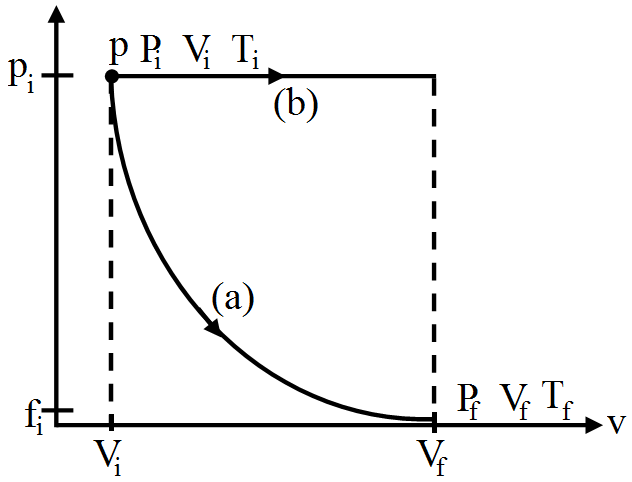
Plot the P-V diagram for each case. In which of the two cases, is the work done by the gas more?

Answer
  1.  The expension from Vi to Vf tempreature Ti remains constant so isothermal expension i.e. PiVi = PfVf constant T.
  2. The expension is at constant pressure pi so isobaric process so graph P-V will be parallel to V axis till its volume becomes Vf As the area enclosed by graph (a) is less than (b) with volume axis so W.D. by process (b) is more than of (a).
View full question & answer
Question 33 Marks
Is it possible to increase the temperature of a gas without adding heat to it? Explain.
Answer
Yes, it is possible to increase the temperature of a gas without adding heat to it, during adiabatic compression the temperature of a gas increases while no heat is given to it. For an adiabatic compression, no heat is given or taken out in adiabatic process.

Therefore,$\Delta\text{Q}=0$

According to the first law of thermodynamics,

$\Delta\text{Q}=\Delta\text{U}+\Delta\text{W}$

$\Delta\text{U}=-\Delta\text{W}(\Delta\text{Q}=0)$

In compression work is done on the gas, i.e. work done is negativ. Therefore, $\Delta\text{U}=$ positive.

Hence, internal energy of the gas increases due to which its temperature increases.

View full question & answer
Question 43 Marks
Consider a Carnot’s cycle operating between T1 = 500K and T2=300K producing 1k J of mechanical work per cycle. Find the heat transferred to the engine by the reservoirs.
Answer
Efficiency of Carnot's engine $\mu=1-\frac{\text{T}_{2}}{\text{T}_{1}}$

Tempreature of source or reservior = T1 = 500K

Tempreature of sink T2 = 300K 

$\therefore\mu=1-\frac{\text{T}_{2}}{\text{T}_{1}}$

$\frac{\text{Output work}}{\text{Input work}(E)}=1-\frac{300}{500}$

$\frac{1000\text{J}}{\text{x}}=1-0.6$

$\text{x}=\frac{1000}{\text{x}}=0.4$

$\text{x}=\frac{1000}{0.4}=2500 \text{J} .$

View full question & answer
3 Marks Question - Physics STD 11 Science Questions - Vidyadip