Question
  1. How are electromagnetic waves produced? Explain.
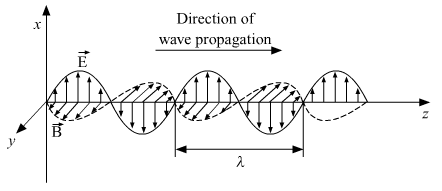
  2. A plane electromagnetic wave is travelling through a medium along the +ve z-direction. Depict the electromagnetic wave showing the directions of the oscillating electric and magnetic fields.
Answer

  1. Electromagnetic waves are formed as a result of accelerating (electric) charges under electric field. Electric charge exhibit electrostatic behaviour and once they start moving magnetic effects come into play. As a result of this a duality is established which is called electromagnetism. The electromagnetic waves are emitted by those charged particles. These waves move with the velocity of light
  2. The cross product of electric and magnetic field vectors i.e.$\vec{E}\times\vec{B}$  gives the direction in which the wave travels.
It is given that wave is propagating along the +z-axis. This means that electric field vector is oscillating in positive x- direction and magnetic field vector in positive y-direction.
The propagation of electromagnetic wave in +z direction is shown here:

Need a full question paper?

Generate a complete, print-ready paper with questions like this in minutes — across 16+ boards, with answer keys.
Start Generating Free

Similar questions

Comment on the following :(i) Electric conductivity.(ii) Dependence of resistivity and resistance on temperature.
The band gap between the valence and the conduction bands in zinc oxide (ZnO) is 3.2eV. Suppose an electron in the conduction band combines with a hole in the valence band and the excess energy is released in the form of electromagnetic radiation. Find the maximum wavelength that can be emitted in this process.
Two identical cells of emf 1.5 V each joined in parallel supply energy to an external circuit consisting of two resistances of 7 $\Omega$ each joined in parallel. A very high resistance voltmeter reads the terminal voltage of cells to be 1.4 V. Calculate the internal resistance of each cell.
In a p-n junction, a potential barrier of 250meV exists across the junction. A hole with a kinetic energy of 300meV approaches the junction. Find the kinetic energy of the hole when it crosses the junction if the hole approached the junction.
  1. From the p-side.
  2. From the n-side.
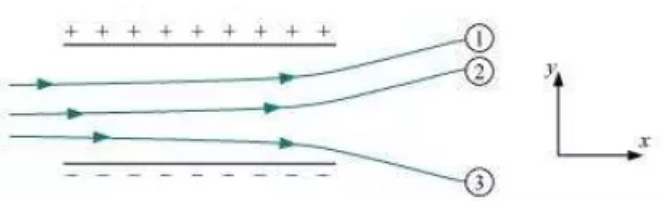
Figure 1.33 shows tracks of three charged particles in a uniform electrostatic field. Give the signs of the three charges. Which particle has the highest charge to mass ratio?
Trace the rays which are passing through a convex lens and a concave lens.
Explain the use of motor starter.
Two bodies make an elastic head-on collision on a smooth horizontal table kept in a car. Do you expect a change in the result if the car is accelerated on a horizontal road because of the noninertial character of the frame? Does the equation "Velocity of separation = Velocity of approach" remain valid in an accelerating car? Does the equation "Final momentum = Initial momentum" remain valid in the accelerating car?
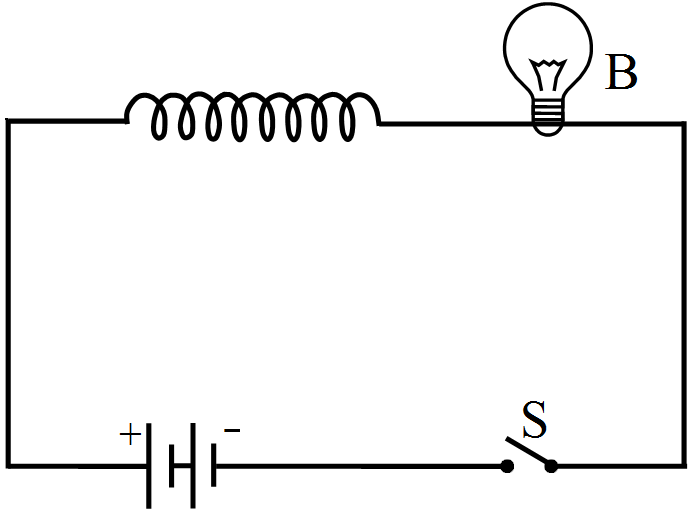
Figure shows a light bulb (B) and iron cored inductor connected to a dc battery through a switch (S).
  1. What will one observe when switch (S) is closed?
  2. How will the glow of the bulb change when the battery is replaced by an ac source of rms voltage equal to the voltage of dc battery? Justify your answer in each case.
You have learnt in the text how Huygens’ principle leads to the laws of reflection and refraction. Use the same principle to deduce directly that a point object placed in front of a plane mirror produces a virtual image whose distance from the mirror is equal to the object distance from the mirror.