Question
Is $\text{p}=\frac{\text{E}}{\text{c}}$ valid for electrons?

Answer

From Einstein's mass- energy equation,

$\text{E}=\text{mc}^2$

$\Rightarrow\text{E}=\frac{\text{m}_0\text{c}^2}{\sqrt{1\frac{\text{v}^2}{\text{c}^2}}}$

Relativistic momentum,

$\text{p}=\text{mv}$

$\Rightarrow\text{p}=\frac{\text{m}_0\text{c}^2}{\sqrt{1\frac{\text{v}^2}{\text{c}^2}}}$

Combining the above equations, we get:

$\text{E}^2=\text{m}_0^2\text{c}^ 4+\text{p}^2\text{c}^2$

From the above equation, it is clear that for $\text{p}=\frac{\text{E}}{\text{c}}$ to be valid, the rest mass of the body should be zero. As electrons do not have zero rest mass, this equation is not valid for electrons.

Need a full question paper?

Generate a complete, print-ready paper with questions like this in minutes — across 16+ boards, with answer keys.
Start Generating Free

Similar questions

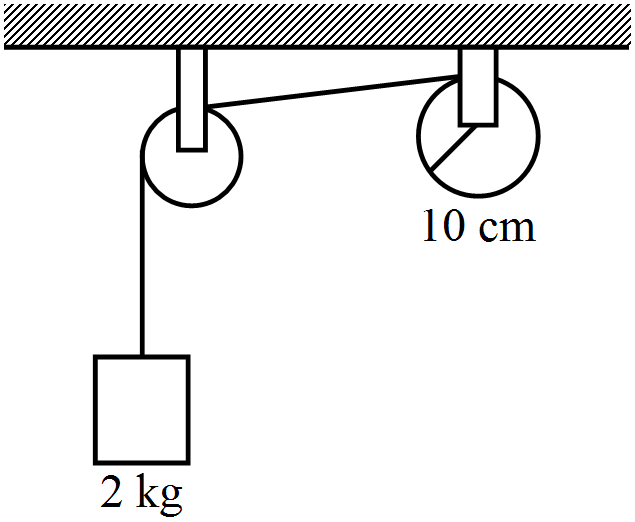
A string is wrapped on a wheel of moment of inertia 0.20kg-m2 and radius 10cm and goes through a light pulley to support a block of mass 2.0kg as shown in figure. Find the acceleration of the block.

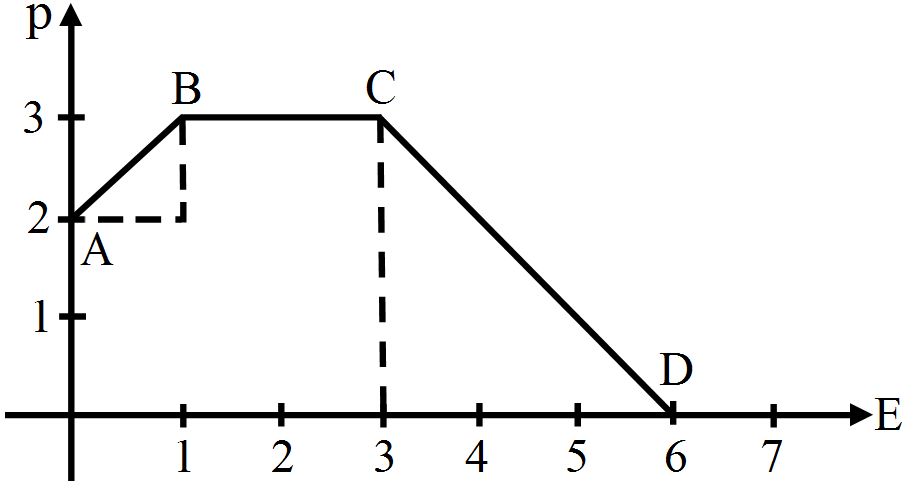
Figure shows momentum versus time graph for a particle moving along x-axis. In which region, force on the particle is large. Why?

A metallic ball has a radius of 9.0cm at 0°C. Calculate the change in its volume when it is heated to 90°C. Given that coefficient of linear expansion of metal of ball is 1.2 × 10⁻⁵K-1.
Water near the bed of a deep river is quiet while that near the surface flows. Give reasons.
A body starts from a point A and moves to B. If it returns to the same point, find the:
  1. Displacement.
  2. Distance.
  3. Velocity.
  4. Average speed.
[Given: AB = s, velocity = v]
The magnetic field due to a long straight wire has been derived in terms of $\mu_0,$ i and d. Express this in terms of $\in_0,$ C, i and d.
An atmospheric pressure is 106 dyne/cm². Find its value in SI unit system.
Calculate the efficiency of a Carnot's engine working between steam point and ice point.
Briefly explain the formation of trade wind.
Two bodies A and B have thermal emissivity of 0.01 and 0.81 respectively. The outer surface area as of both the bodies are same. The two emit the same total radiated power. The wavelength $\lambda_\text{B}$ corresponding to the maximum intensity in radiations from B, is shifted from the wavelength $\lambda_\text{A}$ a corresponding to the maximum intensity in radiations from A by $1\mu\text{m}.$ If the temperature of body A is 5802K, find the temperature of body B and the wavelength ago $\lambda_\text{B}.$