Question
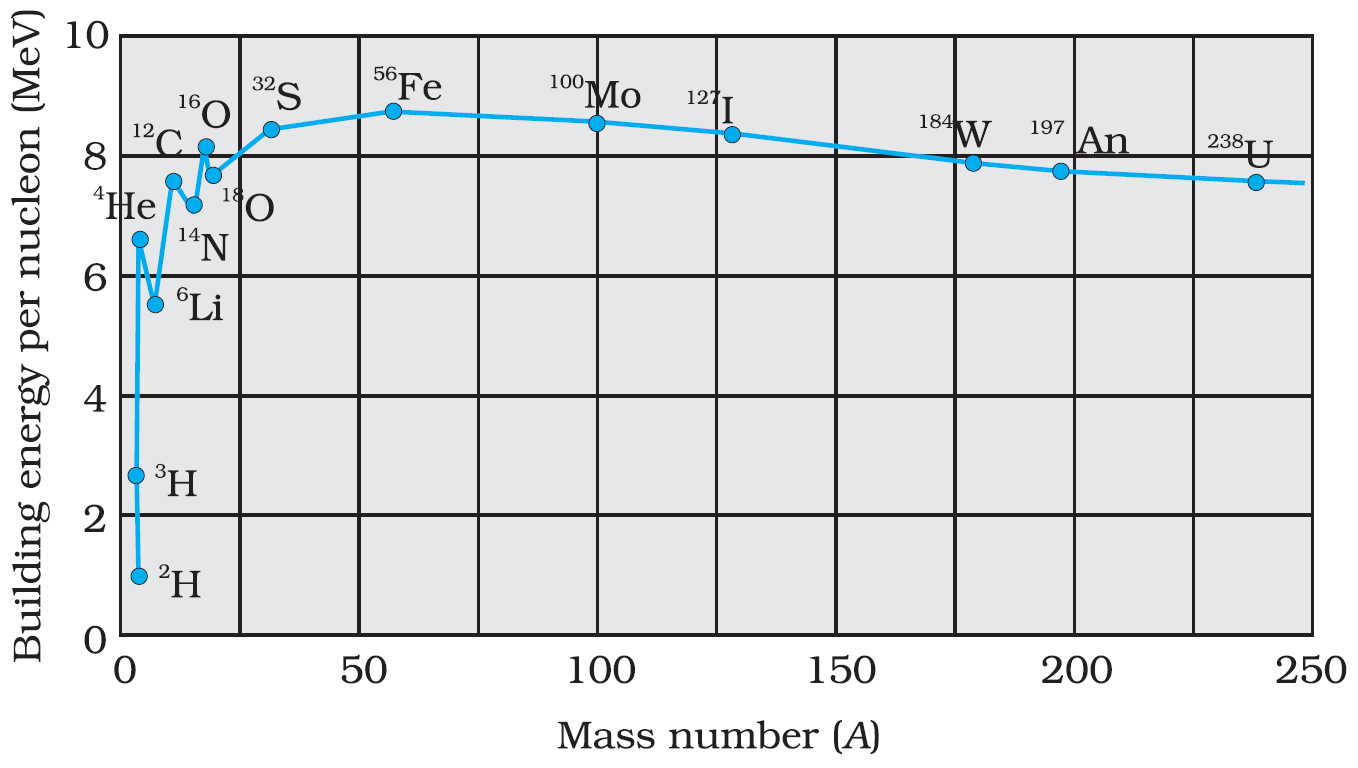
  1. Explain the processes of nuclear fission and nuclear fusion by using the plot of binding energy per nucleon (BE/ A) versus the mass number A.
  2. A radioactive isotope has a half-life of 10 years. How long will it take for the activity to reduce to 3·125%?

Answer

  1.  


Nuclear fission: Binding energy per nucleon is smaller for heavier nuclei (greater than 200) i.e., heavier nuclei are less stable. When a heavier nucleus splits into the lighter nuclei, they become stable, this happens in nuclear fission.

Nuclear fusion: The binding energy per nucleon is small for light nuclei (between 2 to 20), i.e., they are less stable. So when two light nuclei combine to form a heavier nucleus, the higher binding energy per nucleon of the latter results in the release of energy. This is what happens in a nuclear fusion.
  1. $\frac{\text{R}}{\text{R}_0}=\frac{\text{N}}{\text{N}_0}=\Big(\frac{1}{2}\Big)^{\text{n}}$
$\frac{\text{R}}{\text{R}_0}=3.125\%=\frac{3.125}{100}=\frac{1}{32}=\Big(\frac{1}{2}\Big)^5$

$=\Big(\frac{1}{2}\Big)^\text{n}=\Big(\frac{1}{2}\Big)^5\Rightarrow\ \text{n}=5$

$\text{t}=\text{nT}_{\frac{1}{2}}=5\times10=50\text{ year}$

Need a full question paper?

Generate a complete, print-ready paper with questions like this in minutes — across 16+ boards, with answer keys.

Start Generating Free

Similar questions

A beam of light moving along $x$-axis is represented by the electric field $E_y=600 Vm ^{-1} \sin \omega$ $\left(t-\frac{x}{c}\right)$. Calculate the maximum magnitudes of electric and magnetic fields on a charge $q=2 e$ moving along the $y$-axis with a speed of $3.0 \times 10^7 m / s$ (where $\left.e=1.6 \times 10^{-19} C \right)$.
An electron and photon have same energy 100eV. Which has greater associated wavelength?
What is the magnitude of magnetic force per unit length on a wire carrying a current of 8 A and making an angle of 30º with the direction of a uniform magnetic field of 0.15 T?
What is the kinetic energy of an electron in electronvolts with mass equal to double its rest mass?
Can an electromagnetic wave be deflected by an electric field or a magnetic field?
The condition of air in a cloeed room is described as follows. Temperature = 25°C, relative humidity = 60%, pressure = 104kPa. lf all the water vapour is removed from the room without changing the temperature, what will be the new pressure? The saturation vapour pressure at 25°C = 3.2kPa.
popular game in Indian villages is goli which is played with small glass balls called golis. The goli of one player is situated at a distance of 2.0m from the goli of the second player. This second player has to project his goli by keeping the thumb of the left hand at the place of his goli, holding the goli between his two middle fingers and making the throw. If the projected goli hits the goli of the first player, the second player wins. If the height from which the goli is projected is 19.6cm from the ground and the goli is to be projected horizontally, with what speed should it be projected so that it directly hits the stationary goli without falling on the ground earlier?
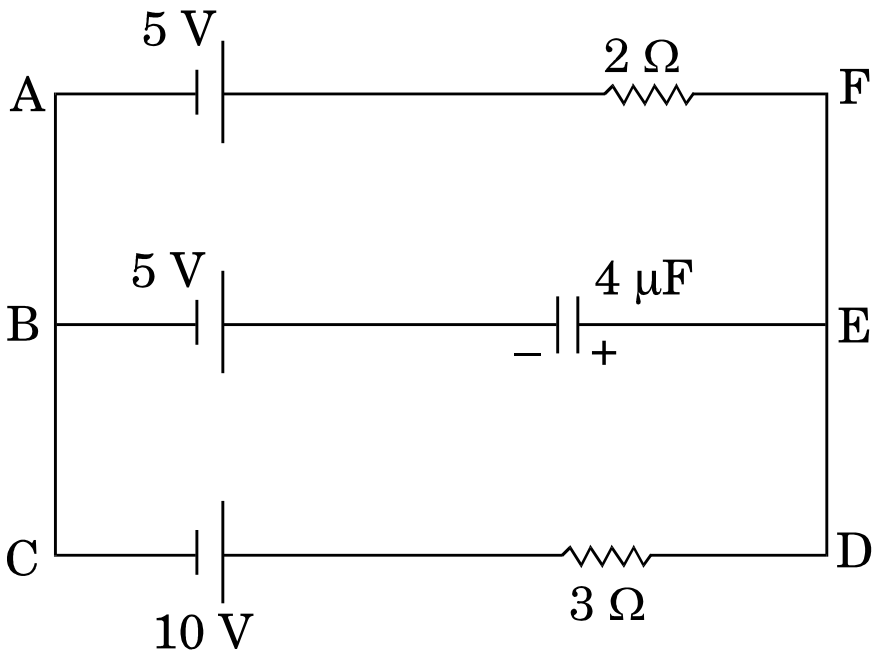
In the given circuit, with steady current, calculate the potential drop across the capacitor in terms of V.
A spring stores 5J of energy when stretched by 25cm. It is kept vertical with the lower end fixed. A block fastened to its other end is made to undergo small oscillations. If the block makes 5 oscillations each second, what is the mass of the block?
Find the Q-value and the kinetic energy of the emitted α-particle in the $\alpha $-decay of
  1. $^{226}_{88}\text{Ra}$ and
  2. $^{220}_{86}\text{Rn}.$
Given

$\text{m}(^{226}_{88}\text{Ra})=226.02540\text{ u}.$ $\text{m}(^{222}_{86}\text{Rn})=222.01750\text{ u}.$

$\text{m}(^{222}_{86}\text{Rn})=220.01137\text{ u}.$ $\text{m}(^{216}_{84}\text{Po})=216.00189\text{ u}.$