Question
Is the given sequence $a, 2a, 3a, 4a,...$ forms an$ AP$? If it forms an $AP$, then find the common difference d and write the next three terms.

Answer

from the given sequence, we can have
$a_{2}-a_{1}=2 a-a=a$
$a_{3}-a_{2}=3 a-2 a=a$
$ a_{4}-a_{3}=4 a-3 a=a$
since $a_{k+1}-a_{k}$ i.e. the common difference is the same for all values of k
Hence, the given sequence forms an AP.
Now the next three terms are:
$a_5= a + 4d = a + 4a = 5a$
$a_6= a + 5d = a + 5a = 6a$
$a_7= a + 6d = a + 6a = 7a$
Next three terms are: 5a, 6a and 7a

Need a full question paper?

Generate a complete, print-ready paper with questions like this in minutes — across 16+ boards, with answer keys.
Start Generating Free

Similar questions

If $\text{A, B, C}$ are interior angles of a $\triangle \text{A B C}$, then Show that : $\sin \left(\frac{B+C}{2}\right)=\cos \frac{A}{2}$
Solve the following systems of equations:
2(3u - ν) = 5uν,
2(u + 3ν) = 5uν.
A rectangular piece is $20\ m$ long and $15\ m$ wide. From its four corners, quadrants of radii $3.5\ m$ have been cut. Find the area of the remaining part.
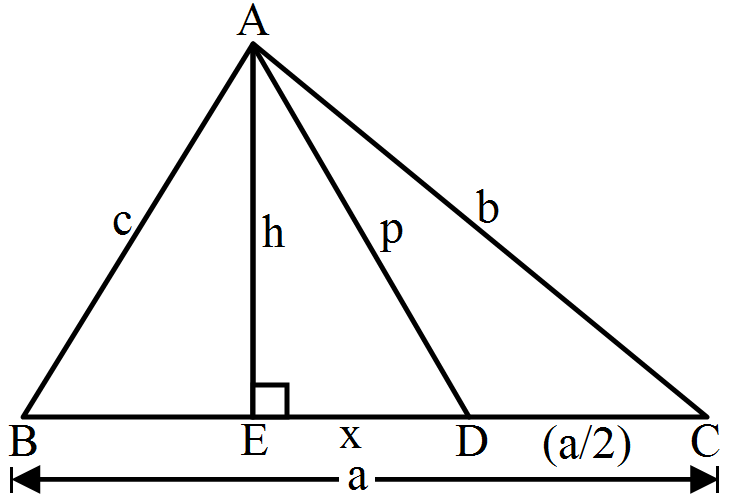
In the given figure, D is the midpoint of side BC and $\text{AE}\perp\text{BC}.$ If BC = a, AC = b, AB = c, ED = x, AD = p and AE = h, prove that.
$(\text{b}^2-\text{c}^2)=2\text{ax}$
Find the roots of the quadratic equations by using the quadratic formula in each of the following:
$2x^2 - 3x - 5 = 0$
Find the value of k for which the following equations have real and equal roots:
$(k + 1)x^2 - 2(k - 1)x + 1 = 0$
A well of diameter $4 m$ is dug $21 m$ deep. The earth taken out of it has been spread evenly all around it in the shape of a circular ring of width to form an embankment. Find the height of the embankment.
Using prime factorization, find the $HCF$ and $LCM$ of:
$396, 1080$
Solve the following equations by using the method of completing the square:
$\frac{2}{\text{x}^2}-\frac{5}{\text{x}}+2=0$
During the $2011$ census, the records of various aspects like good health, death rate and literacy rate were recorded for all the States and Union territories of India. The Literacy rates of $40$ cities are given in the following table:
Literacy rate $($in $\%)$ $35-40$ $40-45$ $45-50$ $50-55$ $55-60$ $60-65$ $65-70$ $70-75$ $75-80$ $80-85$ $85-90$
Number of cities $1$ $2$ $3$ $x$ $y$ $6$ $8$ $4$ $2$ $3$ $2$
If it is given that the mean literacy rate is $63.5,$ then find the missing frequencies $x$ and $y.$