The rate of radiation of a black body at $0°C$ is $E\,J/sec$ . The rate of radiation of this black body at ${273^o}C$ will be
Medium
Download our app for free and get started
(a) $\frac{{{E_1}}}{{{E_2}}} = {\left( {\frac{{{T_1}}}{{{T_2}}}} \right)^4} \Rightarrow \frac{E}{{{E_2}}} = {\left( {\frac{{273 + 0}}{{273 + 273}}} \right)^4}$$ \Rightarrow {E_2} = 16\;E$.

Download our appand get started for free
Experience the future of education. Simply download our apps or reach out to us for more information. Let's shape the future of learning together!No signup needed.*
Similar Questions
- 1Instantaneous temperature difference between cooling body and the surroundings obeying Newton's law of cooling is $\theta$. Which of the following represents the variation of $\ln \theta$ with time $t$ ?View Solution
- 2Hot water cools from ${60^o}C$ to ${50^o}C$ in the first $10$ minutes and to ${42^o}C$ in the next $10$ minutes. The temperature of the surrounding is ......... $^oC$View Solution
- 3A cylindrical steel rod of length $0.10 \,m$ and thermal conductivity $50 \,Wm ^{-1} K ^{-1}$ is welded end to end to copper rod of thermal conductivity $400 \,Wm ^{-1} K ^{-1}$ and of the same area of cross-section but $0.20 \,m$ long. The free end of the steel rod is maintained at $100^{\circ} C$ and that of the copper rod at $0^{\circ} C$. Assuming that the rods are perfectly insulated from the surrounding, the temperature at the junction of the two rods is ................... $^{\circ} C$View Solution
- 4Find Temperature difference between $B$ and $C$ ? (All rods are identical)View Solution
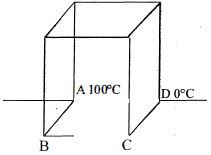
- 5hree rods of same dimensions are arranged as shown in figure they have thermal conductivities ${K_1},{K_2}$ and${K_3}$ The points $P$ and $Q$ are maintained at different temperatures for the heat to flow at the same rate along $PRQ$ and $PQ$ then which of the following option is correctView Solution
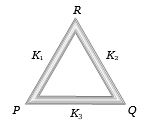
- 6View SolutionIce is used in a cooler in order to cool its contents. Which of the following will speed up the cooling process?
- 7View SolutionThe amount of radiation emitted by a perfectly black body is proportional to
- 8A body of length 1m having cross sectional area $0.75\;m^2$ has heat flow through it at the rate of $ 6000\; Joule/sec$ . Then find the temperature difference if $K = 200\;J{m^{ - 1}}{K^{ - 1}}$ ...... $^oC$View Solution
- 9A cup of coffee cools from $90^{\circ} \mathrm{C}$ to $80^{\circ} \mathrm{C}$ in $\mathrm{t}$ minutes, when the room temperature is $20^{\circ} \mathrm{C}$. The time taken by a similar cup of coffee to cool from $80^{\circ} \mathrm{C}$ to $60^{\circ} \mathrm{C}$ at a room temperature same at $20^{\circ} \mathrm{C}$ is :View Solution
- 10Two identical square rods of metal are welded end to end as shown in figure $(i)$ , $20$ calories of heat flows through it in $4$ minutes. If the rods are welded as shown in figure $(ii)$, the same amount of heat will flow through the rods in ....... $\min.$View Solution