A black body at a temperature of $1640 K$ has the wavelength corresponding to maximum emission equal to $1.75$ $\mu $. Assuming the moon to be a perfectly black body, the temperature of the moon, if the wavelength corresponding to maximum emission is $ 14.35$ $\mu $ is ...... $K$
Easy


Download our appand get started for free
Experience the future of education. Simply download our apps or reach out to us for more information. Let's shape the future of learning together!No signup needed.*
Similar Questions
- 1View SolutionA piece of blue glass heated to a high temperature and a piece of red glass at room temperature, are taken inside a dimly lit room then
- 2There are two spherical balls $A$ and $B$ of the same material with same surface, but the diameter of $A$ is half that of $B$. If $A$ and $B$ are heated to the same temperature and then allowed to cool, thenView Solution
- 3View SolutionAs compared to the person with white skin, the person with black skin will experience
- 4View SolutionThe spectrum from a black body radiation is a
- 5$Assertion :$ A body that is good radiator is also a good absorber of radiation at a given wavelength.View Solution
$Reason :$ According to Kirchhoff’s law the absorptivity of a body is equal to its emissivity at a given wavelength. - 6View SolutionAt a certain temperature for given wave length, the ratio of emissive power of a body to emissive power of black body in same circumstances is known as
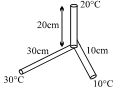
- 7Three rods made of the same material and having same cross-sectional area but different lengths $10\,\,cm$, $\,\,20 cm$ and $30\,\,cm$ are joined as shown. The temperature of the joint is ....... $^oC$View Solution
- 8A hollow sphere of inner radius $R$ and outer radius $2R$ is made of a material of thermal conductivity $K$. It is surrounded by another hollow sphere of inner radius $2R$ and outer radius $3R$ made of same material of thermal conductivity $K$. The inside of smaller sphere is maintained at $0^o C$ and the outside of bigger sphere at $100^o C$. The system is in steady state. The temperature of the interface will be ........ $^oC$View Solution
- 9View SolutionA piece of glass is heated to a high temperature and then allowed to cool. If it cracks, a probable reason for this is the following property of glass
- 10The absolute temperatures of two black bodies are $2000 K$ and $3000 K$ respectively. The ratio of wavelengths corresponding to maximum emission of radiation by them will beView Solution