Question
It is found experimentally that $13.6 eV$ energy is required to separate a hydrogen atom into a proton and an electron. Compute the orbital radius and the velocity of the electron in a hydrogen atom.

Answer

Total energy of the electron in hydrogen atom is $-13.6 eV =-13.6 \times 1.6 \times 10^{-19} J$
$=-2.2 \times 10^{-18} J$
Thus from Eq., we have
$-\frac{e^2}{8 \pi \varepsilon_0 r}= E$
This gives the orbital radius
$r=-\frac{e^2}{8 \pi \varepsilon_0 E}$
$=-\frac{\left(9 \times 10^9 Nm ^2 / C ^2\right)\left(1.6 \times 10^{-19} C \right)^2}{(2)\left(-2.2 \times 10^{-18} J\right)}$
$=5.3 \times 10^{-11} m$
The velocity of the revolving electron can be computed from Eq. with $m =9.1 \times 10^{-31} \ kg$,
$\frac{1}{2} m v^2=\frac{e^2}{4 \pi \epsilon_0 r^2}$ thus velocity of electron is given by : $-$
$v=\frac{e}{\sqrt{4 \pi \varepsilon_0 m r^2}}$
$=2.2 \times 10^6 m / s$

Need a full question paper?

Generate a complete, print-ready paper with questions like this in minutes — across 16+ boards, with answer keys.
Start Generating Free

Similar questions

Define the term magnetic inclination. Deduce the relation connecting the horizontal component and inclination with the help of a diagram.
  1. Define torque acting on a dipole of dipole moment $\overrightarrow{p}$ placed in a uniform electric field $\overrightarrow{\text{E}}$. Express it in the vector form and point out the direction along which it acts.
  2. What happens if the field is non-uniform?
  3. What would happen if the external field $\overrightarrow{\text{E}}$ is increasing (i) parallel to $\overrightarrow{p}$ and (ii) anti-parallel to $\overrightarrow{p}$?
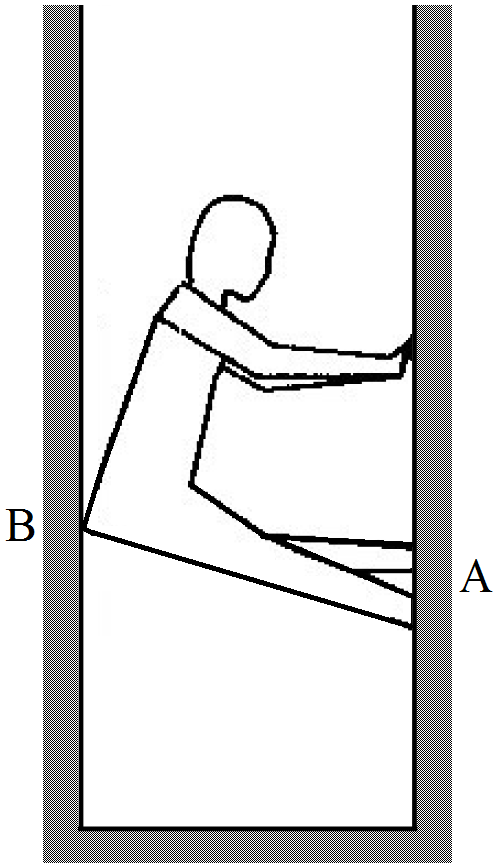
A person $(40\ kg)$ is managing to be at rest between two vertical walls by pressing one wall A by his hands and feet and the other wall B by his back. Assume that the friction coefficient between his body and the walls is $0.8$ and that limiting friction acts at all the contacts.
  1. Show that the person pushes the two walls with equal force.
  2. Find the normal force exerted by either wall on the person. Take $g = 10m/s^2.$
Sketch a graph showing the variation of fringe width versus the distance of the screen from the plane of the slits (keeping other parameters same) in Young’s double slit experiment. What information can one obtain from the slope of this graph?
Explain the principle, construction, working and application of moving coil galvanometer.
The magnetic field due to a long straight wire has been derived in terms of $\mu_0,$ i and d. Express this in terms of $\epsilon_0,$ C, i and d.
A particle of mass ‘m’, with charge ‘q’ moving with a uniform speed ‘v’, normal to a uniform magnetic field ‘B’, describes a circular path of radius ‘r’. Derive expressions for the:
  1. Time period of revolution.
  2. Kinetic energy of the particle.
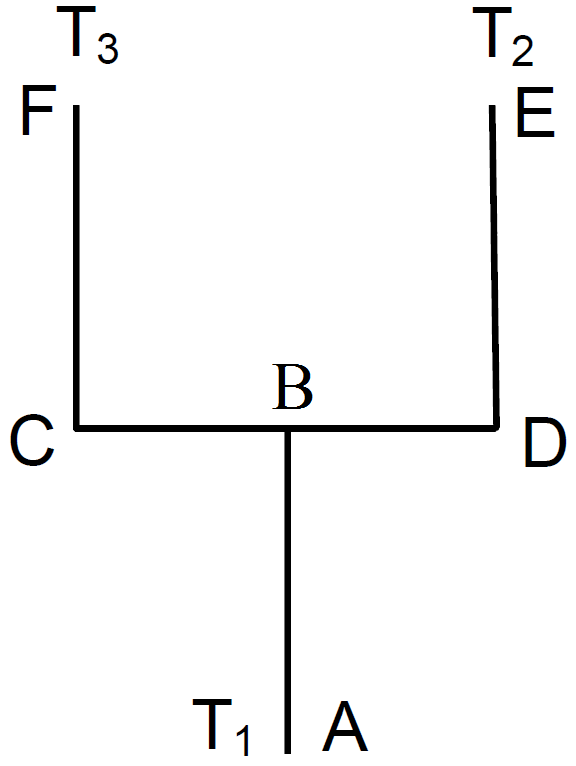
Four identical rods $AB, CD, CF$ and $DE$ are joined as shown in figure. The length, cross$-$sectional area and thermal conductivity of each rod are $l, A$ and $K$ respectively. The ends $A, E$ and $F$ are maintained at temperatures $T_1, T_2$ and $T_3$ respectively. Assuming no loss of heat to the atmosphere, find the temperature at $B.$​​​​​​​
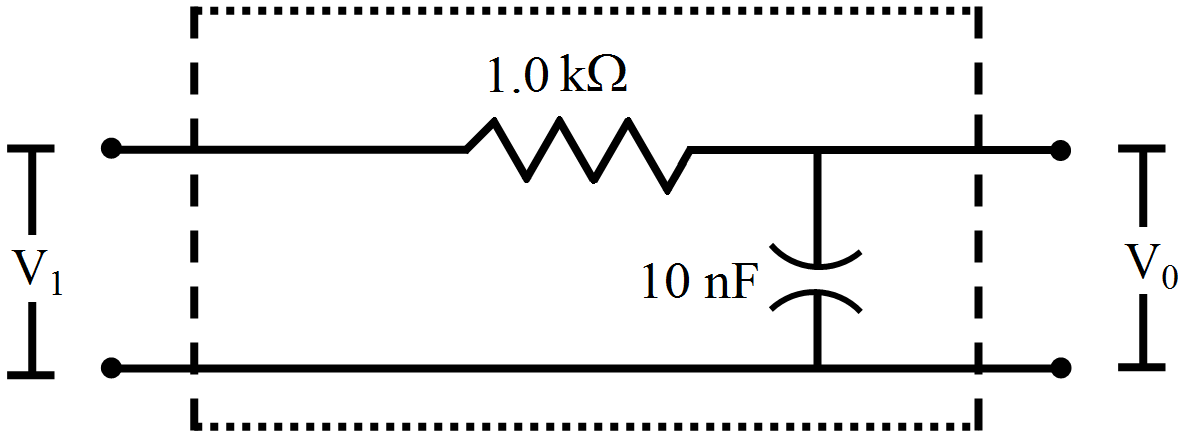
Figure shows a typical circuit for a low$-$pass filter. An $AC$ input $V_{i }= 10mV$ is applied at the left end and the output $V_0$ is received at the right end. Find the output voltage for$ ν = 10\ kHz, 1.0\ MHz$ and $10.0\ MHz.$ Note that as the frequency is increased the output decreases and, hence, the name low$-$pass filter.
Should the energy of a photon be called its kinetic energy or its internal energy?