Question
Explain the principle, construction, working and application of moving coil galvanometer.

Answer

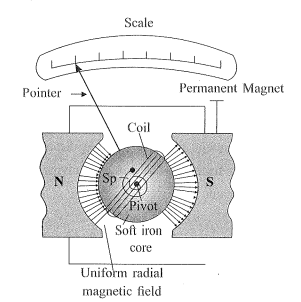
Image
Figure shows a moving coil galvanometer.
• Principle :
A torque is exerted on the current carrying coil placed in uniform magnetic field.
• Construction :
A thin copper wire is wounded on rectangular frame placed between two cylindrical permanent magnets as shown in the figure. The coil is arranged so it can rotate freely.
A small cylinder of soft iron is placed on the axis of the coil, without touching the coil, to produce a uniform radial magnetic field.
When current is passed through the coil a torque acts on it and it deflects. The steady deflection of coil is indicated by a pointer attached with it.
• Working :
When a current flows through the coil, a torque acts on it, causing it to deflect.
If the area vector of the coil makes an angle $\theta$ with the magnetic field, torque acting on coil is
$\tau= NIBA \sin \theta$
Due to the radial magnetic field, the angle between $\overrightarrow{ A }$ and $\overrightarrow{ B }$ will always be $90^{\circ}$.
$\therefore \tau=\text { NIBA }$
Due to the deflection of the coil, the restoring torque is produced in the spring which is directly proportional to the deflection of the coil $(\phi)$
$\therefore$ Restoring torque $\tau^{\prime}=k \phi$
Where, $k=$ torsional constant of the spring.
For steady deflection, from equation (1) \& (2)
$\begin{aligned}
\tau^{\prime} & =\tau \\
k \phi & =\text { NIAB } \\
\therefore \phi & =\left(\frac{ BAN }{k}\right) \cdot I \\
\therefore \phi & \propto I \quad(\because B , A , N , K \text { are constant })
\end{aligned}$
Thus, the deflection of the coil is directly proportional to the current.
Uses : Galvanometer is used to detect the presence of current in the circuit.
To measure small electric currents (of the order $10^{-6} A$ )
Using galvanometer, ammeter and voltmeter can be constructed.

Need a full question paper?

Generate a complete, print-ready paper with questions like this in minutes — across 16+ boards, with answer keys.
Start Generating Free

Similar questions

Consider two conducting spheres of radii $R_1$ and $R_2$ with $R_1 > R_2$​​​​​​​. If the two are at the same potential, the larger sphere has more charge than the smaller sphere. State whether the charge density of the smaller sphere is more or less than that of the larger one.
What physical quantity is the same for $X-$rays of wavelength $10^{-10} m,$ red light of wavelength $6800 \mathring A$ and radiowaves of wavelength $500m$?
Draw a plot showing the variation of binding energy per nucleon with mass number A. Write two important conclusions which you can draw from this plot. Explain with the help of this plot, the release in energy in the processes of nuclear fusion and fission.
A point source emitting light uniformly in all directions is placed 60cm above a table-top. The illuminance at a point on the table-top, directly below the source, is 15 lux. Find the illuminance at a point on the table-top 80cm away from the first point.
Write Einstein’s photoelectric equation and point out any two characteristic properties of photons on which this equation is based.
Briefly, explain the three observed features which can be explained by this equation.
State Lenz's law. Give one example to illustrate this law. "The Lenz's law is a consequence of the principle of conservation of energy." Justify this statement.
$A$ charge of $+2.0 \times 10^{-8}C$ is placed on the positive plate and a charge of $-1.0 \times 10^{-8}C$ on the negative plate of a parallel $-$ plate capacitor of capacitance $1.2\times10^{-3}\mu\text{F}.$ Calculate the potential difference developed between the plates.
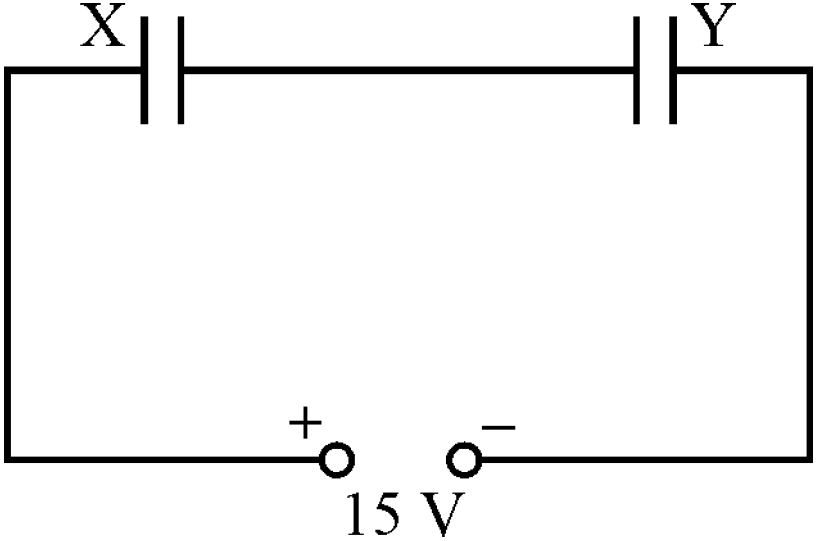
Two parallel plate capacitors X and Y have the same area of plates and same separation between them. X has air between the plates while Y contains a dielectric medium of $\varepsilon_{\text{r}} = 4.$
  1. Calculate capacitance of each capacitor if equivalent capacitance of the combination is $4\mu\text{f}.$
  2. Calculate the potential difference between the plates of X and Y.
  3. Estimate the ratio of electrostatic energy stored in X and Y.
  1. If one of two identical slits producing interference in Young’s experiment is covered with glass, so that the light intensity passing through it is reduced to 50%, find the ratio of the maximum and minimum intensity of the fringe in the interference pattern.
  2. What kind of fringes do you expect to observe if white light is used instead of monochromatic light?
The maximum speed and acceleration of a particle executing simple harmonic motion are $10\ cm/s$ and $50\ cm/s^2.$ Find the position$(s)$ of the particle when the speed is $8\ cm/s.$