Question
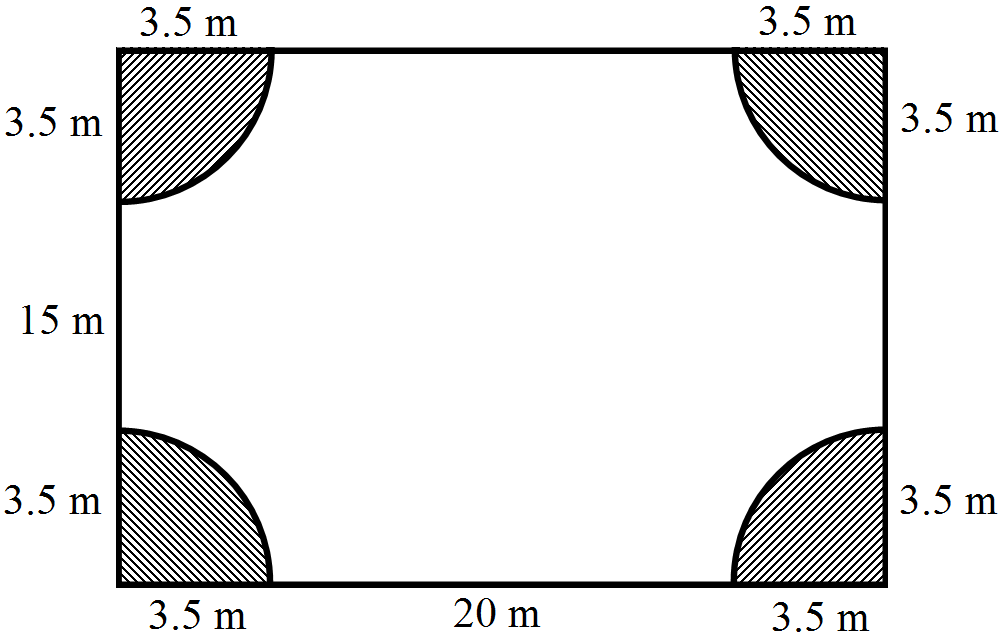
It is given that the length of the rectangular piece is $20\ m$ and its width is $15\ m$.And, from each corner a quadrant each of radius $3.5\ m$ has been cut out. A rough figure for this is given below:
Answer

Length of rectangular portion $(l) = 20m$
breadth $(b) = 15m$

Area of the rectangular piece $= l \times b = 20 \times 15 = 300m^2$
Radius of semicircular portion $(r) = 3.5m$
Total area of $4$ quadrants
$=4\times\frac{1}{4}\times\pi\text{r}^2=\frac{22}{7}\times(3.5)^2\text{m}^2$
$=\frac{22}{7}\times12.25\text{m}^2=22\times1.75\text{m}^2=38.5\text{m}^2$

Need a full question paper?

Generate a complete, print-ready paper with questions like this in minutes — across 16+ boards, with answer keys.
Start Generating Free

Similar questions

Find the least number which must be subtracted from each of the following numbers so as to get a perfect square. Also find the square root of the perfect square so obtained.$3250$
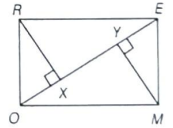
A rectangular MORE is shown below :
Image
Answer the following questions by giving appropriate reason.
(i) Is $R E=O M?$
(ii) Is $\angle MYO =\angle R X E?$
(iii) Is $\angle M O Y=\angle R E X?$
(iv) Is $\triangle M Y O \cong \triangle R X E?$
Tell what property allows you to computer? $\frac{1}{3}\times\Big(6\times\frac{4}{3}\Big)\text{as}\Big(\frac{1}{3}\times6\Big)\times\frac{4}{3}$
Find the multiplicative inverse of the following:$-1$
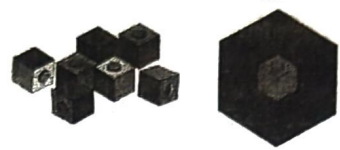
Interlocking cubes come in different colours. Different shapes can be created by joining them.
Image
Sasha is making large cube using small interlocking cubes. She starts with a yellow cube and then fits one layer of red cubes around it to make the large cube.
On the basis of above given information, answer the following questions.

(i) What is the number of red cubes used?
(a) 9 $~~\quad$ (b) 18
(c) 26 $\quad$ (d) 27

(ii) Sasha considers the red layer as the first layer on the yellow cube. Which equation can be used to find the number of red cubes?
(a) $6 x^2$ $~\qquad$ (b) $x^3$
(c) $x^3+1$ $\quad$ (d) $2(x+2)^2+4 x^2$
(iii) The red cube is surrounded by a layer of green cubes. The resulting figure is also a cube. What is the number of green cubes used?
(iv) Shubham puts $\text x$ layers around the yellow cube. How many small cubes did he use on the top-most face of the large cube so formed?
Find the least number which must be subtracted from each of the following numbers so as to get a perfect square. Also find the square root of the perfect square so obtained.
$402$
In a right triangle $ABC, ÐB = 90^\circ $. If $AB = 6 \ cm, BC = 8 \ cm$, find $AC$
Find the least number which must be subtracted from each of the following numbers so as to get a perfect square. Also find the square root of the perfect square so obtained.$1989$
Name the property under multiplication used in the following:$\frac{-19}{29}\times\frac{29}{-19}=1$
Out of the total population of a town, $60 \%$ are males and the rest are females. $20 \%$ of the males and $25 \%$ of the females are illiterate. $85 \%$ of the males and $60 \%$ of the females are employed.
(1) What percentage of the total population is illiterate?
(a) $22 \%$$\quad$(b) $28 \%$$\quad$(c) $35 \%$$\quad$(d) $45 \%$
(2) What is the ratio of the number of literate males to that of illiterate females?
(a) $16: 5$$\quad$(b) $4: 5$$\quad$(c) $24: 5$$\quad$(d) $12: 5$
(3) What percentage of the total population is unemployed?
(a) $25 \%$$\quad$(b) $28 \%$$\quad$(c) $35 \%$$\quad$(d) $45 \%$
(4) What is the ratio of the number of employed males to that of employed females?
(a) $17: 12$$\quad$(b) $8: 3$$\quad$(c) $16: 15$$\quad$(d) $17: 8$