Question
It is known that, if the interest is compounded continuously, the principal changes at the rate equal to the product of the rate of bank interest per annum and the principal. Let P denotes the principal at any time t and rate of interest be r% per annum.

Based on the above information, answer the following question.
  1. Find the value of $\frac{\text{dP}}{\text{dt}}.$
  1. $\frac{\text{Pr}}{1000}$
  2. $\frac{\text{Pr}}{100}$
  3. $\frac{\text{Pr}}{10}$
  4. $\text{Pr}$
  1. If P0 be the initial principal, then find the solution of differential equation formed in given situation.
  1. $\log\Big(\frac{\text{P}}{\text{P}_0}\Big)=\frac{\text{rt}}{100}$
  2. $\log\Big(\frac{\text{P}}{\text{P}_0}\Big)=\frac{\text{rt}}{10}$
  3. $\log\Big(\frac{\text{P}}{\text{P}_0}\Big)=\text{rt}$
  4. $\log\Big(\frac{\text{P}}{\text{P}_0}\Big)=100\text{rt}$
  1. If the interest is compounded continuously at 5% per annum, in how many years will ₹ 100 double itself?
  1. 12.728 years
  2. 14.789 years
  3. 13.862 years
  4. 15.872 years
  1. At what interest rate will ₹ 100 double itself in 10 years? $(\log_\text{e}2 = 0.6931 ).$
  1. 9.66%
  2. 8.239%
  3. 7.341%
  4. 6.931%
  1. How much will ₹ 1000 be worth at 5% interest after 10 years? (e0.5 = 1.648).
  1. ₹ 1648
  2. ₹ 1500
  3. ₹ 1664
  4. ₹ 1572

Answer

  1. (b) $\frac{\text{Pr}}{100}$

Solution:

Here, P denotes the principal at any time t and the rate of interest be r% per annum compounded continuously, then according to the law given in the problem, we get

$\frac{\text{dP}}{\text{dt}}=\frac{\text{Pr}}{100}$

  1. (a) $\log\Big(\frac{\text{P}}{\text{P}_0}\Big)=\frac{\text{rt}}{100}$

Solution:

We have, $\frac{\text{dP}}{\text{dt}}=\frac{\text{Pr}}{100}$

$\Rightarrow\frac{\text{dP}}{\text{P}}=\frac{\text{r}}{100}\text{dt}$

$\Rightarrow\int\frac{\text{1}}{\text{P}}\text{dP}=\frac{\text{r}}{100}\int\text{dt}$

$\Rightarrow\log\text{P}=\frac{\text{rt}}{100}+\text{C}...\text{(i)}$

$\text{At t}=0,\ \ \text{P}=\text{P}_0.$

$\therefore\ \ \text{C}=\log\text{P}_0$

So, $\log\text{P}=\frac{\text{rt}}{100}+\log\text{p}_0$

$\Rightarrow\log\Big(\frac{\text{P}}{\text{P}_0}\Big)=\frac{\text{rt}}{100}...\text{(ii)}$

  1. (c) 13.862 years

Solution:

We have, r = 5, P= ₹ 100 and P = ₹ 200 = 2P0 Substituting these values in (2), we get

$\log2=\frac{5}{100}\text{t}$

$\Rightarrow\text{t}=20\log_\text{e}$

$2 = 20 × 0.6931\ \text{years} = 13.862\ \text{years}$

  1. (d) 6.931%

Solution:

We have,

P0 = ₹ 100, P = ₹ 200 = 2Pand t = 10 years Substituting these values in (2), we get

$\log2\frac{10\text{r}}{100}\Rightarrow\text{r}=10\log2=10\times0.6931=6.931$

  1. (a) ₹ 1648

Solution:

We have P0 = ₹ 1000, r = 5 and t = 10 Substituting these values in (2), we get

$\log\Big(\frac{\text{P}}{1000}\Big)=\frac{5\times10}{100}=\frac{1}{2}=0.5$

$\Rightarrow\frac{\text{P}}{1000}=\text{e}^{0.5}$

$\Rightarrow\text{ P} = 1000 × 1.648 = ₹ \ 1648$

Need a full question paper?

Generate a complete, print-ready paper with questions like this in minutes — across 16+ boards, with answer keys.

Start Generating Free

Similar questions

Western music concert is organised every year in the stadium that can hold 36000 spectators. With ticket price of ₹ 10, the average attendance has been 24000. Some financial expert estimated that price of a ticket should be determined by the function.
$\text{p}(\text{x})=15-\frac{\text{x}}{3000}$ where x is the number of tickets sold.

Based on the above information, answer the following questions.
  1. The revenue, R as a function of x can be represented as.
  1. $15\text{x}-\frac{\text{x}^2}{3000}$
  2. $15-\frac{\text{x}^2}{3000}$
  3. $15\text{x}-\frac{1}{3000}$
  4. $15\text{x}-\frac{\text{x}}{3000}$
  1. The range of x is.
  1. [24000, 36000]
  2. [0, 24000]
  3. [0, 36000]
  4. None of these
  1. The value of x for which revenue is maximum, is.
  1. 20000
  2. 21000
  3. 22500
  4. 25000
  1. When the revenue is maximum, the price of the ticket is.
  1. ₹ 5
  2. ₹ 5.5
  3. ₹ 7
  4. ₹ 7.5
  1. How many spectators should be present to maximize the revenue?
  1. 21500
  2. 21000
  3. 22000
  4. 22500
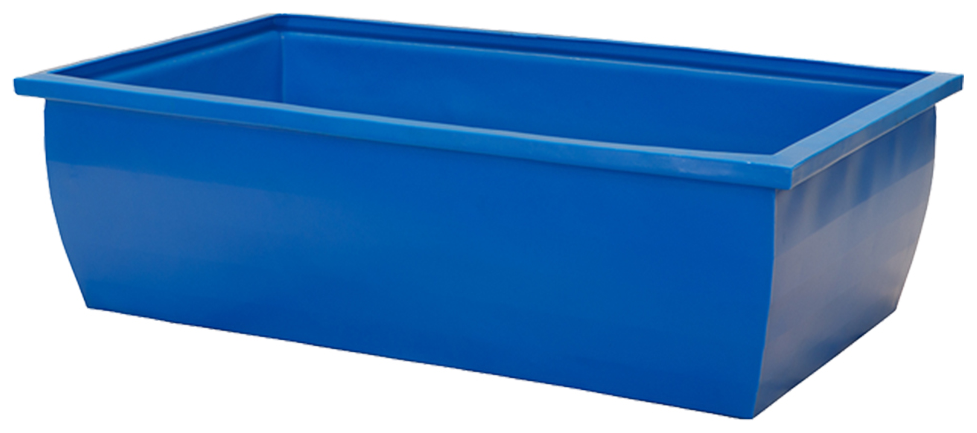
Nitin wants to construct a rectangular plastic tank for his house that can hold 80 ft3 of water. The top of the tank is open. The width of tank will be 5 ft but the length and heights are variables. Building the tank cost? ₹ 20 per sq. foot for the base and ₹ 10 per sq. foot for the side.

Based on the above information, answer the following questions.

  1. In order to make a least expensive water tank, Nitin need to minimize its.
  1. Volume
  2. Base
  3. Curved surface area
  4. Cost
  1. Total cost of tank as a function of h can be represented as.
  1. c(h) = 100h - 320 - 1600/ h
  2. c(h) = 100h - 320h - 720h2
  3. c(h) = 100 + 320h + 1600h2
  4. $\text{c}\big(\text{h}\big)=100\text{h}+320+\frac{1600}{\text{h}}$
  1. Range of h is.
  1. (3, 5)
  2. $\big(0,\infty\big)$
  3. (0, 8)
  4. (0, 3)
  1. Value of hat which c(h) is minimum, is.
  1. 4
  2. 5
  3. 6
  4. 6, 7
  1. The cost of least expensive tank is.
  1. ₹ 1020
  2. ₹ 1100
  3. ₹ 1120
  4. ₹ 1220
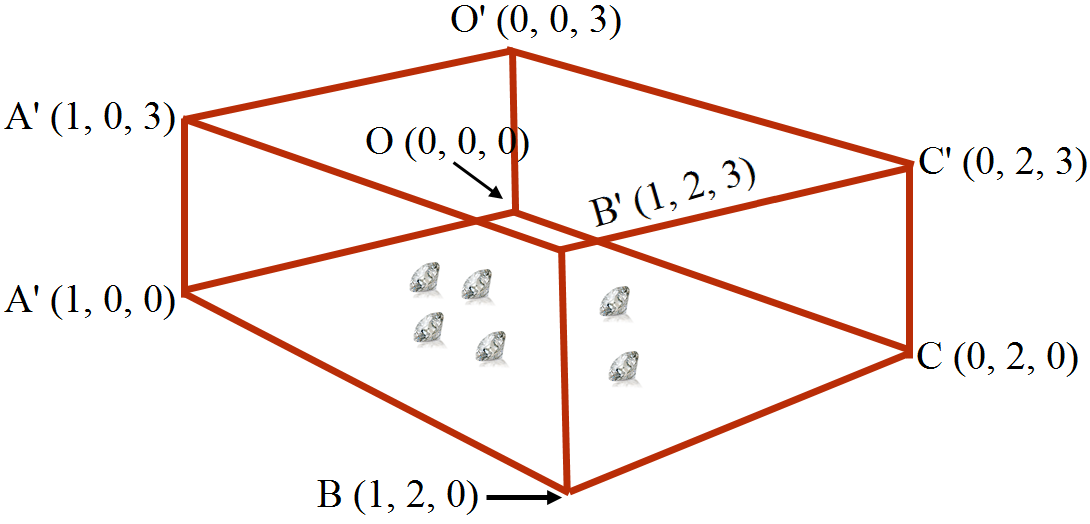
In a diamond exhibition, a diamond is covered in cubical glass box having coordinates O(0, 0, 0), A(1, 0, 0), B(1, 2, 0), C(0, 2, 0), O'(0, 0, 3), A'(1, 0, 3), B'(1, 2, 3) and C'(0, 2, 3).

Based on the above information, answer the following questions.
  1. Direction ratios of OA are:
  1. < 0, 1, 0 >
  2. < 1, 0, 0 >
  3. < 0, 0, 1 >
  4. None of these
  1. Equation of diagonal OB' is:
  1. $\frac{\text{x}}{1}=\frac{\text{y}}{2}=\frac{\text{z}}{3}$

  2. $\frac{\text{x}}{0}=\frac{\text{y}}{1}=\frac{\text{z}}{2}$

  3. $\frac{\text{x}}{1}=\frac{\text{y}}{0}=\frac{\text{z}}{2}$

  4. None of these
  1. Equation of plane OABC is:
  1. x = 0
  2. y = 0
  3. z = 0
  4. None of these
  1. Equation of plane O' A' B' C' is:
  1. x = 3
  2. y = 3
  3. z = 3
  4. z = 2
  1. Equation of plane ABB' A' is:
  1. x = 1
  2. y = 1
  3. z = 2
  4. x = 3
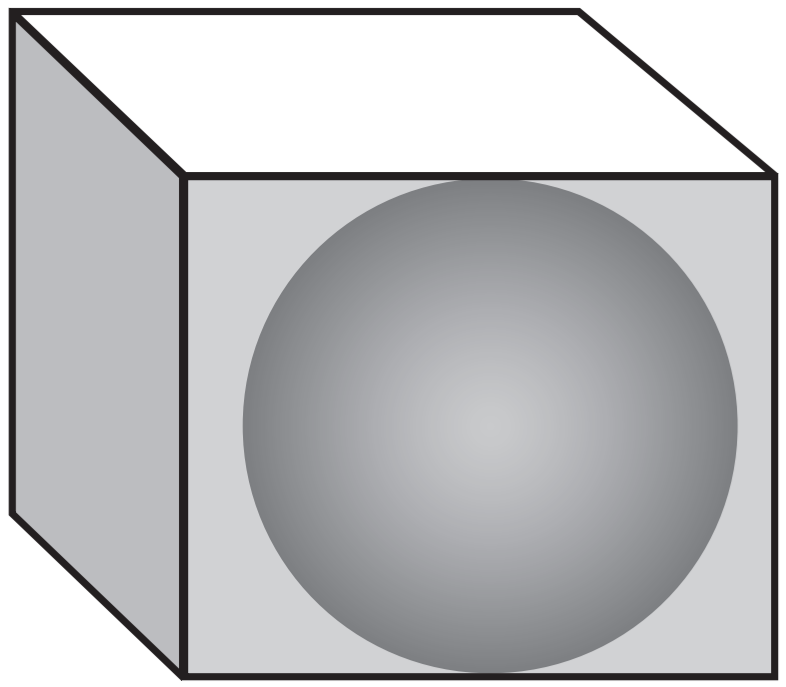
Shreya got a rectangular parallelepiped shaped box and spherical ball inside it as return gift. Sides of the box are x, 2x, and $\frac{\text{x}}{3},$ while radius of the ball is r.

Based on the above information, answer the following questions.
  1. If S represents the sum of volume of parallelepiped and sphere, then Scan be written as.
  1. $\frac{4\text{x}^3}{3}+\frac{2}{2}\pi\text{r}^2$
  2. $\frac{2\text{x}^2}{3}+\frac{4}{3}\pi\text{r}^2$
  3. $\frac{2\text{x}^3}{3}+\frac{4}{3}\pi\text{r}^3$
  4. $\frac{2}{3}\text{x}+\frac{4}{3}\pi\text{r}$
  1. If sum of the surface areas of box and ball are given to be constant k2 then x is equal to.
  1. $\sqrt{\frac{\text{k}^2-4\pi\text{r}^2}{6}}$
  2. $\sqrt{\frac{\text{k}^2-4\pi\text{r}}{6}}$
  3. $\sqrt{\frac{\text{k}^2-4\pi}{6}}$
  4. $\text{None of these}$
  1. The radius of the ball, when Sis minimum, is.
  1. $\sqrt{\frac{\text{k}^2}{54+\pi}}$
  2. $\sqrt{\frac{\text{k}^2}{54+4}}$
  3. $\sqrt{\frac{\text{k}^2}{64+3\pi}}$
  4. $\sqrt{\frac{\text{k}^2}{4\pi+3}}$
  1. Relation between length of the box and radius of the ball can be represented as.
  1. $\text{x} = \frac{2}{\text{r}}$
  2. $\text{x}=\frac{\text{r}}{2}$
  3. $\text{x}=\frac{2}{\text{r}}$
  4. $\text{x}=3\text{r}$
  1. Minimum value of S is.
  1. $\frac{\text{k}^2}{2(3\pi+54)^\frac{2}{3}}$
  2. $\frac{\text{k}}{2(3\pi+54)^\frac{3}{2}}$
  3. $\frac{\text{k}^3}{2(4\pi+54)^\frac{1}{2}}$
  4. $\text{None of these}$
A poster is to be formed for a company advertisement. The top and bottom margins of poster should be 9cm and the side margins should be 6cm. Also, the area for printing the advertisement should be 864cm2.

Based on the above information, answer the following questions.
  1. If a cm be the width and b cm be the height of Poster, then the area of poster, expressed in terms of a and b, is given by.
  1. 648 + 18a + 12b
  2. 18a + 12b
  3. 584 + 18a + 12b
  4. None of these
  1. The relation between a and b is given by.
  1. $\text{a}=\frac{648+12\text{b}}{\text{b}-18}$
  2. $\text{a}=\frac{12\text{b}}{\text{b}-18}$
  3. $\text{a}=\frac{12\text{b}}{\text{b}+18}$
  4. $\text{None of these}$
  1. Area of poster in terms of bis given by.
  1. $\text{a}=\frac{12\text{b}^2}{\text{b}-18}$
  2. $\text{a}=\frac{648\text{b}+12\text{b}^2}{\text{b}-18}$
  3. $\text{a}=\frac{648\text{b}+12\text{b}^2}{\text{b}+18}$
  4. $\text{a}=\frac{12\text{b}^2}{\text{b}+18}$
  1. The value of b, so that area of the poster is minimized, is.
  1. 54
  2. 36
  3. 27
  4. 22
  1. The value of a, so that area of the poster is minimized, is.
  1. 24
  2. 36
  3. 40
  4. 22
Show that for $\text{a}\geq1,\text{ f(x)}=\sqrt{3}\sin\text{x}-\cos\text{x}-2\text{ax}+\text{b}$ is decreasing in R.
A spherical ball of salt is dissolving in water in such a manner that the rate of decrease of the volume at any instant is propotional to the surface. Prove that the radius is decreasing at a constant rate.
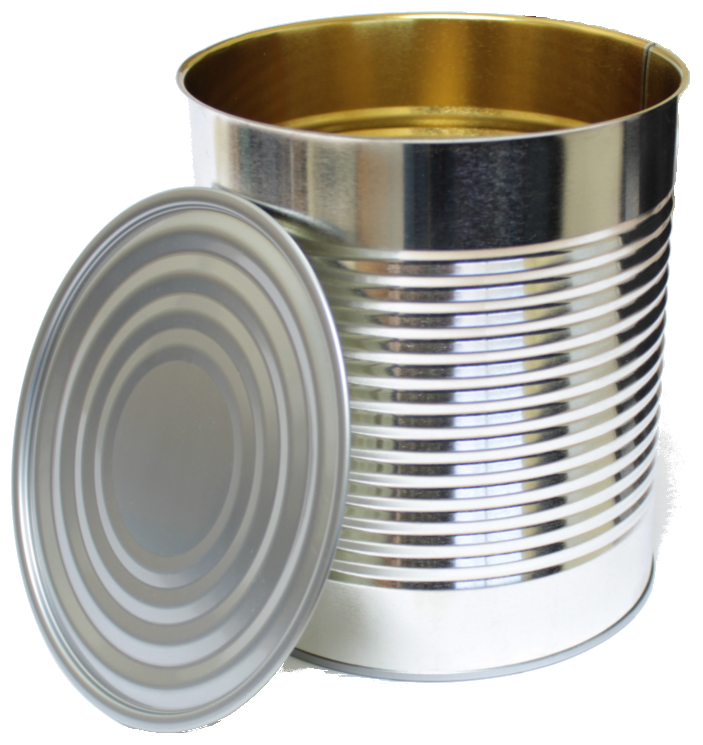
A tin can manufacturer designs a cylindrical tin can for a company making sanitizer and disinfector. The tin can is made to hold 3 litres of sanitizer or disinfector.

Based on the above in formation, answer the following questions.
  1. If r cm be the radius and h cm be the height of the cylindrical tin can, then the surface area expressed as a function of r as.
  1. $2\pi\text{r}^2$
  2. $2\pi\text{r}^2+6000$
  3. $2\pi\text{r}^2+\frac{5000}{\text{r}}$
  4. $2\pi\text{r}^2+\frac{6000}{\text{r}}$
  1. The radius that will minimize the cost of the material to manufacture the tin can is.
  1. $\sqrt[3]{\frac{600}{\pi}}\text{cm}$
  2. $\sqrt{\frac{500}{\pi}}\text{cm}$
  3. $\sqrt[3]{\frac{1500}{\pi}}\text{cm}$
  4. $\sqrt{\frac{1500}{\pi}}\text{cm}$
  1. The height that will minimize the cost of the material to manufacture the tin can is.
  1. $\sqrt[3]{\frac{600}{\pi}}\text{cm}$
  2. $2\sqrt[3]{\frac{1500}{\pi}}\text{cm}$
  3. $\sqrt{\frac{1500}{\pi}}$
  4. $2\sqrt{\frac{1500}{\pi}}$
  1. If the cost of material used to manufacture the tin can is $₹\frac{100}{\text{m}^2}$ and $\sqrt[3]{\frac{1500}{\pi}}\approx7.8,$ then minimum cost is approximately.
  1. ₹ 11.538
  2. ₹ 12
  3. ₹ 13
  4. ₹ 14
  1. To minimize the cost of the material used to manufacture the tin can, we need to minimize the.
  1. Volume.
  2. Curved surface area.
  3. Total surface area.
  4. Surface area of the base.
The function f(x) will be discontinuous at x = a if f(x) has
  • Discontinuity of first kind : $\lim\limits_{\text{h}\rightarrow0}\text{f}(\text{a}-\text{h})$ and $\lim\limits_{\text{h}\rightarrow0}\text{f}(\text{a}+\text{h})$ both exist but are not equal. If is also known as irremovable discontinuity.
  • Discontinuity of second kind : If none of the limits $\lim\limits_{\text{h}\rightarrow0}\text{f}(\text{a}-\text{h})$ and $\lim\limits_{\text{h}\rightarrow0}\text{f}(\text{a}+\text{h})$ exist.
  • Removable discontinuity : $\lim\limits_{\text{h}\rightarrow0}\text{f}(\text{a}-\text{h})$ and $\lim\limits_{\text{h}\rightarrow0}\text{f}(\text{a}+\text{h})$ both exist and equal but not equal to f(a).
Based on the above information, answer the following questions.
  1. If $\text{f}(\text{x})=\begin{cases}\frac{\text{x}^2-9}{\text{x}-3},&\text{for x}\neq3\\4,&\text{for x}=3\end{cases},$ then at x = 3
  1. f has removable discontinuity.
  2. f is continuous.
  3. f has irremovable discontinuity.
  4. None of these.
  1. Let $\text{f}(\text{x})=\begin{cases}\text{x}+2,&\text{if x}\leq4\\\text{x}+4,&\text{if x}\geq4\end{cases}$ then at x = 4
  1. f is continuous.
  2. f has removable discontinuit.
  3. f has irremovable discontinuit.
  4. None of thesee.
  1. Consider the function f(x) defined as $\text{f}(\text{x})=\begin{cases}\frac{\text{x}^2-4}{\text{x}-2},&\text{for x}\neq2\\5,&\text{for x}=2\end{cases},$ then at x = 2
  1. f has removable discontinuity.
  2. f has irremovable discontinuity.
  3. f is continuous.
  4. f is continuous if f(2) = 3
  1. If $\text{f}(\text{x})=\begin{cases}\frac{\text{x}-|\text{x}|}{\text{x}},&\text{x}\neq0\\2,&\text{x}=0\end{cases},$ then at x = 0
  1. f is continuous.
  2. f has removable discontinuity.
  3. f has irremovable discontinuity.
  4. None of these.
  1. If $\text{f}(\text{x})=\begin{cases}\frac{\text{e}^\text{x}-1}{\log(1+2\text{x})},&\text{if x}\neq0\\7,&\text{if x}=0\end{cases},$ then at x = 0
  1. fis continuous if f(0) = 2
  2. f is continuous
  3. f has irremovable discontinuity.
  4. f has removable discontinuity.
If the area of a circle increases at a uniform rate, then prove that perimeter varies inversely as the radius.