Question
It is required to construct a $10\mu\text{F}$ capacitor which can be connected across a 200V battery. Capacitors of capacitance $10\mu\text{F}$ are available but they can withstand only 50V. Design a combination which can yield the desired result.
Answer

Let there are ‘x’ no of capacitors in series ie in a row
So, x × 50 = 200
⇒ x = 4 capacitors.
Effective capacitance in a row $=\frac{10}{4}$
Now, let there are ‘y’ such rows
So, $\frac{10}{4}\times\text{y}=10$
⇒ y = 4 capacitor.
So, the combinations of four rows each of 4 capacitors.

Need a full question paper?

Generate a complete, print-ready paper with questions like this in minutes — across 16+ boards, with answer keys.

Start Generating Free

Similar questions

An object is moving along $x-$axis in such a way that its displacement is given by $x = 30 + 20t^2$
where $x$ is in metres and $t$ is in seconds.
  1. Find the velocity and acceleration.
  2. What are the initial position and the velocity of the object?
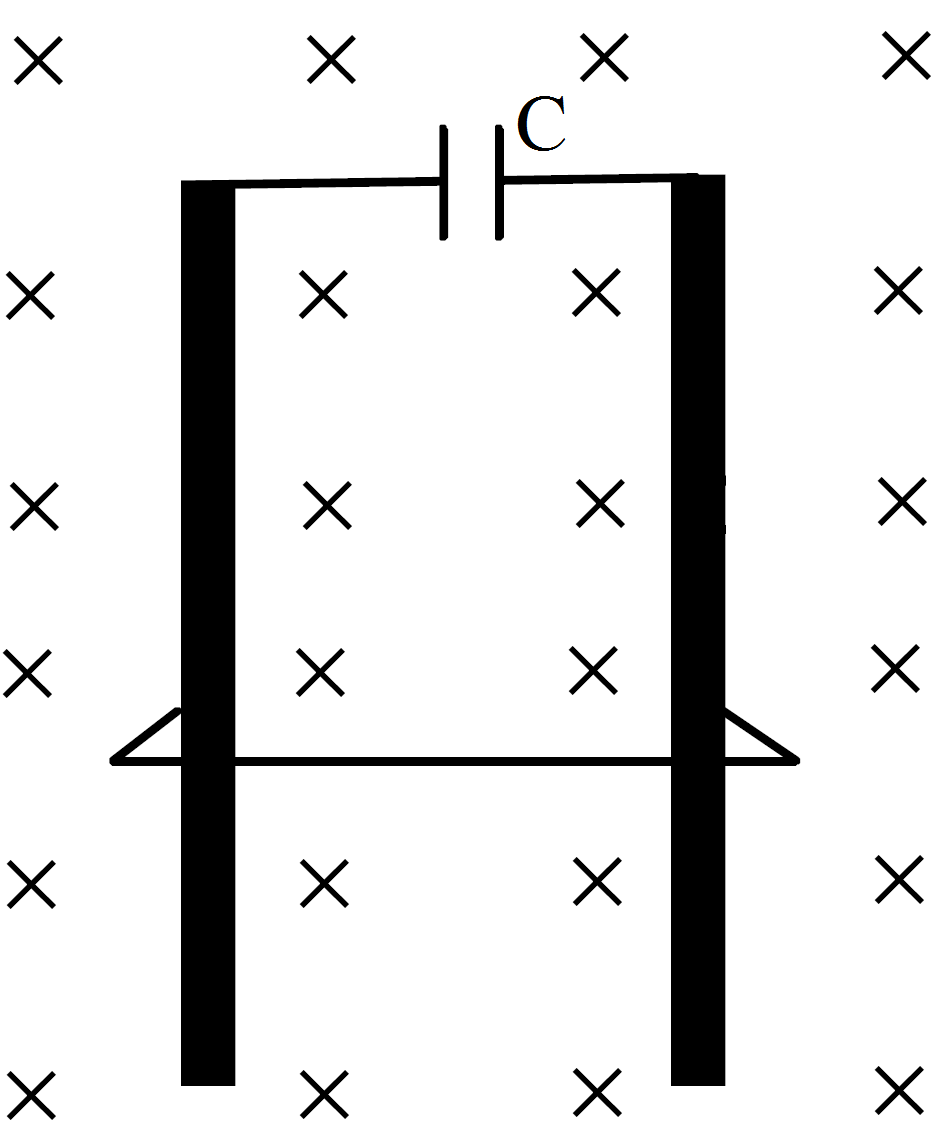
A wire of mass m and length l can slide freely on a pair of smooth, vertical rails (figure). A magnetic field B exists in the region in the direction perpendicular to the plane of the rails. The rails are connected at the top end by a capacitor of capacitance C. Find the acceleration of the wire neglecting any electric resistance.
An ideal gas is kept in a long cylindrical vessel fitted with a frictionless piston of cross-sectional area $10cm^2$ and weight $1kg$. The length of the gas column in the vessel is $20cm$. The atmospheric pressure is $100kPa$. The vessel is now taken into a spaceship revolving round the earth as a satellite. The air pressure in the spaceship is maintained at $100kPa$. Find the length of the gas column in the cylinder.
Check the accuracy of following formulas:
(i) $F =\frac{m v^2}{r}$
(ii) $T =\frac{\text { hrgd }}{2}$
(iii) $T =2 \pi \sqrt{\frac{l}{g}}$
(iv) $Y =\frac{ MgL }{\pi r^2 l}$ Here, Y is Young's modulus.
(v) $S =u t+\frac{1}{2} a t^2$
(vi) $\frac{1}{2} m v^2=m g h$
(vii) $v^2=u^2+2 a s$ where $v$ and $u$ are final and initial velociteis respectively. a is acceleration and $s$ is the distance covered.
(viii) $n=\frac{1}{2 l} \sqrt{\frac{T}{m}}$, Here $n$ is frequency, T is tension force, $l$ is length and $m$ is mass of unit length.
Explain two-dimensional motion by giving an example. Explain the displacement, velocity and acceleration of a particle in two-dimensional motion
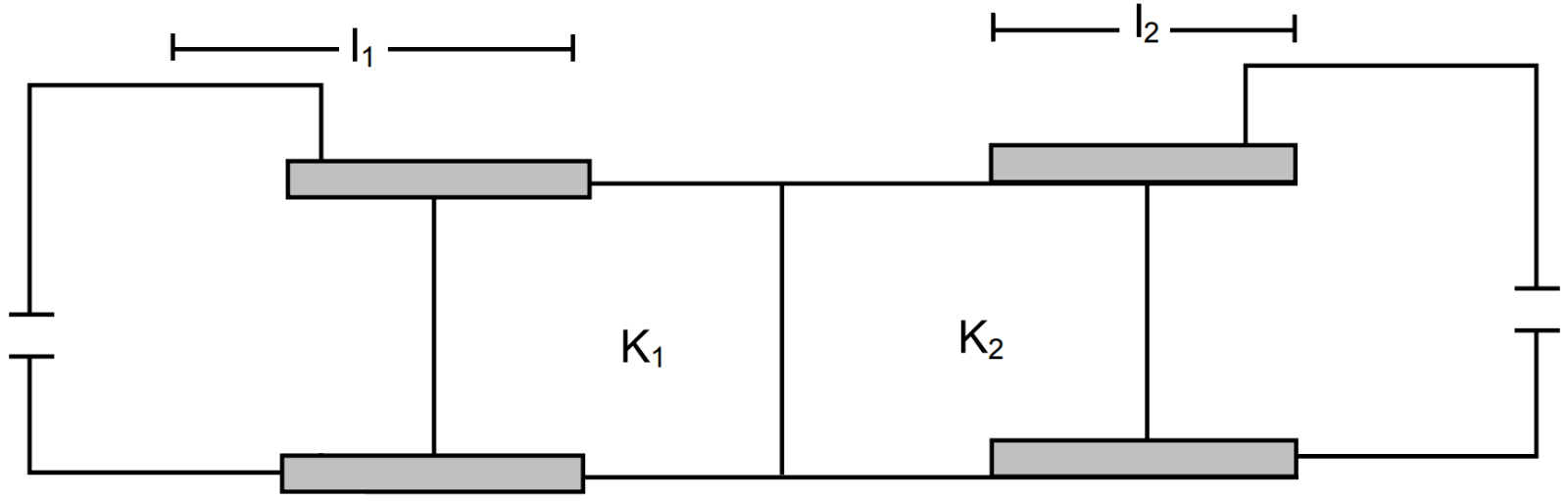
Figure shows two parallel plate capacitors with fixed plates and connected to two batteries. The separation between the plates is the same for the two capacitors. The plates are rectangular in shape with width b and lengths $l_1$ and $l_2$ The left half of the dielectric slab has a dielectric constant $K_1$ and the right half $K_2$. Neglecting any friction, find the ratio of the emf of the left. battery to that of the right battery for which the dielectric slab may remain in equilibrium.
Show that work done by a stretching force to produce certain extension in the wire is given by $\text{w}=\frac{1}{2}$ stretching force × extension. A wire that obeys Hooke's law is of length $l_1$ when it is in equilibrium under a tension $F_1$. Its length becomes $l_2$ when the tension is increased to $F_2$. Calculate the energy stored in the wire during this process.
$(n - 1)$ equal point masses each of mass m are placed at the vertices of a regular n-polygon. The vacant vertex has a position vector a with respect to the centre of the polygon. Find the position vector of centre of mass.
Prove the result that the velocity v of translation of a rolling body (like a ring, disc, cylinder or sphere) at the bottom of an inclined plane of a height h is given by $\text{v}^2=\frac{2\text{gh}}{\Big(\frac{1+\text{k}^2}{\text{R}^2}\Big)}$ using dynamical consideration (i.e. by consideration of forces and torques).
Note: k is the radius of gyration of the body about its symmetry axis, and R is the radius of the body. The body starts from rest at the top of the plane.
Two objects of masses $m_1$ and $m_2$ are moving with velocities $u_1$ and $u_2$ respectively collide in an inelastic collision. If after the collision both the objects move together then calculate the change in the value of energy