MCQ
$IUPAC$ name will be
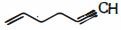
  • A
    Hex $-5-$ en $-1-$ yne
  • Hex $-1-$ en $-5-$ yne
  • C
    Hex $-6-$ en $-1-$ yne
  • D
    Hex $-1-$ en $-6-$ yne

Answer

Correct option: B.
Hex $-1-$ en $-5-$ yne
b

Need a full question paper?

Generate a complete, print-ready paper with questions like this in minutes — across 16+ boards, with answer keys.

Start Generating Free

Similar questions

For the reaction, $\text{N}_2(\text{g})+3\text{H}_2(\text{g})\rightleftharpoons2\text{NH}_3(\text{g});\ \Delta\text{H}$ is:
Identify the $D$ and $E$ in the following reaction

$\begin{array}{*{20}{c}}
  {C{H_3} - CH - CH - C{H_3}\xleftarrow[{ether}]{{Na}}R\,' - Br\,\xrightarrow{{Mg}}'D'\,\xrightarrow{{{H_2}O}}E} \\ 
  {\,\,\,\,|\,\,\,\,\,\,\,\,\,\,\,\,\,|\,\,\,\,\,\,\,\,\,\,\,\,\,\,\,\,\,\,\,\,\,\,\,\,\,\,\,\,\,\,\,\,\,\,\,\,\,\,\,\,\,\,\,\,\,\,\,\,\,\,\,\,\,\,\,\,\,\,\,\,\,\,\,\,\,\,\,\,\,\,\,\,\,\,\,\,\,\,\,\,\,\,\,\,\,\,\,} \\ 
  {\,\,\,\,\,C{H_3}\,\,\,\,\,C{H_3}\,\,\,\,\,\,\,\,\,\,\,\,\,\,\,\,\,\,\,\,\,\,\,\,\,\,\,\,\,\,\,\,\,\,\,\,\,\,\,\,\,\,\,\,\,\,\,\,\,\,\,\,\,\,\,\,\,\,\,\,\,\,\,\,\,\,\,\,\,\,\,\,\,\,\,\,\,\,\,\,\,\,\,} 
\end{array}$

The reaction $Pb \left( NO _3\right)_2$ and $NaCl$ in water produces a precipitate that dissolves upon the addition of $HCl$ of appropriate concentration. The dissolution of the precipitate is due to the formation of
According to Molecular Orbital Theory,

($A$) $\mathrm{C}_2^{2-}$ is expected to be diamagnetic

($B$) $\mathrm{O}_2{ }^{2+}$ is expected to have a longer bond length than $\mathrm{O}_2$

($C$) $\mathrm{N}_2^{+}$and $\mathrm{N}_2^{-}$have the same bond order

($D$) $\mathrm{He}_2^{+}$has the same energy as two isolated He atoms

The correct order of the ionic radii of

$O ^{2-}, N ^{3-}, F ^{-}, Mg ^{2+}, Na ^{+}$ and $Al ^{3+}$ is 

Spontaneity of a chemical reaction is decided by the negative change in
Oxidation state of oxygen in ${F_2}O$ is
The normality of $4\%$ $(w/V)$ $NaOH$ is
A mixture of camphor and benzoic acid can be separated by
At $300\, K$ and $1\, atm,\, 15\, mL$ of a gaseous hydrocarbon requires $375\, mL$ air containing $20\%\,\, O_2$ by volume for complete combustion. After combustion the gases occupy $330\, mL.$ Assuming that the water formed is in liquid form and the volumes were measured at the same temperature and pressure, the formula of the hydrocarbon is :