MCQ
Kerosene oil rises up the wick in a lantern
  • Due to surface tension of the oil
  • B
    The wick attracts the kerosene oil
  • C
    Of the diffusion of the oil through the wick
  • D
    None of the above

Answer

Correct option: A.
Due to surface tension of the oil
a
(a) Kerosene oil surface forms a bulge due to surface tension.

Need a full question paper?

Generate a complete, print-ready paper with questions like this in minutes — across 16+ boards, with answer keys.
Start Generating Free

Similar questions

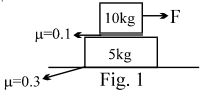
The maximum $"F"$ which will not cause motion of any of the blocks. ...... $N$
If masses of two point objects are tripled and distance between them is doubled, then gravitational force of attraction between them will .......... $\%$
Match List$-I$ with List$-II$

      List $-I$       List $-II$
$(A)$ Moment of inertia of solid sphere of radius $(R)$ about any tangent  $(I)$  $\frac{5}{3} MR ^{2}$
$(B)$ Moment of inertia of hollow sphere of radius $(R)$ about any tangent $(II)$ $\frac{7}{5} MR ^{2}$
$(C)$ Moment of inertia of circular ring of radius $(R)$ about its diameter. $(III)$ $\frac{1}{4} MR ^{2}$
$(D)$ Moment of inertia of circular disc of radius $(R)$ about any diameter. $(IV)$ $\frac{1}{2} MR ^{2}$

Question: Choose the correct answer from the options given below

Two metallic spheres each of mass $M$ are suspended by two strings each of length $L$ . The distance between the upper ends of strings is $L$ . The angle which the strings will make with the vertical due to mutual attraction of the spheres is
A man fires a bullet of mass $200 \,g$ at a speed of $5 \,m/s$. The gun is of one $kg$ mass. by what velocity the gun rebounds backwards ........ $m/s$
The force of gravitation is
The angular speed of seconds needle in a mechanical watch is
A tuning fork of frequency 480Hz is used to vibrate a sonometer wire having natural frequency 410Hz. The wire will vibrate with a frequency.
What is number of degrees of freedom of an ideal diatomic molecule at ordinary temperature?
A mass $m$ is placed at point $P$ lies on the axis of a ring of mass $M$ and radius $R$ at a distance $R$ from its centre. The gravitational force on mass $m$ is